
Contents
Glossary of Antique Terms B covering everything from Baccarat to Buhl Work and Bow-Front to Burr

Below you will find antique related words or antique terms begining with 'b' with everything from baccarat to burr and many more that you might find useful.
The list is not exhaustive but we will add to it as time goes by. The descriptions detailed are only intended to be relevant to how the word or term relates to antiques and although the same word may have other meanings in other contexts, we have not and do not intend to detail those meanings here.
In some instances we have included pictures to enhance the meaning of the word or term and we have also indexed each word in order that you may link to the explanation when the word or term appears in other pages on the site.
baccarat (glass - french - millefiori and sulphides)
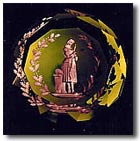
A leading French glassworks founded in 1764. First producing soda glass then in 1816 it began to produce high-quality lead crystal and decorative glass.
Especially noted for its millefiori paperweights and sulphides which are very collectable today ... Baccarat Glass
george bacchus & sons (glass - british pressed glass)
A Birmingham base glassworks founded in the early 19thC. which produced the first pressed glass in the UK. Exhibited at the great exhibition of 1851 and specialised in cut, engraved and coloured glass tableware and paperweights.
bachelors chest (furniture - chest of drawers)
A term that describes a low, compact chest of drawers made during the first half of the 18thC. with a top that folds out to form a table. Also bachelors table which has compartments for dressing and shaving equipment as well as surfaces for palaying cards or writing.
back board (furniture - wood backing )
The wooden backing to an item of case furniture or a mirror. 18thC and early 19thC furniture had wooden back boards but late 19thC furniture usually has plywood backing.
back plate (clocks and watches - mechanism)
The hindmost member of the pair of metal plates that hold the mechanism of a clock in place. sometimes engraved with decorative motifs or the makers name.
back screen (furniture - fire screen)
Early 19thC introduction of a chair backing, usually of woven cane, that protected its user from the heat of a fire.
Invented by englishman john davis in 1594, a navigational instrument supporting two scaled arcs. The precursor of the 18thC octant. The user stood with his back to the sun and aligned one scale on the horizon and the other on the shadow cast by his sighting piece. The two scale readings added together gave the suns height and allowed the latitude to be calculated.
backstamp (ceramics - base mark - makers mark)
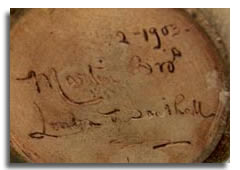
The term used for the mark printed by potteries on the underside of pottery and porcelain to denote the makers name, pattern, style, date, etc.
backstool (furniture - armless chair - stool)
A three or four legged stool with a back extending from the rear legs. Introduced in the late 16thC when the term 'chair' only applied to a seat with arms. Became known as a single or side chair in the 18thC.
bacon cupboard (furniture - farmhouse settle)
Mainly farmhouse furniture and a type of settle made up of a long bench with a panelled cupboard doubling as a backrest and sometimes drawers set beneath. Dating from the middle ages to the 19thC..
bada (british antique dealers association)
An organistation of antique shops and individual dealers formed to try to maintain standards within the antiques trade. B.A.D.A - British Antique Dealers Association.
baff (carpets - farsi - knot)
The Farsi word for knot.
Also armeni-baff for for carpets knotted by armenians. Also bibi-baff for very finely woven rugs knotted by a bibi (princess) of the bakhtairi nomads of central persia, although normally referring to any bakhtiari rug.
baguette (gemstone - jewel cutting)
A type of gemstone cut particularly in diamond cutting.
bail handle (furniture - metal handle)
A simple curved metal handle such as a semi-circular drawer handle or the handle of a kettle..
ballie scott, mackay hugh (architect - 1865-1945)
British architect of international repute who also designed furniture with colourful inlay work and metalwork in the style of the arts and crafts movement.
alexander bain (clockmaker - electric clock - 1811-1877)
A scottish clock maker and scientist who patented the first electric clock in 1840.
baize (textiles - billiard table)
A loose-woven woollen cloth usualy dyed green or red and the term used since the 17thC. to describe a flannel like cloth produced in the eastern counties of england. Commonly used to cover card and billiard tables and for drawer linings.
bakelite (plastic - leo baekland 1907)
A thermosetting plastic that is highly durable and easily dyed. Patented by leo baekland in 1907. It is heat resistant, very hard and opaque. Used for low cost art deco jewellery in imitation of jet buckles and everything from ashtrays to radios.
balance (clocks and watches - mechanism)
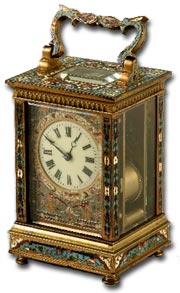
The wheel in a clock or watch that regulates the escapement. Erratic prior to the invention of the balance sping in 1675 which uses a spiral hairspring to make the movement of the balance wheel more regular and isochronous. as significant a development for portable clocks and watches as the pendulum was for standing clocks.
Not as accurate as a pendulum, as the spring balance is susceptible to hot and cold, until various forms of compensation balance were developed in the 18thC.
baldric (militaria - sword belt)
A sword belt, usually of leather that is worn over one shoulder and diagonally across the chest to hold the sword at the wearers waist or hip.
ball clock (clock - gravity clock)
Similar to a gravity clock, where it is still powered by falling on its own weight but a ball clock is suspended on a chain.
ball foot (furniture - feet )
One of the many types of feet used to finish the legs of tables and chairs and to support bookcases and cabinets. The leg or foot simply finishes in a sperical ball.
balloon clock (clocks and watches - bracket clock)
A form of bracket clock, usually wooden cased with the case in the form of a tall slender upright topped by a round or oval clock housing.
ball turning (furniture - ornamentation)
A series of turned wooded spheres of equal size used to ornament the legs and stretchers of tables and chairs. Used in the 17th and 18th centures.
baluster (architectural - style - ornamentation)
The architectural shape of a turned column or post usually in a series to form a balustrade. Also a shape used in the forming of table legs, chair backs and silver & glass dinking glass stems. Also a shape used in forming pottery and porcelain vases.
bamboo furniture (furniture - victorian - 18thC. chinoiserie)
Furniture made in imitation of real bamboo in the 18thC and usually crafted from strong woods such as beech and turned, carved and painted to resemble bamboo. Also late victorian furniture made from real bamboo which was rather fragile for the tables, chairs, bookcases and what-nots produced..
banding (furniture - decoration)
A decorative inlay or veneer strip in contrasting wood or metal. Often used as a border on door panels, table tops and drawer fronts. Straight-banding is cut along the grain of the wood. Cross-banding is cut across the grain. Feather or herringbone banding if ormed from two narrow veneers laid at an angle to each other to provide a chevron effect. Fine banding is known as stringing or line inlay.
banjo clock (clocks and watches - wall clock - willard)
A pendulum wall clock resembling an upturned banjo and introduced by the willard family of clock makers in boston, USA. Many reproductions produced in the late 19th to mid-20thC. An elaborate clock known as the 'girandole' designed in the USA in 1818, resembles the banjo clock but has gilded decoration including scrolls, bords and festoon
bank of england dollar (coins - british)
A Silver coin struck for a few years at the beginning of the 19thC. Circulating examples, also known as bank tokens, were all dated 1804, inscribed with the word ‘dollar’ beneath an image of Britannia on the reverse, and had a face value of 5s (25p). -- 3s and 1s6d dominations were struck in 1811. The entire coinage was made obsolete in 1816.
banko ware (ceramics - japanese)
Pottery made by, or in the style of Japanese 18thC potter Numanami Shigenaga. The wares are typically decorated with human figures, monkeys or other animals picked out in enamels or glazes with touches of underglaze blue. Rrevived in the 19thC. usually enamelled grey stoneware teawares, in the form of a lotus or other flower.
A needlework or painted wood panel, on a horizontal bar that can be raised or lowered on a vertical pole, usually of wood and sometimes of metal.
bantam work (furniture, lacquer )
Coloured layers that are sometimes applied and then topped by a black surface so that various decorative effects can be produced by cutting through the stratified colours.
barbers bowl (ceramics - shaving - surgery - bleeding)
A shaving dish usually ceramic but sometimes silver or metal, used by barbers in the 17th 18th and 19th centuiries. With a semi-circular section cut out of the rim that fit beneath the clients chin. Could also be placed around an arm and used as a bleeding bowl for blood-letting (surgery was the barbers major function until the 19th century).
barcelona chair (furniture - chair)
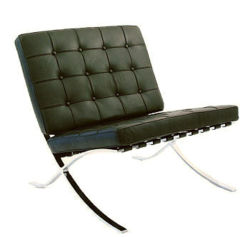
The Barcelona Lounge Chair is a classic of 20th century modernist furniture design by architect Ludwig Mies van der Rohe, and his partner Lilly Reich.
bare faced tenon (furniture - joint)
A joint in which the tenon retains one or more of the original sides of the timber.
bargello (textiles - embroidery - design)
An embroidery design with colours worked in pointed or flame shaped patterns that graduate through their various shades. Also -- flame stitch, florentine stitch or hungarian stitch.
barge ware (ceramics - brown earthenware)
A dark brown glazed earthenware with white clay relief patterns, produced in Derbyshire c1860-1910. Bird and flower motifs were tinted green, blue and pink. Usually as large teapots, with miniature teapot finials, jugs and chamber pots. Sold at measham, leicestershire on the ashby-de-la-zouch canal. Also - bargee or measham ware.
bargueno (vargueno)
The Vargueño (also Bargueño) is a desk produced in the 15th century that is still produced today.
The vargueño was sometimes used for sewing or as a jewel chest instead of solely for reading and writing and storing the necessary implements for these activities.
The vargueño is a portable desk which resembles the top half of a fall front desk. It is basically a chest with its lid on the side, and an interior equipped with a good quantity of small drawers and pigeon holes.
As a general rule the interior of a vargueño is much more richly decorated than the exterior. Thus a vargueño looking very plain from the exterior will have a reasonably rich and well sculpted interior while a vargueño with impressive exterior decorations will have a truly ornate and extremely rich interior with ivory inlays and velvet decoration. It is one of the best examples of wood craftsmanship in Renaissance Spain.
barion cut (gemstone - jewel cutting)
A type of gemstone cut particularly in diamond cutting.
barley sugar twist (furniture - decoration, woodwork, turning)
Turned decoration mainly on wood furniture, particularly legs and chair backs but also seen on victorian brass candlesticks.
barnack, oscar (scientific, instruments - 1879-1936)
German microscope designer and inventor of the leica camera, launched in 1925 by the german company leitz. The leica camera was the first miniature precision camera of its kind.
barograph (scientific - instrument, barometer)
An aneroid barometer of the type that that records air pressure, introduced in the 18thC. the aneroid mechanism moves a pen against a slowly turning drum of graph paper.
barometer (scientific - instrument - weather)
An instrument for registering atmospheric pressure and forecasting weather conditions, first produced in the late 17thC. Various types of barometer exist including aneroid, stick, angle and wheel.
baroque pearls (jewellery - baroque )
Pearls of irregular shape widely used in baroque and renaissance jewellery of the 15th to the 17th centuries. The pearls were often decorated with gemstones or enamelling that took the form of mythological figures.
baroque style (style - ornate architectural)
An extravagent and ornate style based on the architecture of 17thC italy, where sculptutors played a crucial role in the design of furniture, ceramics, ivory and silver. By joining forces with gilders the sculptors earned recognition as craftsman in their own right rather than as the employees of joiners and cabinet makers. Their influence was evident in elaborate architectural furniture and in the abundant use of cupids, cornucopia and other symmetrical, curvaceous designs.
A dominate style of the decorative arts during the late 17th and early 18th centuries. A popular but less elaborate form developed in the USA during the first half of the 18thC. Paved the way for the lighter more frivolous and colourful rococo style.
barrel (clocks & watches - mechanism)
A hollow cylindrical metal box or drum in a clock or watch that contains the driving or going spring and is connected to the first wheel in the train. From c1580 to 1600 the casing was almost always of brass. A going barrel has the first wheel of the train mounted on the same arbor, doing away with the two part fusee. It was used for striking trains of the 17thC german renaissance clocks and for both going and striking trains of French spring clocks.
barr, flight & barr (ceramics - royal worcester - manufacturer)
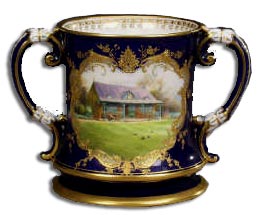
Name of the partners and a period in the history of the royal worcester porcelain company.
Specifically between 1783 and 1813. See royal worcester for full details.
francesco bartoluzzi (pictures - engraving -1727-1815)
Pioneer of the process of stipple engraviing and owner of large print works in london in the 18thC. He produced society portraits and domestic and rural scenes.
barum ware (ceramics - earthenware )
Earthenware pottery made in Barnstaple, North Devon, and popular from c.1879 until the early 20thC. Specialities include simple jugs and vases with respresentations of birds, flowers, marine life or dragons painted in SLIP in soft colours, and sometimes wuth outlines incised.
bas d'armoire (furniture - chest of cupboards & drawers )
French term for a low 18thC chest with double doors enclosing cupboards and drawers.
bas relief (furniture - sculpture - carving)
A method of sculpting which entails carving or etching away the surface of a flat piece of stone or metal. The word is derived from the Italian basso rilievo, the literal translation meaning "low contrast" as opposed to "alto rilievo" ("high contrast"). To explain simply, it is a sculpture portrayed as a picture. The portrayed image is raised above the background flat surface.
basal rim (ceramics - everted rim - curved)
The term referring to a ceramic vessel with a curved rim.
basaltes ware (ceramic - stoneware - wedgwood)
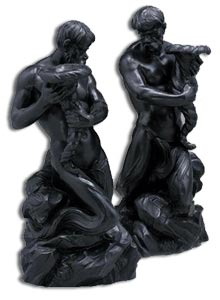
A very hard and fine grained stoneware produced by staffordshire potters and ultimately improved by Wedgwood around 1768.
A relatively cheap ceramic product that found a ready market for reproduction bronzes and cameos that were popular in the late 18thC.
Wares included vases, bronze-glazed vases, large busts and general pots.
base metal (metalware - alloys - copper - lead)
The general term for non-precious metals such as copper, lead, iron and tin and their alloys such as brass, pewter, bronze and nickel silver.
basin stand (furniture - wash stand)
The precursor to the modern wash-basin which is very similar to its Victorian ancestor, but has replaced the pottery or metal bowl on a wash stand that was used in previous periods and continued in use for much of the 19th century. The wash-basin we use today was preceded by a bowl or dish, placed on a piece of furniture known as a 'wash or basin stand'. The top of this was often either of marble or else tiled. The bowl was originally of a metal such as copper or pewter. Earthenware and porcelain versions were widespread by the mid-18th century. British bowls were decorated with transfer designs, rather than being hand-painted. A jug or ewer was used to fill and empty the bowl.
john baskerville (metalware - japanning - polychrome - 1706-1775)
Best known as a typographer, but baskerville was also a key manufacturer of japanned metalware. He was based in Birmingham and is reputed to have introduced polychrome painting on japanned bases.
basket glass (glass - openwork - basket)
Glass container in the shape of a basket, for sweets or fruit. Openwork sides attached to a moulded base are made from threads of glass pincered together.
basket-top clock (clocks & watches - bracket clock - wood/metal dome)
A bracket clock with either a repousse metal dome or a cushion-moulded (flat-topped with curved edges) wood dome.
basketwork (furniture - wickerwork - cane - lloyd loom)
A general term for chairs and other furniture made of wicker, cane, or woven, coarse sea grass. In wickerwork the basket weave is worked around a frame of stiff rods and it was popular in Victorian times for both indoor and outdoor use. Pieces ranged from round single chairs to full lounge chairs with foot rests. Also -- lloyd loom.
basse-taille (decoration - enamelling - gold or silver)
Basse taille is a type of enamelling in which translucent enamel (powdered glass with colorants) is applied over a metal surface that has been textured by etching, engraving, stamping or chiselling by hand. This results in the metal background and the pattern over it being seen through the translucent enamel.
The enameling technique is used usually using gold or silver, where it is engraved or carved in low relief and then covered with translucent vitreous enamel. This technique dramatizes the play of light and shade over the low-cut design and also gives the object a brilliance of tone. It was developed in Italy in the 13th century. See also enamelling
bassine-cased (clocks & watches - enamel decoration)
A shallow pocket watch of circular shape dating from the mid-17thC. With a rounded cover and back that curves gently into the central band. The case is often finely decorated with enamel.
bassinet (woodwork - wickerwork - cradle)
A wickerwork basket used as a cradle, usually with an integral hood. Also -- used to describe late 19thC baby carriages with a hooded basketwork body.
batavian ware (cermics - chinese export ware)
Early 18thC chinese export porcelain named after the dutch east india company trading station in Batvia (now Jakarta), Java. It is typically in the form of tea services decorated with blue and white, often fan-shaped panels, and with a coffee-brown glaze on the outer side of bowls and saucers. Copies of the style made at meissen in Germany and leeds, england, were also known as Batavian and Kapuziner ware.
bateman family (metalware - silver - london silversmiths )
London family of silversmiths producing domestic silverware in the 18th and 19th centuries. Hester Bateman (1708-94), the best known member, was trained by her husband John, and on his death carried on the business with her sons. A vast amount of domestic silver marked by its grace of line and simplicity of decoration was produced with her mark, including tableware, snuffboaxes, seals and wine labels. Hester retired in 1790, and her sons Peter and Jonathan, and Jonathan's wife, Ann carried on the firm. The change in management was marked by substituting a thread decoration for Hester's beading. Ann Bateman's son William took the business - and the style of Bateman silver - into the Victorian era.
bath metal (metalware - alloy - bronze)
An inexpensive bronze-like alloy used by some independent 18thC coiners (ass opposed to the Royal Mint) and from the late 18thC for small bozes and buttons.
batik (textiles - hand-painted - 16thC.)
Distinctive patterned and dyed fabric from the East Indies, brought to Europe by the Dutch in the 16thC. In the batik process, melted wax is applied to parts of the design not intended to take colour, and the cloth is then dyed. This is repeated as necessary for other colours, the wax being washed out with hot water after each dyeing. Some batik is also hand-painted. The process was used in the 16th and 17thC Europe for dyeing expensive facbrics such as velvet, but the bold batik colours and patterns were printed on cotton and dyed by other processes from the 19thC.
bat-print (ceramic - decoration - transfer printing)
A type of decoration on ceramics using a transfer print technique. Bat-printing was used in Staffordshire in the early 19thC. The designs were transferred to the glazed earthenware by means of a flexible sheet - or bat -of glue or gelatine. see also transfer printing
battersea (ceramics - enamel - chelsea porcelain)
Enamel factory based in Battersea, London, specialising in items such as snuffboxes, plaques, wine labels, and watch and toothpick cases. Early porcelain boxes made at chelsea had battersea enamel lids. Designs were often transfer-printed onto a white enamel ground, then painted in delicate colours. The factory, run by John Brooks, pioneer of the transfer printing process, it only survived for three years (1753-6) but its influence lived on in enamelware produced in South Staffordshire and Birmingham.
bauhaus (design school - german)
A German school of design founded in Weimar in 1919 by Walter Gropius, an architect-designer. The Bauhaus aimed to produce prototype designs for everyday, mass-produced items. It explored the amnufacturing processes and new materials of the machine age such as stainless steel and plastics, and coordinated the skills of architects, engineers, painters, sculptors and designers. The school was closed by the Nazis in 1933, but revived in the German city of Ulm after the war and inspired industrial design in the mid-20thC.
baywood (woodwork - mahogany)
See mahogany
bead moulding (decoration - woodwork - moulding)
A narrow, half-round convex molding, which when repeated forms reeding.
beadwork (textiles - decoration - beads)
A form of embroidering textiles using small, coloured glass beads with, or instead of, needlework. Beadwork was a popular covering for small boxes and mirror frames in late 16th and 17th-century Europe, particularly in Britain, and in the 19thC for chair covers, purses, pictures and other objects.
beaker (drinking vessel - 11thC)
Drinking cup without handles or stem, and usually with a foot rim. Early beakers were made in wood, glass and pottery, although from the 11thC there were silver, silver-gilt and gold examples. British beakers are usually more plainly decorated that their continental counterparts. In the 18thC, glasses generally replaced beakers for table use.
bearskin (militaria - headgear - Brigade of Guards)
Tall, military black fur hat, originally made from bear skin. It has been worn by British guardsmen since the 18thC, and is now part of their ceremonial dress.
beauvais (textiles - tapestry - france)
Centre for weaving in northern France. The Beauvais Tapestry Factory was founded in 1664, and ultimately amalgamated with gobelins in 1940. Typical Beauvais tapestries - in the form of wall-hangings, carpets and furniture covers - have commedia dell'art scenes or extracts from contemporary paintings, framed by heavily festooned drapes; Classical and chinoiserie motifs are also seen. They are brilliantly coloured, often with a dominant yellow ground known as 'Spanish tobacco'. From 1725, imitation Beauvais tapestries were made in Berlin. The 19thC brought specialisation in furniture covers.
carl becker (coins - fakes & forgery - 19thC. german forger)
Notorious German forger of ancient Greek coins, who operated in the early 19thC. Fortunately for modern collectors, his extensive repertoire of copies was exposed and published after his death.
bedstead furniture - bed - framework)
The framework of a bed, which raises mattress and bedding material above floor level. Bedsteads only became widespread in Europe from the early 17thC. Monument-like bedsteads with eleborately carved wooden canopies were made during the renaisssance, the canopies designed to provide privacy, protection from draughts, dirt and insects. The emphasis shifted from woodwork to fabric hangings in the mid-17thC, and a host of different bed styles were introduced over the next century. 19thC bed designs tended to be more functional.
beech (wood - hardwood - country furniture)
A pale, smooth and straight grained wood, one of the most inexpensive hardwoods available. Beech was often stained and used as a substitute for walnut in country furniture, expecially chairs, of the 17th and 18th centuries. It is also seen gilded or painted. Although subject to woodworm, beech has the advantage of taking close nailing without splitting.
peter behrens (designer - german - art nouveau - 1868-1940)
German illustrator, architect, craftsman and designer of industrial and domestic fittings. Behrens's early furniture, ceramics, jewellery and glass designs were in art nouvea style, but by 1898 he was designing simple, stream-lined household onjects for commercial production. He was a founder member of the DEUTSCHER WERKBUND, 1907, a group of German artists and manufacturers. le corbusier, Walter Gropius and Ludwig Mies van der Rohe all worked under Behrens c.1910.
william and mary beilby (glass - decoration - white enamel)
A brother and sister team of glass enamellers in the late 18thC. They decorated wine glasses and decanters with colourful heraldic designs or rustic scenes with romantic ruins and creepers, usually in white enamel.
bellarmine (ceramics - stoneware jug - bellarmino)
Bulbous brown stoneware jug with a bearded head in low relief on the narrow neck, and frequently with relief coats of arms on the body. Bellarmines originated in 16thC Germany, the bearded head said to be that of Cardinal Roberto Bellarmino, a leader of the counter reformation much hated by German Protestants. Many Bellarmines were exported to Britain and copied particularly at john dwights fulham pottery in London. Reproductions were made in Germany until the late 19thC. Also known as greybeards.
belle epoque (decorative arts - fine period - 19thC.)
French for fine period, generally used to describe an elaborate and sumptuous decorative arts style which was prevalent in Europe from the end of the 19thC up until World War I.
belleek (ceramics - irish - parian porcelain)
A ceramics factory in County Fermanagh, Northern Ireland, founded in 1857. Its speciality was a delicate PARIAN procelain. Wares are wholly or partly treated with a clear or pearlised, and sometimes iridescent, glaze. Belleek table and ornamental items are often decorated with or in the shape of shells and other marine life. Porcelain strips woven into baskets and perforated designs are also typical.
bell-metal (metalware - bronze alloy)
A tough bronze alloy used for bells and occasioanlly for cooking utensils such as skillets.
john belter (cabinet maker - rococo - rosewood)
(1804-63) German-born US cabinet-maker, after whom Belter Furniture (carved and upholstered bentwood suites) was names. Belter's revived ROCOCO style was very popular and he displaced cabinet-maker Duncan PHYFE as New York's leading craftsman. He patented a plywood process using rosewood which was then ornately carved.
benares brassware (metalware - brassware - indian)
Indian-style brassware, including trays and table tops. The genuine articles were made in India, but imitations were produced in Birmingham from the late 19thC, and sometimes exported to India and imported back again to suggest authenticity.
bends (furniture - rocking chair)
The curved runners of rockers of a rocking chair located between the back and front feet.
william benson (architect - arts and crafts)
(1854-1924) British architect and leading furniture and metalwork designer in the arts and crafts movement. Unlike the more purist members of the movement, Benson was not dismissive of mass-production methods, and his factory at Hammersmith, London, produced commercial domestic objects such as chandeliers, 1883-1923.
bent-limb doll (dolls - carved )
Doll with limbs that are in one carved piece rather than jointed. The bent-limb style is normally reserved for baby dolls and was first introduced on composition dolls in 1910, and on vinyl models from the late 1930's.
bentwood (wood - curves - windsor chair)
Lightweight solid or laminated timber, usually birch, soaked in hot water or steamed to make it pliable so that it is easily worked into curves. The technique was originally used for 18thC WINDSOR CHAIRS, but a distinctive style of bentwood furniture really became established in the mid-19thC with the work of the Austrian furniture-maker Michael THONET. Thonet Bentwood is strong, light, graceful and made from solid timber; it was soon seen in homes, cafes and hotels throughout Europe. In the 20thC, designers such as Alvar Aalto, marcel Breuer and others, widened the range of the bentwood styles, usually by using laminated timer.
jean berain (designer - louis xiv - 18thC berainesque)
(1637-1711) French draughtsman, engraver and designer, and one of the originators of the LOUIS XIV style. Berain worked as court designer from 1674, and his published symmetrical designs influenced ornamentation on contemporary furniture, carpets and silverware. Mid-18thC Moustiers FAIENCE was very often decorated in so-called style Berainesque.
bergere (furniture - armchair)
French name for a deep, tub-chaped, upholstered armchair of the early 19thC, with continuous top and arm rails and a slightly concave back. Some versions are caned between the arms and seat and have a loose seat cushion.
berlin (ceramics - manufacturer - rococo)
German ceramics centre with faeince factories from 1678, a minor porcelain factory founded 1751, and a factory established
1763 which was known mainly for the production of dinner services and figures in restrained rococo style. In the 19thC this factory produced blanks which were sent to outside decorators for painting.
berlin iron jewellery (metalware - cast iron jewellery)
Early 19thC cast-iron jewellery made principally in Germany. People were given Berlin iron in exchange for their precious jewellery to boost the Prussian State gold reserves. Items such as brooches, necklaces and crosses in classical or gothic-style designs were typically crafted in delicate openwork patterns and laquered black. Production continued in Germany and Paris until the end of the 19thC.
berlin woolwork (textiles - embroidery - german wool)
Home worked embroidery popular in the 19thC in Europe and the USA, using wool which was originally dyed in Berlin. German wool manufacturers marketed the wools by providing coloured pattern charts that could be easily transferred onto canvas.
beryl (gemstone - mineral, emerald, aquamarine)
A mineral that forms several varieties of gemstones, notably emerald and aquamarine. The stone in its purest form is colourless, but impurities cause pale-coloured varieties of gems including yellow, pink and green beryl.
bevel (metalware - angled edge)
General term for any edge cut at an angle to a flat surface.
bezel (metalware - clock glass - gemstone mount)
Metal rim or band set around the edge inside the
shutting edge of a container. Also - Rim or setting edge of a ring that holds the stone or ornament, often loosely applied to the whole setting. Also - Metal rim holding the glass or watch or clock face.
bi (chinese - jade - heaven)
Flat jade disk, also spelt pi, with a hole in the centre. It symbolised heaven and was used ritualistically in China until the end of the reign of the last emporor in 1912.
bianco-sopra-bianco (ceramics - tin glazed - delftware - maiolica)
Itlalian for 'white-on-white', referring to tin glazed earthenware with white-painted decoration introduced by the Italians on maiolica in the 16thC. It is seen in mid to late 18thC Lambeth and Bristol delftware and Chinese and English porcelain.
bible box (box - oak - bible)
17thC box, usually of oak with a hinged lid. Bible boxes were designed to hold the family bible or other books or writing materials. Some, designed to double as a lectern, have a sloping lid.
bidri (metalware - indian - inlaid)
Indian metalwork - copper, lead and tin alloy, blackened with a mixture of sal ammoniac and saltpetre, and INLAID with silver or brass. Bidri ware such as spice boxes and the bases for hookah pipes was imported from India in the 19thC.
biedermeier (decorative arts - neo-classical furniture)
A restrained neoclassical decorative art style originating in Germany in the early 19thC, which was most evident in furniture design.
dominik biemann (glass - engraver - bohemian glass 1800-57)
Prominent bohemian glass engraver. He specialised in portraits but also engraved hunting scenes, landscapes and old master paintings. His work appears on glasses, beakers and medallions, usually signed with various spellings of his name (Bieman, Biman or Bimann).
biggin (metalware - george biggin - silver plate coffee pot)
Late 18thC and 19thC style of British coffee pot in silver or sheffield plate. The design is attributed to the London silversmith George Biggin (1803). The pots have a cylindrical or barrel-shaped body and a short spout with built-in filter for ground coffee; the handle is usually of hardwood, such as ebony, or ivory. Biggins were either warmed on a stand over a spirit lamp or placed on a fire hob.
billet (decorative motif - tankard thumbpiece)
A Romanesque, pre-gothic, ornamental motif of moulding using alternating blocks or cylinders.
Also - The thumbpiece on tankards and flagons.
billies and charlies (fakes & forgeries - medieval amulets)
The term describing 19thC forgeries of medieval amulets, pilgrim badges, figures and seals. Many were cast by William Smith and Charles Eaton of London and are named for them. The men claimed to have found the objects in the Thames' river bed. The forgeries were often made in poor-quality pewter with relief decoration.
william billingsley (ceramics - derby, swansea, nantgarw)
Ceramic artist who started at royal crown derby and subsequently set up his own porcelain company. Famous for the billingsley rose.
bilston enamels (jewellery - enamel ware - bilston)
Articles of jewellery and objects of vertu made in Bilston and other parts of Staffordshire in the 18th and early 19th centuries. Most enamelled objects made in Britain at this time, including boxes, scent bottles and candlesticks, came from the Bilston area. Some incorporated small enamel plaques, others were coated in white enamel and then painted with motifs of landscapes, flowers and birds.
birch (wood - furniture, biedermeier)
A native timber of northern Europe, creamy in colour, tinged with pink or yellow, and with a fine, even, wavy grain. It has been used mainly as a solid wood for chairs and country furniture, especially in the 18thC, and is seen in biedermeier furniture. Selected pieces were occasionally used as a cheap substitute for satinwood. In the 19thC cheap birch furniture was mass-produced, and after the invention of the rotary cutting lathe in 1890, it was common as a veneer and for plywood.
birdcage (furniture - tripod table)
The wooden hinged mechanism which is found on some 18thC TRIPOD TABLES. It is fixed at the top of the the pedestal and enables the table surface to swivel, tilt, fold or be fixed horizontally.
birds eye maple (wood - american - birds-eye - fiddleback)
See MAPLE.
biscuit (ceramic - unglazed - sevres - derby)
Fired but unglazed ceramics. Biscuit procelain has a crisp, dry appearance that was used for statuettes and reproductions of Classical sculptures, initially by sevres from 1753, and later by derby and porcelain factories throughout Europe. Biscuit-firing is the term for the first firing prior to glazing.
biscuit barrel (box - barrel shaped container)
Barrel-shaped biscuit container dating from near the end of the 19thC. Some examples have a matching tray to catch falling crumbs. Biscuit barrels were made in various materials including electroplated silver, solid silver or ceramics, and often with metal mounts.
biscuit warmer (metalware - silver stand)
Late 19thC silver stand for serving and keeping warm biscuits at the table. The warmers, also known as folding biscuit boxes, consist of a stand with a central column with either a handle of finial and two or more bowls which open out horizontally and close vertically onto the column.
bisque (ceramics - biscuit porcelain - doll heads)
Term for the unglazed, matt-surface biscuit porcelain that was the most popular material for doll's heads from the mid-19thC to the 1930's, and revived 1960-80. Flesh colour and features are painted on after an initial firing, then fired again at a low termperature to fix the colours. The term all-bisque refers to a doll with head, limbs and body made of bisque.
bizarre silk (textiles - silk - spitalfields)
A figured silk cloth fashionable for dresses in Europe c1695-1720. Designs were inspired by Oriental textiles, typically with tropical foliage, flora and jagged lines, woven in gold or silver thread. The cloth was produced in Britain at the spitalfields silk factories.
black basalt (ceramics - wedgwood)
A very hard and fine grained stoneware produced by staffordshire potters and ultimately improved by wedgwood around 1768. A relatively cheap ceramic product that found a ready market for reproduction bronzes and cameos that were popular in the late 18thC. Wares included vases, bronze-glazed vases, large busts and general pots
black jack (tankard - leather)
British tankard-shaped leather jug, popular until the 18thC. It was lined with pitch to make it water-tight, and often had a metal rim.
blackamoor (furniture - figural stand)
The term used to describe a figural stand depicting a black man or woman holding a tray or table. See also gueridon
blacking (metalware - armour - guns)
A rust-resisting treatment applied to guns or armour, using either chemicals or paint.
blanc-de-chine (ceramics - chinese - fujien porcelain)
18thC French term for porcelain made in Fujien province in south-eatern China from the 17thC (late MING dynasty) to the present. Unpainted wares, including small, finely modelled figures, large sculptured models of deities and other wares often with relief decoration were exported to Europe. The ware was copied by nearly all early European porcelain factories including mennecy, bow and chelsea during the 18thC.
blank (coins - ceramic undecorated)
A prepared piece of metal ready for striking into a coin, also known as a flan, or, particuarly in the USA, as a planchet.
Also - Undecorated glass or ceramic item (also called in-the-white in ceramics) that is passed to an outside decorator for painting or printing.
bleeding bowl (ceramics - metalware - porringer - barbers bowl)
A shallow bowl made of ceramics or metal used by doctors in the mid 1750's when bleeding a patient was common practice. See also porringer
bleu persian (ceramics - nevers - persian design)
Late 17thC. style of ceramic decoration in predominantly persian styles with light coloured decoration against a blur background. See also nevers
blind earl (ceramics - worcester porcelain pattern)
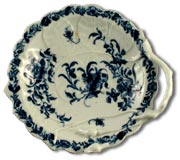
A worcester pattern. Blind Earl. was embossed with rose buds and leaves the design originating at the Chelsea porcelain factory and produced at Worcester from the 1750's.
In the 19th century the pattern was named after the Earl of Coventry who lost his sight in a riding accident. He ordered a service in this pattern so that he could feel the raised decoration.
blind fret (furniture - carving - fretwork)
A style of fretwork where the fretwork is carved upon or applied to a solid surface and cannot be seen through. It is sometimes seen backed by fabric such as pleated silk, as on a decorative panel on a door or a cupboard. See also - fretwork
blind tracery (furniture - carved decoration)
Typical gothic decoration carved in relief on a solid background, often found on furniture.
blockfront (furniture - american - design)
An American 18thC case furniture design in which the centre section is a flattened concave curve flanked by outer section of flattened convex curves.
bloom (glass - error in making - wear)
Dull, matt surface on old glassware. This may be caused by too much alkali in the glass, by the presence of sulphurous smoke during reheating, or by wearing away of decoration such a gilding.
blue and white (ceramic - decoration)
The most widely-used and longest-lasting decorative ceramic colour scheme, in which cobalt blue is an underglaze colour. Cobalt blue retains its true colour over a wide range of firing temperatures, from low-fired earthenwares to the most highly fired porcelains.
blue cloth helmet (militaria - headgear - british army)
Cloth-covered helmet with a top soike worn by the British army from 1879 and still worn by some military bands.
blue dash (ceramic - decoration - delftware)
Simple blue on white decoration comprising oblique, regularly spaced, cobalt-blue dashes. The decoration is found on the rim of 17th-18thC London and Bristol delftware chargers.
blue john (mineral - derbyshire - )
A type of Crystalline fluorspar with bands of yellow, purple, blue and white, mined in Derbyshire. It was popular in the late 18th and late 19th centuries, when it was used for objets de vertu, candlesticks and candelabra.
blueing (metalware - rust retardent - armour)
The heat treatment of iron or steel which forms a thin surface layer of blue oxide. This retards rusting, and was also used to decorate armour.
blunderbuss (militaria - gun - coachmans)
A shoulder gun with a flared muzzle for scattering shot widely, increasing the probability of a hit without taking aim. In the 18thC it was commonly used as a house or coach defensive weapon.
board-ended stool (furniture - stool )
The dining seat of the 14th, 15th ad 16th centuries. Instead of legs, the stools were supported on boards which were vertical or inclined inwards towards the seat and held firm by horizontal apron pieces.
bob pendulum (clocks & watches - pendulum)
A short, light-weighted pendulum which swings through a wide arc, and is associated with a verge escapement. It can be either pear or lens-shaped.
bobbin (textiles - lace)
Small spool or reel that is wound with the thread used on lockstitch machines. Bobbins can be wound on the sewing machine or come pre-wound from the thread supplier. Generally, pre-wound bobbins contain much higher yardage than machine wound bobbins allowing for fewer bobbin changes. The most common bobbin size for embroidery machines is a style “L” bobbin, even though other special large hook machines may use style “M” bobbins. see lace.
bocage (ceramics - floral decoration - background)
A French term meaning thicket, used to describe ceramic foliage or flowers that provide a background for a central subject. Bocage is typical of rococo style, often framing figures in a canopy or arbour, and was particularly popular from the 1750s to the 1770s.
bohemia (glass - waldglas - facet cut)
Region of what was Czechoslovakia, renowned for its elaborately engraved glass. The earliest wares, dating from the 14thC, were made of waldglas (forest glass) - a crude, mould-blown product which used wood as a source of potash for the flux. Venetian techniques were introduced in the 16thC and wheel engraving was common. The development of lime glass a century later provided a better medium for decoration and led to facet cutting and elaborate engraving. One of the most noted engravers was Ludwig Moser who specialised in portrait work.
Although independent artists produced much of the finest work under the patronage of German princes, factories such as those at Haida (now Novy Bor) and Karlsbad (now Karlovy-Vary) also produced fine-quality ware from the mid 19th to early 20th centuries, including cased glass and flashed glass in brilliant colours.
bois durci (wood - ebony substitute )
Mid-19thC ebony substitute, made from sawdust and animal blood or other water-soluble protein. The mixture coagulated on heating and could be die-stamped into decorative mouldings for furniture, medallions and trays.
boiserie (decoration - carved wood wall panel)
French term for 17th and 18thC wooden wall panelling ornately decorated with carving. Boiseries were often painted white with the ornamentation highlighted in gold or bright colours, and might also incorporate paintings.
bole (ceramics - clay - gilding)
Red or yellow, fine ochre clay used as a ground by gilders prior to applying gold leaf. see also gilding.
bolection moulding (furniture - moulding - levels)
A furniture moulding used where two surfaces of differing levels meet.
bombard (medieval - leather jug)
A large jug made of sewn leather and lined with pitch or resin to make it watertight; used from medieval times to the 18thC.
bombe (furniture - bulging curve - rococo)
Literally translated form the French as bulging, a term used for a swelling shape seen originally on chests of drawers and commodes of the Louis XIV period. The outward swell or curve towards the base of a piece was a popular feature during the Rococo period.
bonbonniere (boxes - sweet box - comfit)
Small container for sweets, popular in the 18thC. Also known as comfit and sweetmeat boxes, they were crafted in a variety of materials, particularly silver and porcelain, and often in novelty shapes such as a shoe or a head.
bone ash (ceramic - bone china)
Calcium phosphate from burned and ground animal bones, which was used as a fusing and stabilising agent in soft-paste porcelain, particularly in 18thC English factories, in bone china, and as a whitening agent in creamware.
bone china (ceramic - hard paste porcelain - spode)
A modified hard-paste porcelain containing up to 50 per cent bone ash. Its introduction by spode in 1794 was an important step in the development of european ceramics; by the early 19thC, most British porcelain factories were making bone china, and the recipe is still used today. Bone china is tougher and cheaper to make than soft-paste porcelain, and slightly softer but again cheaper to mass-produce than hard-paste porcelain.
bonheur-du-jour (furniture - writing table)
A lady's elegant, clender-legged writing table often fitted with toilet accessories. Shelves and pigeonholes, sometimes enclosed by a tambour or cylinder fall, are set at the back of the table surface. There may be a cupboard or shelves above for ornaments. Bonheurs-du-jour were introduced in France in the 1760s and soon afterwards produced in Britain.
bore (militaria - gun barrel)
Inner surface of a gun barrel. The diameter of the bore is the calibre.
zachariah boreman (ceramic - decorator - landscapes)
A renowned ceramic artist employed by royal crown derby at the very beginning. He specialised in landscape painting.
borne (furniture - sofa )
Circular, upholstered Victorian ottoman-type sofa, sometimes known as a conversation seat, which has three or four seat divisions and a central cone providing a backrest.
boston rocker (furniture - rocking chair)
A rocking chair having a high back with spindles, a decorative panel at the top, and a seat and arms that curve downward in front.
boteh (decorative motif - oriental - paisley pattern)
One of the most common motifs used on Oriental weavings, and the inspiration for the european paisley pattern.
johan bottger (ceramics - stoneware - meissen - 1682-1719)
German alchemist and the inventor of european hard-paste porcelain. Bottger also pioneered a very hard red stoneware (1709), a glazed, white procelain (1709) and Bottger lustre, a pale purple lustre glaze made with gold (c1715). In 1710 he was appointed director of the newly formed meissen porcelain factory... more
bottle ticket (metalware - silver - bottle label)
A small plaque. Also known as a bottle label or wine label, for hanging around the neck of a wine bottle or decanter, which bears the name of the contents. Bottle tickets were first made in silver in the 1730s, and later in enamel on copper, sheffield plate, procelain or glass. Some bottle tickets carry the name, initials or family crest of the owner.
boudoir doll (dolls - decorative - cloth body)
Elaborately and fashionably dressed, long limbed doll designed as an ornament for an adult's bedroom, rather than as child's toy. The dolls were popular c1915-1930, but continued to be made in the 1940s. Most have cloth bodies, although there are also some composition, wax and ceramic examples.
boulle (furniture - marquetry - buhl work)
A marquetry technique, also known as buhl work, using metal, usually brass, and tortoiseshell in reverse patterns, sometimes combined with other materials and often set in an ebony veneer. It was a popular technique in France from the late 17thC through to the 19thC, and in Britain from 1815. The term is associated with the French cabinet-maker and ebeniste Andre Boulle (1642-1732) of the Louis XIV period in France. He specialised in elegant, highly ornamental furniture - mainly for the nobility. He also produced cases for longcase clocks and barometers, gilt-bronzed chandeliers, candelabra and andirons.
mathew boulton (meatlware - inventor - silversmith - sheffield plate)
(1728-1809) Inventor, entrepreneur and leading metalware manufacturer. His factory at Soho, Birmingham produced not only furniture mounts, buckles, buttons, snuffboxes and sword hilts, 1759-66, but also, as a private mint, struck Britain's first copper pennies in 1797. Boulton established the Birmingham assay office in 1773 and his factory, using the designs of Robert Adam and a host of local craftsmen, greatly contributed to the city's successful silver industry. From the 1760s he specialised in sheffield plate, becoming Britain's primary producer. He also produced ormolu objects, such as vases, candlesticks and clock cases, and mounts for ornaments and ceramic pieces. Boultons later work was staff designed for mass production.
bourdalou (furniture - personal travelling coach pot)
Oval-shaped receptacle, designed for use by woman when travelling. Bourdaloues, also known as coach pots or slippers, date from c1710 and were generally made of porcelain or pottery, occasionally of silver, japanned metal or glass. They look rather like sauceboats, but the front lip curves inwards rather than out.
bow (ceramics - manufacturer - soft paste porcelain)
One of the first soft-paste porcelain manufacturers in britain. It was the largest of the 18thC English porcelain factories, and made a broader range of products for a wider market than Chelsea ... see Bow Porcelain Section
bowenite (mineral - serpentine - like jade)
A mineral resembling jade but a harder variety of serpentine and cream, grey or pale green in colour. See also serpentine
bow-front (furniture - swell front - shape)
A curving, convex front on a chest of drawers, commode, cabinet or sideboard, also known as swell front.
bowie knife (militaria - curved knife - james bowie)
A knife with a broad curved-back blade, named after James Bowie (1796-1836), a Kentuckian colonel. It was popular in the USA but most were manufactured in Britain.
box bedstead (furniture - panelled bed)
Bed enclosed on three sides by framed panelling, on the fourth side by curtains or sliding panels, and above by a flat tester. Box bedsteads were seen in poor households in Scotland and the North of England and Wales u to the mid-19thC.
box stool (furniture - oak stool)
A 17thC JOINED oak stool with a box beneath a hinged seat.
boxlock (militaria - percussion firearm)
A flintlock or percussion firearm with the firing mechanism mounted centrally on the stock.
boxwood (wood - hardwood - european - inlay)
A very close-grained, yellow hardwood native to Europe. It was expecially popular for stringing in the late 18th and early 19th centuries. It was also ideal for blocks for wood engraving and for moulds. The undulating figure of the wood from its roots and branches made box a popular material for inlay work and marquetry in the 16th and 17th centuries.
bracket clock (clocks & watches - wall bracket - spring clock)
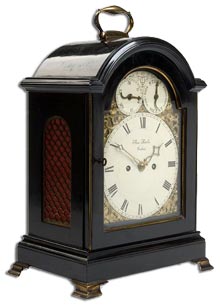
A general term for a spring driven clock, usually wooden-cased, with a vertical dial on the front face and generally with a pendulum-controlled excapement.
The movement, or mechanism, is contained between two vertical plates.
The term originates from the fact that lthough most clocks of this type stood on pieces of furniture, some were furnished with a suporting wall bracket. In the 17th and 18th centuries, they were called spring clocks.
edgar brandt (furniture - art deco - wrought iron)
(1880-1960) The most renowned French metalworker of the art deco period, and designer of furniture, screens and decorative panels. He used a combination of metals, such as iron, brass and copper and is also known for this wrought-iron work, often with a hammered finish. Brandt formed a company in New York called Ferrobrandt.
brandy bowl (decorative - drinking bowl)
A shallow, oval bowl with two opposing handles, used both for tasting and for drinking brandy. Brandy bowls were made in Holland in the 17th and 18th centuries and revived in the 19thC; in the early 18thC, versions made in New York were exported to Britain.
brandy saucepan (metalware - silver - brandy warmer)
A small, silver saucepan with a bellied, pear-shaped or cylindrical body, used since the 17hC for warming brandy and other beverages. See also pipkin
brass (metalware - alloy - copper and zinc)
A strong yellow alloy of copper and zinc; a higher level of zinc produces a yellower metal. Brass is malleable and easy to work. It has been worked in Britain from the Middle Ages. Large-scale production came c.1700, with better quality metal from c.1720. Some small brass ornaments and mounts for clocks were silvered. In the 19thC, thin sheet brass was introduced and designs were stamped out under presses to produce ornaments, inkstands, letter racks and door furniture.
breakfast table (furniture - extending table )
A small, light, four-legged table with two extendable hinged flaps. The custom of entertaining friends to a late breakfast died out towards the end of the 18thC, and the term became more generally applied to lighter and smaller versions of dining tables for use in the breakfast room.
breakfront (furniture - projecting front )
Term used to describe a piece of furniture with part of its fromt projecting. Breakfront bookcases, sideboards, wardrobes and clothes presses were popular in the 18th and 19th centuries.
breech (militaria - barrel - breech-loading)
The closed end of a barrel, where the charge or cartridge is placed. Breech-loading weapons were easier to load than muzzle-loading ones. Although they were used from the 15thC, it was not until the 19thC that they were perfected.
abraham loius breguet (clocks and watches - tourbillon - 1747-1823)
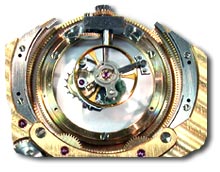
Swiss born watchmaker working in Paris from c1762. He specialised in subscription watches or souscription watches which were made to order for clients or subscribers, and self-winding watches.
In 1795, Breguet invented an escapement mechanism-called the tourbillon which reduced errors caused by the changing position of a watch as it was carried around. He also developed montres a tact which have knobs set at each hour for telling the time by touch in the dark.
Breguet's watch cases are often very thin, with gold or silver dials. He signed his pieces 'Braguet a Paris' until 1791, when he developed a hidden signature to discourage forgeries. He went into partnership with his son Louis-Antoine c1807.
breloque (jewellery - ornament - chatelaine)
Small ornament worn on a watch chain or chatelaine. It was typically made of gold or enamel and often in the form of a tiny statuette. Porcelain breloaques were made at chelsea and derby in the 18thC.
bretby (ceramics - pottery manufacturer - christopher dresser)
Derbyshire earthenware pottery, established 1883. Bretby made pieces to the designs of christopher dresser.
marcel breuer (furniture - designer - chrome- 1902-81)
Hungarian-born furniture designer and architect, specialising in interiors. Breuer trained at the bauhaus school of design. His furniture was easily mass-produced and he was largely responsible for introducing chrome into ordinary households for the first time. Many of Breuer's designs were produced by the thonet brothers' furniture factory in Vienna. Breuer left Germany for Britain in 1935 and two years later settled in the USA.
bright-cut engraving (metalware - decoration - engraving)
Method of engraving metal articles especially adams-style silverware, developed in late 18thC Birmingham. The engraving instrument, or graver, has a double edge which removes slivers of metal and burnishes the cut surface to produce a smooth, polished, faceted decoration.
brilliance (gemstones - facet brilliance)
Radiant brightness of a diamond or other transparent gemstone, enhanced by the skilled arrangement of facets. A stone's brilliance is enhanced if the facets cause a greater deflection of light entering a stone and minimal loss of light through the stone's base.
briolette (gemstones - cutting)
The Briolette Cut is a drop-shaped stone with triangular or diamond-shaped facets all the way around. There is no table, crown or pavilion. The more facets, the more brilliant the stone appears. The facets on a Briolette are all triangular in shape entirely covering the circular cross section of the stone. Briolette diamonds are found in antique and estate jewelry from the Victorian, Edwardian and Art Deco eras. Briolettes are one of the earliest diamond cuts.
In or about 1476 Lodewyk (Louis) van Berquem, a Flemish polisher of Bruges, introduced absolute symmetry in the design of facets. He cut stones in the shape known as pendeloque or briolette. Briolette cut diamonds are also being newly cut, especially in larger sizes like 10 to 12 carats, primarily in India. See also JEWEL CUTTING
nicholas briot (coins - charles I)
c.1579-1646) French die-sinker who produced machine-made coins of very high quality for Charles I in the 1630s.
bristol (ceramics tin glazed - glass bristol blue)
A centre for British glassmaking from the mid 17th to 19th centuries. Bristol glass-making was established c.1651; in the 18thC opaque white glass resembling porcelain and often decorated in similar style was important, but the city best became known for its Bristol blue glass made in the late 18thC, most notably by Lazarus and Isaac Jacobs. It was used to make decanters, finger bowls, patch boxes and liners for silver casters, and other wares, which were often gilded. Blue glass was produced at many other factorties in Britain and firm attribution is usually impossible. The city's glass-makers were also noted for their high quality cutting, engraving and enamelling. See also NAILSEA.
Also - An important ceramics centre for the production of tin-glazed earthenware in the 17th abd 18th centuries. This initially followed the style of Italian maiolica, and later of delftware. In 1750 a soft-paste porcelain formula containing soapstone was pioneered at a Bristol factory founded by Benjamin Lund. A limited range of blue and white domestic ware was produced. The soapstone formula
by worcester, which took over Lund's company in 1752. In 1770, William cookworthy, the chemist who made Britain's first hard-paste porcelain, transferred his plymouth factory to Bristol. The Bristol factory closed in 1781, the patent rights transferring to newhall in Staffordshire.
britannia metal (metalware - pewter - silver plate - EPBM)
A type of pewter containing no lead but a high proportion of tin, and shaped by a process known as spinning. This formed objects around a pattern (or model) on a power-driven wheel, which produced thinnner wares than the earlier cast pewter. Britannia metal was made extensively in Sheffield, London and Birmingham. From the second half of the 19thC it was often used as the base metal in electroplating instead of copper or nickel silver and marked 'EPBM' (electroplated britannia metal). This is softer than electroplated nickel silver (EPNS) and melts easily, so is virtually impossible to repair.
britannia standard (metalware - silver standard )
The compulsory standard for silverware in Britain 1697-1720. The proportion of pure silver (95.8 per cent). It was introduced as a deterrent against the practice of melting down sterling silver coinage to make domestic silverware. After 1720, the production of Britannia silver was optional.
broad (coins - gold one pound - oliver cromwell)
Gold £1 coin struck in 1656 which was circulated for only a short period. Broads usually bear a portrait of Oliver Cromwell.
broadsword (militaria - sword - double edged)
A cutting sword with a flat, wide, double-edged blade.
brocade (textile - richly figured - cloth of gold)
Finely woven textile with coloured threads added to form a raised pattern on the upper surface of the material, making a richly figured cloth. (The word brocade derives from the Latin brocare meaning 'to figure'.) Originally the ground patterns of flowers and scrolls were in gold or silver, and the fabric was known as cloth of gold; coloured silk threads came later, and today, cotton and man-made fibres are used. Brocade can be made in various weights for dressmaking or furnishings. Brocantine is brocade with a raised pattern that imitates embroidery.
phillippe joseph brocard, (glass - french maker - syrian techniques)
(1867-90) French glass maker who revived 13th-century Syrian techniques of enamelling in brilliant colours. Early works copied Islamic lamps and tableware, but later output was original - mainly moulded glassware decorated with more subdued enamel colours.
brocatelle (textile imitation brocade - Marble table tops)
Imitation BROCADE made of cotton or silk, with a raised pattern in the warp and a flat weft background. The term is often used to refer to any cloth with a raised pattern. Also - A variegated marble which was used to make table tops in the 18thC, also known as brocatello.
brockage (coins - mis-struck)
A mis-struck coin, on which the design appears normally on one side, but with the same design in intaglio or incuse form on the other. It is caused by a previously struck coin failing to eject from the pair of dies.
achille brocot, (clocks and watches - clockmaker - brocot suspension)
(1817-78) French clock-maker who devised the brocot suspension which enabled timekeeping to be regulated by altering the length of the pendulum suspension spring by a key turned in the dial. He also introduced a jewelled deadbeat escapement, sometimes called a visible escapement as it was often mounted in the middle of the dial.
broderie anglais (textile - embroidery - cut work)
Mid-19thC cutwork embroidery, usually of linen or cotton, made in Britain and parts of Europe from the late 18thC. Floral patterns are formed by embroidering around holes cut in the fabric in buttonhole stitch.
john brogden, (jeweller - etruscan - egyptian style)
(1842-85) London based jeweller who specialised in antique and archaeological styles. Typical Brogden pieces incorporate Classical motifs and reliefs inspired by the Etruscan, Assyrian and Egyptian civilisations and pieces mounted with the claws of tigers or vultures.
bronchit (glass - decoration - bronzite)
Matt black decoration painted on glass. The technique, also known as bronzite, was developed c.1910 in Vienna. The motifs - flowers, figures, animals and geometrical shapes - anticipated art deco style.
bronze (metalware - hard alloy - coper and tin)
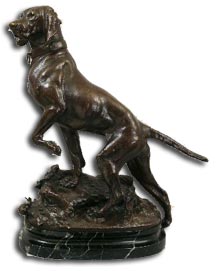
Hard alloy of copper and tin which develops a brown or green surface patina with age. Bronze has been used for various utensils requiring strength and durability, such as buckets, cooking pots and lamps, as well as for weapons, statues, ornaments and furniture. Bronze is usually shaped by casting and then chiselled to add sharp detail.
bronzes d'ameublement (metalware - bronze gilt fittings)
French term used to describe small gilt-bronze fittings, including clock-cases, firedogs, lamps and lighting appliances.
brown bess (militaria - musket - british army)
The nickname for the flintlock musket used by the British army 1720 - 1840.
browning (militaria - oxidising firearms)
The process of artificially oxidising the metal parts of a firearm to produce a dull brown lustre finish and a guard against rusting.
die brucke (decorative arts - dresden - expressionists)
Group of artists who founded Dresden, Germany 1905. Although it broke up in 1913, the group's Expressionist style had a considerable impact on public taste, reviving, for example, an interest in woodcuts and other graphic arts.
brushing slide (furniture - shelf between drawers)
A sliding shelf between the top drawer and the top surface of a chest of drawers or above the middle drawer of a tallboy. Its function was to provide a pull-out surface on which clothes could be laid out for brushing prior to wearing.
brussels tapestry (textile - gobelins paris - tapestry)
The most technically refined tapestry in Europe from the 15th to the 17th centuries - when the gobelins factory in Paris became the main production centre. Brussels tapestry hangings were prized for detailed, realistic compositions, perfection of technique and colour and fine materials. They continued to be produced to a lesser degree throughout the 18thC.
budai (oriental - buddhist figure - prosperity and happiness)
Buddhist figure signifying long life, prosperity and happiness. It is also spelt butai and putai, and in Japanese as hotei. The figure is depicted either alone or with children tugging at his ear lobes, pot belly or the sack of treasures by his side.
buffet (furniture - cupboard)
The forerunner of the sideboard, dating from the 16thC. It consists of two open shelves, sometimes with a small central cupboard in the upper tier. Court cupboards were popular again in the gothic revival of the early 19thC. See also courcupboard
buhl work (furniture - decoration)
A marquetry technique, also known as buhl work, using metal (usually brass) and tortoiseshell in reverse patterns, sometimes combined with other materials and often set in an ebony veneer. See also boulle
bulle clock (closck and watches - battery clock 1922)
The commonest form of electric battery clock, patented in 1922 by the Frenchman Maurice Favre-Bulle. Bulle clocks were marketed from 1924 in Britain by the British Horo-Electric Company until 1939. They are mounted on a circular base covered by a glass dome which contains the clock with its battery, electromagnet and hollow pendulum.
bullet teapot (ceramic - spherical teapot)
Early 18thC silver or ceramic teapot with a spherical or polygonal, bullet shaped body, and usually a flat lid. The design was revived in the 19thC.
bullion (metalware - gold or silver bars)
Gold or silver in the form of bars or ingots; the meltdown value of an object on its actual metal content. Also - Silver wire twisted into threads and used to decorate church vestments and military uniforms; also known as bullion lace.
bulls eye (clocks and watches - half-hunter glass)
The bubble shaped glass in the cover of a half-hunter cased watch.
bureau (furniture - writing desk with drawers)
A chest of drawers with a desk area above, It is enclosed by a sloping flap which opens, supported by pull-out lopers, to reveal a writing surface. At the back of this are recessed pigeonholes and small drawers, Bureaux were introduced during the 17thC and over the next 200 years adopted various forms, including the bureau bookcase, topped by bookshelves with glazed or panelled doors and the bureau cabinet with panelled doors above.
bureau bed (furniture - folding bed)
Antique Bed that can be folded away into a bureau-like carcass with dummy drawers. In the 18th and 19th centuries, various bed disguises were popular in households where space was at a premium, including library press beds, piano beds - complete with dummy pedals - and table beds.
bureau-plat (furniture - writing desk)
French term for a flat-topped writing desk with a frieze containing drawers.
william burges (architect - gothic furniture - 1827-81)
(1827-81) British architect and designer in 19thC gothic revival style. Burge's interpretation of 13thC furniture style resulted in square, solid pieces covered with surface decoration including paintings.
burgonet (militaria - metal helmet - light horse cavalry)
Light metal helmet, with peak, neck guard and hinged cheek flaps, used mainly by light-horsemen in the 16th and 17th centuries.
burmese glass (glass - art glass - queens burmese glass)
An opaque art glass shading from yellow at the bottom to pink at the top, developed by the Mount Washington Company of Massachusetts in 1885. The colours came from mixing uranium or gold oxides with molten glass. From 1886 Thomas Webb & Sons produced 'Queen's Burmese Glass' in Britain, after a tea set bought by Queen Victoria from the US manufacturer.
burr (wood - grain - parquetry - veneer)
Knotty whorls in the grain of wood where there were dense, fibrous swellings on the trunk or roots of a tree, which were used in decorative veneers.
busby (militaria - head gear - fur hat - hussars)
A military fur hat with a bag hanging from one side, often with a plume. It was worn originally by 18thC Hungarian Hussars, but other European hussar regiments adopted it.
franz anton bustelli (ceramics - modeller - nymphenburg - 1723-63)
Swiss-born procelain modeller. He was chief modeller at the nymphenburg procelain factory 1754-63. His commedia dell'arte characters were unsurpassed in their sense of movement and grace.
butlers tray (furniture - handled tray)
Portable tray, usually rectangular, with handholds at each end and mounted either on legs or a folding stand. Butler's trays were used from the early 18thC for serving drinks and removing glasses. They are also known as standing trays.
Padded upholstery with a buttoned, quilted effect introduced in the second half of the 18thC. Strong thread is pulled through the covering material and stuffing to the framework or webbing and hidden on the outside by buttons.
Butons first became widespread in Europe in the 17thC. British buttons from c.1700 were moulded or stamped in metal with hand-painted enamel and porcelain examples later in the century. In the 19thC buttons were mass-produced in a variety of materials.
A keyless watch where the winding button is at the top of the pendant, the winding button stem passing through the pendant.
Leave a Reply
You must be logged in to post a comment.