
Contents
The Antique Marks Glossary - Antique Terms G

Covering everything from gadroon to guinea and gainsborough to gun money.
Here you will find antique terms beginning with the letter G and related words or antique terms including other definitions and meanings you might find useful.
gabbeh (carpets – iran - coarse)
Heavy coarsely woven rugs from west iran. gabbeh’s are woven in thick wool and brightly coloured with bold designs.
gadroon, gadrooning (decorative motif - silver - border)
The continuous convex curves or reeding on metalwork, also used on furniture and ceramics. Gadrooned borders are made up of interlocking, repeated common bosses, the resulting effect producing a circle that appears to be in motion. Some european tin-glaze earthenwares have painted gadroon borders known as false gadrooning, that attempt to produce a three dimensional effect.
gainsborough, chair (furniture - chair )
The 20thC term for an open-sided armchair with upholstered seat, back and arm pads, and with hollow concave arm supports.
gainsbrough (artist - 1836-1906)
16th .
emile gaul (glass – designer - art nouveau - 1846-1904)
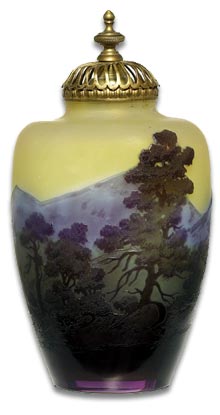
French designer and manufacturer of glass, ceramics and furniture.
Highly influential in the art nouveau movement and founded the nancy school in the late 19thC.
Also founded a glass factory at nancy, france, in 1867 that closed in 1931. See: Emile Galle Section
gallery (decoration - railing - tray or cabinet)
A raised border or miniature railing of wood or metal used as an ornamental surround to the top of a table, tray, shelf or cabinet.
galloon (textiles - gold or silver trim)
Braid, lace or ribbon woven from silver, gold or silk threads used for trimming upholstery, uniforms or dresses.
gandhara (sculpture - buddha - pakistan)
Province in Pakistan form which came stone carvings combining Indian and Mediterranean influences. Early examples date from the 2nd and 3rd centuries and depict Buddha in Graeco-roman costume. Later examples usually heads, are made of stucco or terracotta. The sculpture was much collected in victiorian times. Most common items seen today are relief’s, Buddha figures and miniature stupas or shrines body.
gaozu (carpets - iran - coarse)
See: stem cup.
garden carpet (carpets - iran - coarse)
A persian carpet design which reflects the layout of a formal garden or chahar bagh (four gardens), which is mentioned in the koran as a feature of paradise. The earliest surviving examples date from the first half of the 17thC. See: Antique Carpets & Tapestry
garnet (genstones - red)
Family of minerals including six varieties of similar red gemstone, namely: pyrope (rhodolite), almandine, grossular, andradite (demantoid), spessartite, and uvarovite. The most common garnets used for jewellery are the very dark red pyrope or Bohemian stones, which are usually rose-cut or on bead necklaces, naturally faceted, and almandine garnets
are usually cut en cabochon or emerald-cut.
garniture (decorative display - three five or seven items)
Matching set of three, five or seven ornaments, usually vases, for decorative display.
A garniture de cheminée is a set for the mantlepiece.
The ornaments were originally japanese or chinese export porcelain, or Dutch delft copies, comprising an odd number of baluster vases and covers with an even number of intervening beaker vases of cylindrical or waisted form.
Silver versions were made in small numbers in Europe, and in the late 18thC the term was also used to describe clock and candlestick sets.
Dressing-table sets are known as garnitures de toilette; a set for a side table as a garniture de table.
gasolier (decoration - gas - lighting)
Decorative gas lighting piece made in the latter half of 19thC of brass or other metal. It resembles a chandelier, with branches holding burners emanating from a central shaft, but is hollow to allow gas to be piped through.
gate-leg table (furniture - table - drop-leaf)
A type of drop-leaf table with a structure hinged like a gate beneath that pivots out to support the leaves. The gate-leg was introduced in the late 16thC and in common use up until the end of the 18thC.
gather (glass - molten blob)
Blob of molten glass that is collected from the furnace on the end of a blowpipe and blown into shape.
gauffering (books - textiles - decoration)
The term describing the impresssed decoration on gilded edges of book bindings, applied with heated finishing tools./p>
Also - The term gauffered describes the relief pattern on any textile other than velvet. Velvet decorated in this way is described as stamped velvet.
norman bel geddes (art deco, designer, 1893-1958)
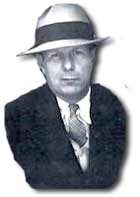
After studying briefly at the Art Institute of Chicago, Bel Geddes worked in a Chicago advertising agency designing posters for General Motors and Packard.
In 1918 he began a successful career as a stage set designer before turning to industrial design in 1927. Despite commissions for the Toledo Scale Co. (1929), and the Standard Gas Equipment Corp. (1932).
It was as polemicist of Modernity that Bel Geddes gained greatest recognition. His book Horizons (1932) was a manifesto for Modern streamlining which promoted a series of futuristic designs for buildings and transport systems. Bel Geddes' positivist vision of a streamlined future reached its apogee with his' futurama 'Metropolis of Tomorrow' for the General Motors Highways and Horizons Pavilion at the 1939 New York World's Fair.
genre painting (painting - victorian - style)
Style of painting linked with the ideals and sensibility of the Victorian middle classes, in which domestic scenes with a moral, sentimental, historical or literary theme were popular.
georgian style (period - style - british)
British 18thC style characterised by the proportions and ornaments of classical architecture, applied universally to buildings, furniture and decorative art forms.
The Georgian era is divided into two main periods: the early Georgian period, 1720-60, under the reign of George I up to 1727 and George II thereafter, and the late Georgian period, 1760-1800, under the reign of George III. The term georgian style can also include the regency period to 1830. See: Antique Periods
gesso (furniture - plaster - decoration)
A form of plaster which can be carved and gilded or painted for use as a decorating medium on furniture. Gesso (pronounced jesso) is a dense mix of powdered chalk and size which hardens on drying. It is built up in layers onto a surface or over a wire framework, or cast into a mould. The material was often used in place of wood for detailed relief work on chairs, mirror frames and pier tables from the mid- 18thC and increasingly in the 19thC.
grinling gibbons (sculptor - charles II - st. pauls - 1648-1721)
Dutch-born sculptor who moved to Britain at 19 and became renowned for his carved decorations in wood, marble and stone. His craft was applied to chimney pieces, picture and mirror frames, panelling, tables and cabinet stands. He was appointed master carver in wood to King Charles II, a position he held until the reign of George I. He was commissioned by Sir Christopher Wren to carry out work in St Paul's Cathedral and Hampton Court Palace.
gilding (decoration - gold )
Liquid gold is a solution of powdered gold leaf and oils containing sulphur. Used on meissen porcelain by 1730, and in Britain from the mid-18thC, it produces a film of metal with a similar effect to that of lustre ware.
james giles (ceramics - worcester - chelsea - 1718-80)
British outside decorator who was responsible for some of the finest decoration on worcester and chelsea porcelain. His London studio also decorated opaque white, green and blue glassware with neoclassical designs similar to those found on Giles's work for Worcester.
gillows (furniture - robert gillow - 18thC)
The most successful firm of British 18thC furniture-makers outside London, founded in Lancaster by Robert Gillow (1704-72), a joiner.
The company was later renowned for its elegant, well-made, solid but simple pieces in georgian and regency styles, and also for its clock cases.
The company appears to be the first British firm to stamp its furniture. The stamped mark 'Gillows' or 'Gillows Lancaster' can usually be seen on the top of drawer fronts. The firm continues to flourish, changing its name to Waring & Gillow Ltd in the early years of the 20thC.
giltwood (wood - gilded - decoration)
Any wood that is gilded, whether with gold paint or gold leaf.
gimmal (vessel - flask - 17thC.)
A flask made of tinted or transparent glass or stoneware from the 17thC. The flask, designed to hold oil and vinegar, has an interior division to make two separate containers each with its own spout.
gimmal ring (jewellery - hooped ring - ornament)
15th to 18thC wedding or engagement ring consisting of two or three interlocking hoops which fit together to form one hoop. The setting also splits and joins again to form an ornament, such as a heart or clasped hands.
ernest gimson (designer - arts and crafts - 1864-1919)
Artist, craftsman and designer, working with furniture, embroidery, metal and plaster. His furniture is traditional with turned legs and rails, spindle backs and rush seats, and was greatly influenced by William Morris. He was involved early on in the arts and crafts movement.
girandole (clock and watches - banjo clock - jewellery drops)
An elaborate US made clock, resembling a banjo clock, designed c1818 with gilded decorations, including scrolls, festoons and birds.
Also - In jewellery, pearl or gem drops suspended in groups of three or more from an earring, pendant or brooch.
glace (furniture - upholstery - lustre finish)
Upholsterer's term for cloth with a highly lustrous surface finish.
glasgow school (design school - art nouveau - C R Mackintosh)
Group of designers and architects centred around the Glasgow School of Art in the late 19thC.
Hallmarks of the group's austere version of art nouveau include stylised floral motifs, celtic ornament, painted or inlaid stained glass and applied metalwork ornament on furniture which generally followed straight or gently curved lines.
Their work was exhibited widely in Europe, and influenced early European industrial designers, especially in Germany and Austria.
glass (glass - fusion of silica)
Hard, transparent or translucent substance made from the fusion of silica, such as sand or flint, and an alkali, such as potash or soda. When heated to about 1100°C (2000°F) the ingredients fuse together and become molten. In this state the metal, as it is technically called, can be shaped by blowing, casting, moulding or pressing. Glass can be coloured by adding metallic oxides to the frit. See: Collecting Antique Glass
drinking glasses (glass - vessels)
The shape, size and decoration of drinking glasses, particularly British ones, often indicate their date as well as purpose. See: Georgian Glass
glastonbury chair (furniture - folding chair)
19thC term for a type of folding chair dating from the late 16thC, said to be based on one used by the Abbot of Glastonbury, and reproduced in the 19thC.
glaze (ceramics - glass like coating - decoration)
In ceramics, a vitreous (glass-like) coating which gives a decorative and impervious finish. Glazes can be matt or glossy, soft or hard, smoother textured, of varying opacity and colour. They are composed of a glass-forming ingredient (usually silica), a flux (to reduce the melting point of the silica), and alumina to help fix the glaze to the clay body.
Glazing takes place either before firing (known as green or raw-glazing), or after the first, biscuit firing when the body has been hardened off.
Lead glaze was perhaps the earliest manufactured glaze, known from 1700 bc, and using ground lead or lead oxide as the flux agent. The lead lent greater translucency and depth of colour to the glaze. It was used on earthenware and soft-paste porcelain in Europe until substituted in the 19thC by less toxic flux materials such as borax. also - salt-glazed stoneware, tin-glazed earthenware.
A smear glaze can be a deliberate, very light glaze applied to the marble-like parian ware or an unintentional coating of leftover glaze from a previous firing.
globe (furniture - map of world - sphere)
Sphere showing a map of the world (terrestrial globe) or of the heavens (celestial globe), that is usually mounted on an axis and can be turned.
gnomon (furniture - sundial arm)
The projecting arm of a sundial, also known as the style. It casts a shadow, the tip of which points to markings round the rim of the dial that show the time. For accurate reading, the angle of the gnomon must be related to the latitude in which the sundial is set.
gobelins (carpets & tapestry - manufacturer - french)
Tapestry works established in 1662 in Paris and still in operation today.
Gobelins produced tapestries and carpets in traditional, classical styles taken from designs, or cartoons, by eminent painters, such as Raffaello Raphael.
In the mid to late 19thC, Gobelins produced tapestry portraits for royalty and panels for Parisian theatres. The quality of the work declined with the introduction of chemical, aniline dyes in the late 19thC and the use of these was suspended in the early 20thC.
Gustave Geoffroi, director 1919-25, set a new policy of commissioning cartoons from 20thC artists, such as Jean Weber, and of using improved synthetic dyes.
goblet (vessel - drinking bowl)
Drinking vessel usually with a large bowl on a stem and foot.
edward william godwin (furniture - aesthetic movement - 1833-86)
British architect, designer and member of the 19thC aesthetic movement. His light, graceful art furniture was often made from ebonised wood, showed Japanese influence in its simple lines, and was easily mass-produced. Art Furniture, a catalogue of his designs, was influential, especially in the USA.
gold (metalware - precious metal)
The most versatile precious metal of all. It is more ductile than any other metal, with the capacity of being drawn out into a fine wire, and so malleable that it can be beaten into a leaf 4 millionths of an inch (a 10 thousandth of a millimetre) thick.
Gold is resistant to corrosion, and to the action of solvents. Pure, 24 carat gold is too soft and heavy to work on its own, and so it is usually alloyed with other metals such as copper.
In 14 carat gold, 14 parts of gold are mixed with 10 parts of other metal; the finest alloys are 18 and 22 carat.
The colour of the gold varies according to the type and quantity of metal used in the alloy. Copper lends a reddish tinge, silver a hint of pale green; a combination of copper and silver results in a brighter yellow than pure gold.
18 carat white gold is an alloy of 25 per cent platinum and 75 per cent pure gold.
gold anchor period (ceramics - manufacturer - chelsea porcelain)
In 1770, the Chelsea factory was sold to derby, although production did not cease until 1784. The products of the two factories merged stylistically into what became known as Chelsea-Derby ware. See: Chelsea Porcelain
william goss (ceramics - manufacture - crested ware - 1833-1906)
Staffordshire potter renowned for his crested ware and porcelain ornaments. Goss's Falcon Pottery was founded in 1858 to produce dressing-table ornaments and jewellery such as brooches and pendants, in parian porcelain. He began marketing parian figures, and the crested wares which became popular holiday souvenirs, in the 1890s.
gothic revival
The 19thC Gothic Revival started with poorly executed and over-elaborate Gothic motifs on European furniture and metalwork, dubbed by the Victorians as abbotsford style and known as Troubadour style in France and Dantesque in Italy.
British architect augustus pugin reacted against this excess in the 1830s, with more authentic methods of construction and decoration. Later furniture designers who followed his lead include william burges, william morris, bruce talbert and charles eastlake.
gouache (painting - paint - water soluble)
Water-soluble artist's paint in which the colour pigments are mixed with a chalky white medium and gum to produce an opaque paint. Gouache was widely used for miniatures as well as for larger paintings; sometimes with watercolours.
gouge carving(furniture - decoration - 17thC oak)
Carved decoration consisting of shallow depressions scooped out with a gouge. It is found mainly on late 16th and 17th-century British oak furniture.
marcel goupy (artist - art nouveau - art deco - 1886-1980)
French art nouveau and art deco artist and designer of glass and ceramics who designed for various factories such as st louis. His work includes glassware decorated with stylised flowers in enamel colours, and both earthenware and porcelain table services decorated with birds and stylised flowers.
gout stool (furniture - foot stool)
A footstool introduced in the late 18thC, designed to ease the discomfort of gout sufferers.
george graham (clocks & watches - watchmaker - 1673-1751)
18thC clock and watch-maker who brought an unprecedented high degree of accuracy to longcase clocks. He made few clocks, but many watches. His introduction of the deadbeat escapement in 1715 replaced the less accurate anchor escapement, and his mercury pendulum in 1726 helped control the pendulum's vulnerability to heat and cold. He also developed the cylinder escapement for watches, which led to slimmer-cased designs. Graham married the niece of clock-maker Thomas tompion, and was in partnership with him in London, continuing the serial numbers initiated by Tompion. See: Antique Clocks
graining (coins - edge - furniture - decoration)
The patterned edge markings on a coin, also known as milling. The practice of graining or edge-lettering was usual in Britain from 1622 to guard against clipping.
Also - The decorative, painted imitation of wood grain or marble onto furniture. Graining was acceptable in the 18th and 19th centuries but was associated with cheap, low-grade furniture during the late Victorian period.
gramophone (furniture - music player - emile berliner)
A type of mechanical music player patented in the USA by Emile Berliner in 1887, using flat discs rather than the cylinders of Edison's phonograph. Early 20thC models used a large, trumpet-shaped horn to amplify the sound, and by the 1920s gramophones were housed in a case.
grand rapids furniture (furniture - art nouveau - american)
Inexpensive, mass-produced furniture of art nouveau, renaissance Revival and other styles made at Grand Rapids, Michigan, USA, c. 1850-1930 and exported to Europe.
grandfather chair (furniture - armchair)
High-backed, open armchair, dating from c. 1850.
gravity clock (clocks and watches - ball clock - rack clock)
Clock powered by the falling of its own weight. A type which is suspended on a chain is known as a ball clock, a rack clock is one mounted on a toothed rack. An inclined plane clock has its movement encased in a canister which rolls down a slope marked with the days of the week.
eileen gray (furniture - architect - lacquer -1878-1976)
Irish architect and furniture designer who became the best European lacquer artist of the period.
Gray made decorative ceramics, including, domestic earthenware, as well as wood, lacquer and modernist tubular steel furniture, characterised by plain, linear forms. See: Eileen Gray
great exhibition (exhibition - london - 1851)
An international Exhibition of the Works of Industry of All Nations, to give its full title - held in 1851 at the original Crystal Palace in Hyde Park, London.
william greatbach (ceramics - wedgwood - 1735-1813)
English potter who made transfer-printed cream-coloured wares and fruit-shaped tablewares, glazed by Josiah wedgwood for whom he worked 1788-1807. See: Wedgwood.
griffin (decoration - eagle and lion)
Mythological creature with an eagle's head and wings and a lion's body, used as a decorative motif during the renaissance period.
grille (furniture - lattice - doors)
Brass latticework used as panels in the doors of cabinet furniture, often replacing glass during the late 18th and early 18th centuries. also vinaigrette.
en grisaille (ceramics - decoration - jesuit ware)
A painting technique used on ceramics and glass using shades of grey and black to imitate either sculpted stone relief, or engravings as on Chinese jesuit ware c1720-50.
groat (coins - british - silver)
British silver coin with a face value of 4d(1.66p). Its name derives from the word 'great', because of the coin's size compared with the smaller penny.
Groats were mainly used 1350-1560, but were issued before and after these dates. The Britannia groat, for example, was issued in the 19thC. This was the same size as the silver 3d but thicker and displayed the face of Britannia.
groove-and-tongue (furniture - decoration - fluting )
Carved decoration found on items of furniture like concave fluting partially filled with a convex moulding.
walter gropius (designer - bauhaus)
See bauhaus.
gros point (textiles - cross stitch)
A large cross stitch usually in wool on a canvas ground. Point is French for 'needle stitch'.
grotesque (decoration - figural - mythological)
Extravagant decorative motif in which figures of humans, mythological beasts, birds, animals and sphinxes are used at the whim of the artist.
The design elements are loosely linked by motifs such as intertwining scrolls, strapwork or foliage. Grotesque decoration was used in virtually every medium of the decorative arts -carved, inlaid or painted on furniture; engraved, chased or modelled on silver; woven into beauvais tapestries; and painted on maiolica.
Particularly popular during the renaissance and rococo periods, as well as later in the eclectic high Victorian period and in Germany at the same time.
The word stems from the Italian grotte, the subterranean ruins where ancient Roman motifs of this type were discovered during the Renaissance.
andre groult (designer - french art deco - 1884-1967)
French interior decorator and designer of art deco furniture. Groult's furniture features curved lines, harmonising colours and fine materials.
guard chain (clocks and wathes - watch chain)
A long chain, usually of gold, and originally one from which a watch and various other objects were suspended. Guard chains were popular in Britain from the early 19thC until the early 20thC.
gueridon (furniture - stand - candelabrum)
Stand for holding a candelabrum or torch, a tray or a basket. Some early gueridons were in the form of a black human figures now known as blackamoors and were imported to Britain from Holland, Italy and France in the latter half of the 17thC.
The term has come to be commonly used for small occasional tables associated with the Louis XV and Louis XVI periods, with a frieze drawer and platform. interlacing circles derived from Greek and Roman architecture and used to decorate plain or moulded surfaces
.
guinea (coins - british - charles II)
A British gold coin first struck under Charles II in 1663 and so named because some of the bullion gold used to make the first pieces was imported from Guinea by the Africa Company.
The provenance mark of an elephant or elephant and castle was the Africa Company symbol, and is found on some of the coins. After some fluctuation, the value of the coin settled at 21 shillings (£1.05).
The last golden guinea was struck in 1813, but the term denoted 21 shillings until the introduction of decimal currency.
Guineas with a pointed shield on the reverse side, issued 1787-99, are often known as spade guineas.
guls (carpets - decoration - turkoman)
The dominant repeating motif on weavings of the nomadic Turkoman tribes of central Asia. Gul designs vary greatly, but are usually based on an octagon shape containing stylised flowers. Gul is the Farsi word for flower. The motifs are thought by some writers to be tribal emblems, and therefore provide a clue to a carpet's origin.
john gumley (furniture - cabinetmaker - 1691-1727)
Cabinet-maker and manufacturer of mirrors and chandeliers. Gumley was appointed royal cabinet-maker to King George I in 1715.
gun money (coins - james II - melted cannon)
A large, base metal coinage supposedly made from melted-down cannons. It was issued in Ireland by King James II following his exile from England in 1688.
gunmetal (metalware - alloy - copper and tin)
Strong alloy of copper and tin developed in the 19thC to make guns and also cast to make domestic hollow-ware, candlesticks and furniture ornaments.
gutta percha (furniture - decoration - rubber)
Rubbery material made from the resin of an East Indian tree, used in the late 19thC for furniture decorations, dolls and golf balls.
Leave a Reply
You must be logged in to post a comment.