
The Antiques Marks Glossary featuring Antique Terms H

Covering everything from hallmark to hunter and hamada to huguenots.
Here you will find antique terms beginning with the letter H and other related words with antique definitions and meanings.
Contents
hafner ware (ceramics - tiles)
lead-glazed earthenwares, including steins, made by potters best known for their oven tiles.
thomas haig (furniture - cabinetmaker - chippendale)
A cabinetmaker and upholsterer who was the business partner of thomas chippendale. When chippendale died in 1779, haig continued in partnership with chippendales son, Thomas, until 1796.
halberd (militaria - medieval - pole arms)
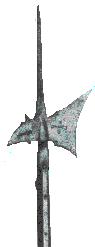
Also referred to as the halbard and the halbert. Used across Europe from the 13th century. The halberd is probably the most famous and recognizable weapon of the polearm group. The halberd was used most extensively in the 15th and 16th centuries and was the most versatile polearm ever developed. It incorporated an axe blade, a spear point, and a pick/hammer beak.
It could be used to hook an enemy to the ground, even off horseback. It could be thrust or used for chopping as well.
Combat training in the use of halberds was fairly extensive as they could be used lethally or non-lethally (to trip, knock down, or otherwise subdue an opponent). While halberds were uncommon as combat weapons after the 17th century, they were carried as symbols of authority and rank well into the 19th century.
The Swiss developed the halberd and were the most famous employers of halberdsmen in their ranks. Even today, the Swiss guards at the Vatican carry halberds (for appearances only; they keep automatic weapons in the armory); the Tower of London Beefeaters are also famous wielders of halberds today.
half hunter (clocks & watches)
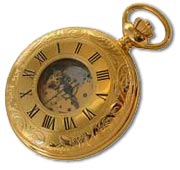
A pocket watch housed within a metal case with a lid which has a small round glazed window surrounded by roman numerals, the time can be seen with lid closed
halfpenny (coins - british)
A british coin with weight value equivalent to half a silver penny.
The earliest halfpence were minted in by viking and wessex kings before the creation of an English nation. These coins, and those of the later saxon kings are extremely rare.
After the norman conquest, and prior to the reign of Henry I (1100-1135) halfpence were produced by cutting a silver penny in half. However, eventually coins half the penny in weight were produced.
Coins from the reigns of Henry I and Henry III have only been discovered recently and it wasn't until the reign of Edward I (1272-1307) that the denomination came into general use.
The early coins are often difficult to identify, especially as there was a rash of Edwards and Henrys in this period, along with a couple of Richards. In addition it is often difficult to read the legend correctly.
The last silver halfpence was produced during the commonwealth and after the civil war. See: Coin Collecting and Numismatics Guide
half-tester (furniture - medieval bed)
A bed with a canopy or tester, supported by the head noard or posts that covers a quarter to a third of the bed area. Half testers were used in late medieval times and revived in the 17th, 18th and 19th centuries.
hall chair (furniture - chair)
Hard seated single chair, designed for the entrance hall and dating from the early 18thC.
william hallet (furniture - cabinetmaker - 1707-1781)
An early Georgian cabinetmaker, who in 1752 became a business partner in vile and cobb.
hallmark (metalware – gold - silver – platinum)
Official marks of an assay office or guild that is stamped on articles with a precious metal content. In the modern age the term applies more to the complete set of marks found on an article of gold, silver or platinum and usually includes a date mark and the makers mark. Hallmarking systems exist throughout europe and america.
In Britain hallmark literally means the mark of the goldsmiths hall, and the original assaying office was established in London in 1300. All but the smallest articles should be hallmarked. This includes any item over half an ounce or 15.5gms, except where the items appearance would be ruined by a hallmark. See Collecting Antique Silver | Silver Hallmarks
hall stand (furniture - cast iron - bent wood)
Province in Pakistan form which came stone carvings combining Indian and Mediterranean influences. Early examples date from the 2nd and 3rd centuries and depict Buddha in Graeco-roman costume. Later examples usually heads, are made of stucco or terracotta. The sculpture was much collected in victiorian times. Most common items seen today are relief’s, Buddha figures and miniature stupas or shrines body.
shoji hamada (ceramics - art pottery - bernard leach - 1894-1978)
Associate and mentor of bernard leach the founder of the art pottery movement in the Britain.
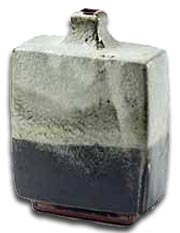
Born misonokuchi, kanagawa prefecture in japan; Shoji was interested in art at an early age and as an 8 year old he would spend time with a relative, who was studying at Tokyo School of Fine Art, and go on painting excursions with him. By the time he was 16 his vocation in pottery and crafts was confirmed, contributing woodcuts to magazines and winning school prizes for art.
In 1912, he saw etchings and pottery by Bernard Leach in art galleries in the Ginza district of Tokyo and the following year enrolled in the Ceramics department of Tokyo Advanced Technical College. Shoji graduated in 1916 and went to work in Kyoto at the Municipal Ceramic Laboratory and visited the potter Kenkichi Tomimoto for the first time. He met Bernard Leach in 1919 at Leach's one-man exhibition in Tokyo and was invited to Abiko where he met Yanagi and travelled to Korea and China with Kawai.
In 1920 Hamada arrived in England with Leach and studied early English slipware in the British Museum before traveling to St. Ives where he spent 3 years helping to set up the St. Ives pottery. His knowledge and practical experience proved critical in the successful establishment of the pottery which has been in continuous production ever since.
In 1955 he was recognised in Japan as a Living National Treasure, the first award of the title, with Tomimoto, Arakawa and Ishiguro.
Shoji Hamada is among this century's most important figures in the world of ceramics. His work is internationally acclaimed and has a place in major American and European collections. Hamada and Leach established new standards of craft in their own countries and influenced artists, craftsmen and potters the world over.
hammered (coins - decoration - martele)
A method of hand striking a coin design on to blank metal using a pair of dies. The method was used until the mid-17thC. Also – metal articles shaped by hand, a process used since ancient times. The metal is gently hammered into shape over a wooden block or leather pad. Also – martele.
hampelmann (toys - jumping jack)
A goblin or mannikin (Little People) in Germanic folklore.
robert hancock (decorative motifs – transfer prints - 1731–1817)
A staffordshire born engraver whose work was the main source of transfer printed designs on bow, Worcester, and caughley porcelain, and possibly also on Battersea enamels.
hand cooler (paperweight – baccarat – clichy)
A small round or egg shaped piece of glass, crystal or stone such as marble or agate used from the 18th to late 19th centuries to keep the hands cool. Most were about one and a half to two inches across. Some were eventually made into miniature paperweights and others intricately carved by glass houses such as bacarrat and clichy.
hand warmer (furniture - medieval bed)
A portable container for hot metal, coals or charcoal that was used to keep the hands warm. Most examples have an outer case of pierced, metalwork such as copper or brass surrounding the inner container and heat source.
hanger (militaria - sword)
A short general purpose sword used by huntsmen, horsemen and sailors in the 17th and 18th centuries.
pierre harache I (metalware – silver - 1682 -1698)
A heugenot silversmith who together with his son Pierre II (1698-1717) specialised in figural silver ornaments, decorated with chasing, embossing gadrooning, pierced and cut card work. Their marks, styles and designs are very similar.
hard metal (metalware – britannia - EPBM)
E.P.B.M. or electroplated Britannia metal is actually a lead, zinc and antimony based alloy, the silverware that is made of E.P.B.M. is usually of the highest quality. E.P.B.M. is also the most difficult to repair
hard-paste (ceramics - porcelain)
Hard-paste porcelain is a hard ceramic that was originally made from a compound of the feldspathic rock petuntse and kaolin fired at very high temperature. It was first made in China around the 9th century.
Historically, "hard-paste" referred to the Asian porcelains that had been prepared from the raw materials. The secret of its manufacture was not known in Europe until 1709, when Böttger of Meissen, Germany discovered the formula.
Despite attempts to keep it secret, the process spread to other German ceramic factories and eventually throughout Europe.
Hard-paste, or just hard porcelain, now chiefly refers to formulatons prepared from mixtures of kaolin, feldspar and quartz. Other raw materials can also be used and these include porcelain and pottery stones. These are the same as petunse, but this name has long fallen out of use. Hard-paste porcelain is now differentiated from soft-paste porcelain mainly by the firing temperature, with the former being higher to around 1400 degrees Celsius and the latter to around 1200 degrees Celsius.
Depending on the raw materials and firing methods used, hard-paste porcelain can also resemble stoneware or earthenware. Hard-paste porcelain can be utilized to make porcelain bisque, a particularly hard type of porcelain. It is a translucent and bright, white ceramic. With it being almost impermeable to water it is unnecessary to glaze the body.
hardstone
Gemstone whose colour and formation makes it suitable for carving objects such as urns and also for use in decorative techniques such as inlaid decoration, mosaic and cameo. Typical examples include agate, lapis lazuli and malachite.
hardwood
A botanical term for wood taken from a broad-leaved tree. Hardwoods are generally harder than softwoods, although not necessarily stronger, and include some of the finest furniture timbers such as mahogany, oak and walnut.
harewood
Sycamore or maple wood which is stained with iron oxide to give a green or silvery finish, and also known as silverwood. It was used from the 17thC and especially popular in the second half of the 18thC. The San Domingo satinwood, a bright yellow wood that turns grey when it has seasoned, is also known as harewood.
harlequin set
A set of objects such as cups and saucers of a common style, but each piece decorated differently. The term is also applied to originally unrelated objects-of furniture, for example - which have been 'matched up' to make a set.
harlequin table
A form of pembroke table with a small box-like structure concealed in the central body which springs open to reveal a nest of drawers and compartments.
john harrison (clocks and watches - 1693-1776)
A Lincolnshire-born carpenter who became an innovative clock-maker. Most clock-makers used metal for mechanical parts of a clock, trying different methods of lubrication to make them more reliable and smooth-running. Harrison was unique in questioning the basic material, and his early clocks have wooden wheels made of the naturally oily lignum vitae.
He also made the first chronometer, in a bid to win a reward offered by Parliament in 1714 for a timekeeper accurate enough to be used for navigation at sea, and was finally granted the £20,000 prize in 1773 thanks to the support of King George III.
In 1728 Harrison introduced the first gridiron pendulum with built-in temperature compensation.
haystack
A conical 19thC measure used in Irish taverns with a stepped neck, and usually of pewter; English versions are slightly different in form and of brass or copper. They are also known as haycocks or harvesters.
ambrose heal (furniture - arts and crafts - 1872-1959)
Artist-craftsman and furniture-maker and designer. He joined Heal & Son, the London-based family furniture-making business, in 1893 and designed all of its furniture from 1896 to the 1930s. Early pieces show the influence of the prevalent arts and crafts movement, and his range of stylish but durable furniture at reasonable prices had a considerable influence on furniture design in the early part of the 20thC. Towards the end of his working life (c.1939), Heal experimented with new materials, including steel and aluminium.
heartwood
The hard inner core and oldest part of a tree. It is denser and darker than the outer layers of sapwood, and does not contain living cells; as the tree grows, the area of heartwood increases.
heat treatment
Process of changing or eliminating the colour of a natural or synthetic gemstone by controlled heating.
hennell family
Silver craftsmen working in a London-based family business, established by David Hennell in 1735. Over 30 personal silver marks were registered by the family until the last son, Samuel, died in 1837. A second Hennell firm was established in 1809 by David's grandson, Robert (b.1769) which operated until 1887.
george hepplewhite (furniture - cabinet-maker - 1786)
British neoclassical cabinet-maker whose pattern book The Cabinet-Maker and Upholsterer's Guide illustrated fashions in a way that was easily interpreted by ordinary cabinet-makers.
herati pattern
Common floral motif used on Oriental carpets, and said to originate in the region of Herat, Iran. Typically it consists of a stylised floral rosette arranged in two-way or four-way symmetry, enclosed within a diamond shape. The motif is also known as the mahi or fish pattern in the carpet trade because of its resemblance to fishes, or more recently, as the in-and-out pattern.
hibachi
Japanese term for a charcoal burner, usually of bronze or cast iron, and used for warming rooms.
high-temperature colours
Certain metal oxide pigments that can withstand the high firing temperatures used to fuse them onto an unglazed ceramic body. They are used as underglaze colours painted onto the biscuit body of porcelain, or painted onto the raw glaze (known as inglaze) of tin-glazed earthenware before the glaze firing. Colours include green from copper, purple from manganese, yellow from antimony and blue from cobalt and are also known as grand feu colours.
hilt
The hand grip of a sword or dagger. Until the 15thC, swords usually had a straight hilt with a crossguard and pommel. Later hilts are more elaborate, in terms of both protection and decoration.
hinge
Folding metal joint which allows doors and lids to open and shut; it can be decorative as well as functional. Before the 16thC, pin hinges were used on boarded and panelled furniture (see joining): a loose pin or barrel acts as a pivot which is pushed through corresponding holes in the two parts to be joined. The wire hinge, consisting of two interlocking loops of wire, was introduced in the 16thC, and is often seen on 17thC coffers. From the beginning of the 18thC, hinges tend to be concealed. A butt hinge is sunk into the edge of the surface so that only a narrow line of metal is visible externally. And in a blind hinge, the pivoting pin and tube are set within the hinge plate so that they are flush with the surface. The join can be further disguised by a rule joint - a hinged joint used on screens or the fold-down leaves of tables so that there is no gap in the outer surface when the leaves are down. On lidded metal and ceramic objects, a book hinge with a rounded back like the spine of a book may be seen, sometimes with the ends of the pin concealed by ornamental caps, and box hinge is found on some stoneware jugs with silver or pewter lids and mouth rims.
hipped
Cabinet-making term for a cabriole leg which extends to or rises above the level of the seat as opposed to ending at the base of the seat rail, and which is often ornately carved from the knee upwards.
hirado ware
Sparsely painted blue and white porcelain made at the Mikawachi kilns for the lords of Hirado, an island near arita, Japan. Most pieces are likely to be 19thC, although production may have been as early as the late 17thC.
hispano-moresque ware (ceramics - tin glazed - spanish)
Spanish tin glazed eartheware that used techniques and designs brought by the Moorish invaders in the 8thC. The most notable wares are decorated with lustre introduced from the 13thC and used especially at Malaga, and in the Valencia area in the 15thC. The ware inspired the development of Italian maiolica and was arguably the first pottery of any artistic value to be produced in Europe since the ancient civilisations.
hochst (ceramics - manufacturer - rococo)
German ceramics factory operating 1746-96. It began making faience useful wares, painted in enamel colours, then produced hard-paste porcelain from 1750, concentrating on Rococo-style tablewares and statuettes, notably by Johann Peter Melchior (1742-1825).
josef hoffmann (designer - art deco - 1870-1956)
See art deco artists and wiener werkstatte.
william hogarth (painter - georgian - 1697-1764)
British painter, caricaturist and silver engraver who depicted the social classes of Georgian times in works such as A Rake's Progress and Marriage a la Mode.
holbein carpets
Family of Turkish carpets incorporating various octagonal motifs, named after the German painter Hans Holbein the Younger, who depicted such carpets in his paintings. The designs actually date from the second half of the 15thC, predating Holbein's paintings by nearly a century. The term embraces small-pattern Holbeins with rows of alternating lozenges and octagons, originating in the Ushak region of western Anatolia, and large-pattern Holbeins with two or three large octagons, woven in Turkey.
holey dollar
Australia's famous first coin - a Spanish piece of eight with the centre cut out and counter-marked, and a face value of 25p (5 shillings). Holey dollars were issued in New South Wales in 1813 and withdrawn 1829. The pieces cut from the centres formed coins in their own right known as dumps and with a face value of 6.25p (1s 3d).
henry holland (architect - empire style - 1745-1806)
Late georgian architect and furniture designer whose work anticipated that of the french empire style.
hollow-ware
Term for gold, silver, pewter and ceramics ware that is hollow, such as bowls and drinking vessels - as opposed to flatware.
holly
Hard, white wood with a close grain and fine texture, often stained a different colour. Holly was used for small pieces of inlaid decoration in solid oak and walnut in the 16th and early 17th centuries and for marquetry from the late 17th to late 18th centuries.
hood
Removable part of a clock which hides the mechanism and surrounds the dial. 2 Semi-circular top of a mirror frame or a cabinet.
thomas hope (1769-1831)
Dutch-born author-traveller, collector, furniture designer and patron of the arts. He moved to England in 1795 with a huge collection of antique vases and sculpture. His Household Furniture and Interior Decoration, published 1807, became a 'bible' for Regency style containing designs for solid pieces of furniture, based on Classical lines and decorated with symbolic motifs taken from Ancient Greek and Egyptian architecture.
horoldt
See meissen.
horse-brass
Flat or slightly curved brass plate with pierced, engraved or stamped decoration designed to ward off evil, advertise the trade of the horse's owner or to bring good luck. Horse-brasses were familiar harness trappings in Britain in the 19thC; examples before 1860 are rare, although similar badges were used in the Middle Ages. Most examples seen today are reproductions.
horsehair
Coarse stuffing from the mane and tail of horses used to upholster seat furniture from the mid-18thC, and widely used throughout the 19thC.
horseshoe table
Table introduced in the `8thC which is shaped like a segment of a ring, sometimes with rounded flaps at either end for extending the surface area. There is often a central pivoted device to move bottles to any point of the radius.
victor horta (architect - art nouveau - 1861-1947)
Belgian art nouveau architect, teacher and designer. His interiors and furniture are characterised by sinuous lines and contrasting areas of space, and by the use of wrought iron, curved metalwork and inlaid decoration. They were much copied throughout Europe. See: Victor Horta Art Nouveau Artist.
huguenots
Protestant refugees from France, known for their highly skilled craftsmanship and who influenced decorative arts in Europe from the end of the 17thC. In 1685, Louis XIV of France revoked the Edict of Nantes, which had allowed French Protestants religious freedom of worship. As a consequence, Britain and other European countries received a flood of Huguenots fleeing persecution. Many of these were cabinet-makers, tapestry and cloth weavers or silversmiths, and their work was of the highest quality. They introduced several new cabinet-making techniques, including marquetry, veneering, japanning and gesso work. Many of the finest silks from the major 18thC spitalfields silk factories in London were the work of Huguenot designer James Leman. Particularly influential was the silverwork produced by Huguenot craftsmen such as David willaume. It is generally solid, decorated with cut-card work, strap work, intricate engraving and the application of cast ornaments in human and animal form. The distinctive Huguenot styles gradually merged with native styles from around 1725. The refugees also brought with them several new vessels, including the soup tureen and the ecuelle.
humpen
Large German 17th-18thC drinking vessels. Glass examples were almost cylindrical in shape, often lidded and decorated with enamel. Reichsadlerhumpen, or adlerglas, carry the double eagle of the Holy Roman Empire, with the armorial bearings of 56 imperial families on its wings. Kurfiirstenhumpen are painted with pictures of the Holy Roman Emperor and his Electors, and others, called Apostelhumpen, with religious scenes.
hunter-cased watch
Pocket watch with a hinged metal cover over the dial. These were first used, from c. 1840, in the hunting field, as the unprotected glass of an open-faced watch in a rider's waistcoat pocket was liable to be knocked and broken. A half-hunter case has an opening cut in the centre of the lid with an additional chapter ring engraved around it to allow the hands to be read without exposing the full dial.
hyalith
Opaque scarlet or black bohemian glass, often with gilding, developed in the early 19thC, probably in imitation of Wedgwood's rosso antico and basaltes ware. It was used mainly for ornaments
Leave a Reply
You must be logged in to post a comment.