
Contents
The Antique Marks Glossary featuring antique terms and definitions covering the letter (K)

From kakiemon to kaendler, kpm and kutani, detailed below you will find antique terms and their meanings for words beginning with the letter K.
kakiemon (ceramic - japanese - decoration)
Kakiemon is the name given to a distinctive palette of colours used initially on Japanese porcelain c1660, comprising turquoise, dark blue, yellow, iron-red, black and occasionally brown.
The name is that of the potter credited with the palette's invention, Kakiemon I, although the palette is more likely to have evolved gradually.
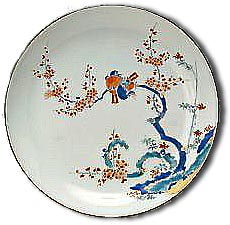
It was copied in the early european porcelain factories during the first half of the 18thC, especially at Meissen, Chantilly, Chelsea and Bow.
Only blue and white wares with no evidence of Kakiemon enamels have been unearthed at the known Kakiemon kiln site near Arita, suggesting that the enamelling was done elsewhere .
kakihan (japanese - artist mark)
Script mark of a Japanese artist (equivalent to the British monogram), which is used to identify Japanese metalwork, netsuke, ceramics and lacquer.
kaleidoscope (toys - optical)
Optical toy consisting of a tube containing mirrors and pieces of coloured glass or paper, popular during the 19thC. Changing patterns appear when the tube is rotated .
charles frederick kandler (silver - silversmtth - rococo - 1727-73)
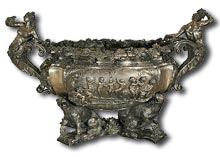
London silversmith, regarded as second only to Paul de lamerie.
Kandler made some highly decorated pieces such as wine coolers, tea kettles and tableware, in Rococo style; they typically had handles cast in the form of birds. Later, neoclassical designs were simpler.
johann joachim kandler (ceramic - modeller - meissen)
1706-75 German porcelain modeller responsible for the eminence of the meissen factory where he was chief modeller 1733-75. Kandler established the porcelain figure - both human and animal - as an art form and influenced figures produced at other German factories from the 18thC until the 20thC. His work was imitated throughout Europe .
kaolin (ceramic - chinese - clay)
Rocks that are rich in kaolinite are known as china clay or kaolin. Kaolinite is one of the most common minerals; it is mined, as kaolin, in Brazil .
kard (militaria - persian - knife)
Indo-Persian straight-bladed, single-edged knife, rather like a kitchen knife. It was carried in a wide scabbard covering much of the hilt .
kashira (kodugu)
The Menuki, Fuchi and Kashira are a way to decorate the Tsuka or sword handle and provide little functional value. They can be made from a wide variety of metals and horn. Good antique quality Kashira will use iron and gold.
katar (militaria - dagger - indian)
Pointed, double-edged Indian dagger with an H-shaped hilt which was gripped on the crossbar and used with a forward-thrusting action.
angelica kauffmann (designer - zucchi - robert adam)
1741 -1807 Swiss-born painter. Kauffmann lived in England (1766-81) before moving to Italy with her husband, artist Antonio zucchi. Her work included wall, ceiling and furniture designs for architect Robert Adam.
kenares (carpets - runner)
A term for long, narrow Oriental carpets made for export to the West from the 19thC. Those made in Persia (Iran) are known as kenares.
kendi (ceramic - drinking vessel - breast)
Globular ceramic or metal drinking vessel with a breast-shaped spout, made in the Far East. Chinese porcelain kendi were exported to the Middle East from the 15thC .
william kent (architect designer - palladian - inigo jones)
1684-1748 Painter, architect, designer and landscape gardener. Kent's buildings were inspired by the austere, Classical lines of palladian style architecture, which he had studied in Italy 1709-19, and influenced also by Inigo jones. Kent's house interiors, however, had a more ornate, baroque style and richly carved, architectural-style furniture, which formed part of a unified scheme. Kent was an acknowledged authority on taste in his own lifetime, and had a great influence on contemporary style .
kerr & binns (ceramics - worcester)
In 1852 Irishmen, Richard William Binns (1819-1900) and William Henry Kerr (1823-1879) took over the management of the Chamberlain & Co. porcelain works in Severn Street, Worcester.
The factory had been ravaged by fire and an extensive building programme took place in the 1850's. Modern machinery was purchased and installed and new working methods improved the quality of the product. See: Royal Worcester History
Watch which is wound by means of an attached key, a ribbed knob or button, rather than by a separate key. The keyless, or button-wound watch was first patented 1820 and much modified and improved during the 19thC, but not generally adopted in Britain until after 1880 .
kick (glass - mouth blown - indentation)
Indentation in the base of glass objects, designed to increase stability .
kidderminster (carpets - flat weave - british)
Key centre for carpet-making from the late 17thC. The Worcestershire factories initially produced flat-weave carpets, which were largely superseded in 1749 by hard-wearing moquette carpets. The town was the first British carpet centre to use the Jacquard loom in the early 19thC, and the industry continued to expand throughout the 19th and 20th centuries .
kilim (carpets - anatolia - bright colour)
A flat-weave rug. Technically, the word as used in the East refers only to 'slit-tapestry' weavings, so called because the weft is discontinued with each change of colour, creating slits. The word kilim is of Persian (Iranian) origin, but the rugs are mainly associated with Anatolia in central Turkey, although they are also made in the Caucasus -where they are known as palas - and elsewhere. Kilims are noted for bright, almost garish, colours and bold designs, often incorporating stylised animals and birds. 2 Kilim can also refer to the flat, woven fringe used to finish off the edges of a pile carpet .
kindjahl (militaria - sword - iran)
A double-edged sword or dagger of south-east Europe and Iran. The hilt tapers inwards from the shoulder to form the handgrip then broadens out again to provide a handstop; there is no crossguard.
kinji
Japanese term meaning 'ground gold', used for highly polished gold lacquer on furniture and other decorative objects. Powdered gold is painted or sprinkled onto a lacquered base and then covered with several layers of clear lacquer.
kaare klint (furniture - designer - 1888-1954)
Danish architect, furniture designer and academic who was largely responsible for the Europe-wide popularity of Scandinavian furniture in the 1920s and 30s.
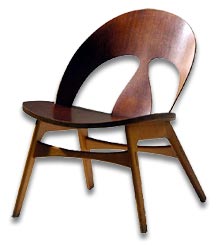
The influence that Kaare Klint had on Danish furniture design is difficult to overestimate. He was the primary force in the founding of the furniture school at the Royal Academy of Fine Arts in Copenhagen in 1924, and as a professor he shaped many of the young designers, most notably Poul Kjaerholm and Borge Mogensen.
Klint's first major work was a collaboration with the architect Carl Petersen. In 1914 they were commissioned to design furniture and fixtures for the Faaborg Art Museum. This resulted in, the well-known Faaborg Chair, a light and elegant piece with clear references to classical furniture.
The construction and proportions of an 18th century English chair are clearly visible his Red Chair, designed in 1927, but with its straight back, deprived of all unnecessary decoration and its beautiful Nigerien leather, the chair was nowhere close to being an imitation.
Other important works by Kaare Klint include The Propeller Stool, also from 1927. An easy chair designed in collaboration with his pupil Edvard Kindt-Larsen in 1930; The Safari Chair and “the Deck Chair” designed in 1933; and “The Church Chair” designed in 1936 for the Bethlehem Church in Copenhagen. Also worth mentioning is Klint’s well-proportioned cabinets and wardrobes, all made in solid Cuban mahogany.
klismos
A Classical chair style from ancient Greece with a shallow, concave backrest and slightly splayed legs. It was said to be the first chair which provided a comfortable, relaxed sitting position. The style
in Europe during the late 18th and early 18th centuries.
kneehole
A recess or opening to provide leg space, introduced to desks, dressing tables and bureaux in the late 17thC. The kneehole desk, introduced in the 18thC, is a desk made in one section with a central recessed cupboard below the frieze drawer and three drawers either side.
knock-down furniture
Term (often abbreviated to KD) used from the late 19thC for furniture that is readily dismantled or folded.
Knole Sofa
Upholstered sofa which transforms into a day bed when the arms are lowered on an iron ratchet. The Knole sofa dates from the early17thC, named after an example at Knole, Kent, and was much copied in Victorian times.
knop
Decorative knob of various shapes, and seen, for example, as part of the stem of a drinking glass or as a turned feature in furniture. When the knop forms an endpiece, as on a spoon handle, lid or chairback, it is known as a finial.
archibald knox
See Art Nouveau and Liberty & Co.
knuckle joint
Interlocking joint of wood used as a hinge on the brackets of drop-leaf tables.
knurling
A decorative edging seen particularly on late 19thC gold and silver. It is an irregular version of gadrooning with grooves cut at varying intervals to create an effect similar to oblong bead moulding.
kobako
Small, shallow Japanese lacquer box, sometimes with a tray, for storing incense, and similar in style, shape and decoration to a kogo.
kodansu
Japanese for 'small box-chest', describing a small lacquer cabinet containing a nest of drawers enclosed by a door for holding personal accessories. It often has engraved silver mounts.
kodogu
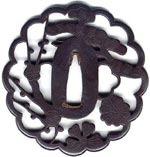
Japanese term for the metalwork and metal mountings on a sword.
Kodogu includes the tsuba (sword guard) , fuchi and kashira (terminals at the top and bottom of the hilt) , menuki (hilt ornaments) , kogai (skewer), mekugi (rivet securing the blade of a sword) and kogatana (utility knife).
The kozuka is the long, flat handle of the kogatana and sometimes refers to the knife itself.
kogo
Shallow, lidded, miniature Japanese box for storing incense (kogo means 'incense box'). Kogo are normally of wood covered with lacquer, but sometimes of ceramic or metal, and are of various shapes. They are usually highly decorated. Kogo first appeared in the 12thC for use at incense and tea ceremonies. Peak production was in the 19thC, when many were exported to the West.
kokeshi
Traditional wooden Japanese folk doll with a cylindrical body, round head and painted features. Dating from the 17thC, kokeshi are thought originally to have been mementos from healing springs,
kpm (ceramics, porcelain)
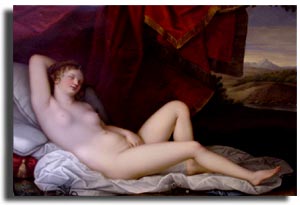
The term associated with Berlins royal porcelain factory - Königliche Porzellan Manufaktur.
The Royal Porcelain Factory in Berlin and has been making fine porcelain since 1750.
In 1763 the prussian king, Frederick the Great, gave the manufactory its name and distinguished trademark, the royal blue scepter.
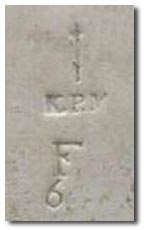
KPM has contributed to the artistic styles of the different periods and the name KPM is synonymous with quality antique porcelain as well as modern classics.
The first location for KPM was in the Neue Friedrichstraße and a little later in the Leipziger Straße, the location of todays city parliament. But it was only after Frederick the Great purchased the factory that the company was moved to its current location on Wegelystraße.
kraak porcelain
Is Chinese export porcelain typically from the 1580-1640's period. Kraak is the dutch term and the porcelain is usually decorated in underglaze blue. Kraak was later extensively imitated at the delft potteries.
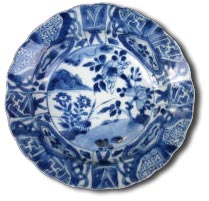
It is characterised by shapes related to metal and mostly in radiating panels. Kraak style occurred well into the 1700's during which period it was transformed into famille verte.
Kraak porcelain was introduced to the west by Portuguese traders who in the 16th century began to import late Ming dynasty blue-and-white porcelain into Europe. It is generally believed that the name "kraak" is taken from the Portuguese ships, called carracks, in which the porcelain was transported.
In 1602 and 1604 the two Portuguese ships the San Yago and the Santa Catarina, were captured by the Dutch, and their cargo which included thousands of porcelain pieces was promptly auctioned off in Holland to eager buyers including the Kings of England and of France. Consequently igniting the European mania for porcelain which lasted for 200 years.
The earliest occurrences of the term "Kraak" are from the mid 17th century and seems to have carried the meaning Chinese true porcelain as opposed to Dutch faiance. The trade in Kraak porcelain continued until the mid-17th century when civil wars, caused by the fall of the Ming dynasty in 1644, disrupted the Chinese supplies.
kris
A traditional dagger of Malaya and the East Indies. The blade is usually rough and either straight or serpentine, widening at the hilt; the grip is straight or acutely angled.
kufic script
Ancient Arabic writing, often used in a stylised form.
kukri
The national weapon of Nepal and the Gurkhas a traditional knife of Nepal, with a curved, broad blade. Those that were carried by Gurkha troops have a black leather scabbard containing two implements; one for use as a small knife, the other a sharpening steel
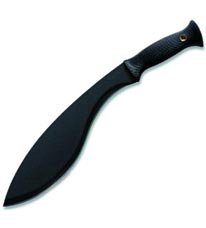
The oldest known Kukri appears to be one in the arsenal museum in Kathmandu, which belonged to Raja Drabya Shah, King of Gorkha, in 1627. However it is certain that the origins of the kukri go further back. There is one tenable story that Alexander’s horsemen carried the “Machaira”, the cavalry sword of the ancient Macedonians, in the fourth century BC during his invasion of north-west India. Its relationship with the kukri is plain. A third century sculpture, of which only a much later Greek copy exists, shows what is probably a Scythian prisoner of war laying down his arms and his weapon looks amazingly like a modern kukri
The kukri has somehow produced a fertile crop of myths and legends in the western world; and the most impossible amongst them are the most believed. First, that a kukri once drawn in whatever circumstances must taste blood before it is resheathed. Second, that a Gurkha, if he possibly can, will take careful aim through the symbolic “kaura” or notch and then hurl the weapon like a boomerang, snick off the enemy’s head and casually snatch the kukri out of the air as it returns. If the first of these were true no Gurkha would survive to adulthood: He would lose pints of blood every day as he chopped wood, sharpened a wooden peg, opened a tin of beans and slashed down encroaching undergrowth. After each task he would have to shed some of his own blood. The second fails to stand the test of a little thought, as much as anyone would hate to be in the path of a flung kukri, they would hate much more to oppose one in the hand of an angry Gurkha.
Not very different is the story (set variously in China, Italy, Burma and the North West Frontier) of the Gurkha coming suddenly on the enemy soldier. Naturally he struck first – the decapitating blow. “Yah, missed!” said the enemy. “Try shaking your head,” came the reply.
Alternatively, one true story is told by General Sir (later Field Marshal Viscount) W J Slim. - “Early in his command of the 14th Army he encouraged constant patrolling by all forward units. One Gurkha patrol on return presented themselves before their General, proudly opened a large basket, lifted from it three gory Japanese heads, and laid them on his table.
They then politely offered him a freshly caught fish for his dinner, which filled the rest of the basket.”
kurk
The name used in the carpet trade for the finest wool available for weaving carpets. It is shorn from the underbelly of sheep and is used to make extremely soft and fine carpets. The word is Armenian for 'wool'. It is most commonly used in the context of 19th and 20thC rugs from Kashan, a major weaving centre in Iran.
Kutani
Kutani means - nine valleys - and is the name of a village. Kutani is used as the name of the pottery and porcelain made at this location, with many small factories and trading shops, rather than just a single factory. The first porcelain from the Kutani village was produced in 1655, in the first year of the Myoreki epoch.
Kutani porcelain is a greyish, coarse-grain porcelain known for bold decoration, primarily in green and yellow augmented by blue and purple.
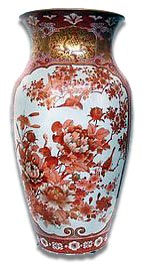
Japanese ceramic history states that stones suitable for porcelain making were found in the Kutani mine of the Daishoji Clan, where Lord Maeda Toshiharu sent Goto Saijiro to the Arita village in the Hizen province to learn how to make porcelain. Kutani Porcelains from this early period are called Ko-Kutani and this is extremely rare.
Around 1800 the Kutani kilns were restored in Kasugayama, Kanazawa City to make utilitarian porcelains, but after a few years the kiln was destroyed by fire. Around 1806-1820 Honda Sadakichi built new kilns in Wakasugi to revive the old style.
In 1823-1831 Yoshidaya Kilns were built in Daishoji at the site of Ko-Kutani to concentrate on commercial porcelain with printed designs. In the mid-1800s the Kutani name was again revived by a number of skilled craftsmen working in different styles of which Kutani Shoza (1816-1883), working with gaudy enamels and with gold brocade, might be the best known.
During the Meiji period (1868-1912) around 70 percent of production in the Shoza style was exported. Today this has increased to around 80 percent. Most of the Kutani porcelain we see today is the Shoza style and Yoshida Kiln export ware, dating from the early 19th century right up until today.
kwaart
A second, lead glaze added to tin-glaxed eartheware after decoration and firing. It was introduced on delft ware in the 17thC, to enhance the brightness of the colours and give a smooth, glassy finish. The idea was taken up by the British, at bristol for example, during the early 18thC, but with less striking results.
kyoto
Centre of Japanese ceramic production 1615-1868, noted particularly for enamelled and gilt pottery initiated by the 17thC potter Ninsei. Much satsuma ware of the meiji period (1868- 1912) was made or enamelled in Kyoto
Leave a Reply
You must be logged in to post a comment.