
Contents
Search the Antique Marks glossary for words, phrases and antique terms beginning with (N)

Here you will find antique terms and related words and meanings beginning with 'N' including descriptions, short histories and associated meanings.
Covering coin related terms like noble and glassmakers like Northwood as well as Japanese Netsuke and the great Doulton modeller Charles Noke.
nabeshima (ceramic - japanese - okawachi)
Japanese porcelain made at Okawachi, 5 miles north of Arita. Nabeshima is the name of a Japanese prince who founded the Nabeshima kilns at the end of the 17thC.
The porcelain was made as presentation ware for the local nobility and was of significantly higher quality than most of that exported to Western markets.
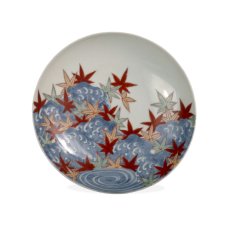
Most of Nabeshima porcelain made between the Enpou era (1673-1681) and around 1750 have been colored with four colors; red, blue, green, yellow, and the designs were adopted from plants or patterns on kimonos.
Nabeshima was characterised by sophisticated decoration and limited shapes, particularly in the first half of the 18thC. Much of the decoration was outlined in underglaze blue and filled with overglaze enamels. Thick celadon glazes, often combined with blue and white or enamelled designs, were also used.
nacre (jewellery - mother of pearl)
Nacre, also known as mother-of-pearl, is the basic substance which is secreted by oysters and mollusks to form the inside of their shells.
When nacre secretions are deposited around a foreign substance which has invaded the mollusk's body, they build up to form a pearl.
Nacre is composed of layers of calcium carbonate (in a crystalline form) and conchiolin (an organic protein substance which provides bonding).
The specific luster, iridescence, and coloring of nacre and, therefore, of any pearl which it forms depends on the number and thickness of the various layers, as well as on whether or not the layers overlap one another.
nails (furniture - country furniture - roman)
Hand-made nails were used particularly from Roman times for fixing hinges and locks before the advent of screws. They were also used concurrently with wooden dowels, for joining planks before the introduction of mortise and tenon joints, although they are seen on country furniture made well into the 18thC. Machine-made nails were made from the early 19thC.
nailsea glass (glass - flecked - bristol)
Bristol glassworks operating 1788-1873. It produced crown and sheet glass, bottles, household ware and flasks. The household wares were made in a pale green glass with no decoration. The flecked and festooned glassware, including jugs, carafes, rolling pins and flasks, which is often called Nailsea glass was almost certainly made elsewhere. see: Collecting Antique Glass | History of Antique Glass
namas (carpets - prayer rug - namazlyk)
Also known as namazlyk. See prayer rug.
nancy school (art nouveau - french - emile galle)
Late 19thC French art nouveau design group with a philosophy of combining art with nature, founded by French designer Emile Gallé. Members of the school included the sculptor, painter and designer Victor Prouvé (1858-1943), glass artists Auguste and Antonin daum, and metalworker and cabinetmaker Louis Majorelle .
nanking ware (ceramic - chinese - blue & white)
Traditional though misleading name given to blue and white chinese export porcelain made at Jingdezhen. The wares were shipped to Europe via the city of Nanking (Nanjing) during the 18th and early 19th centuries. They were usually decorated with Chinese landscapes and buildings, and sometimes with European-influenced borders .
nashiji (decoration - japanese lacquer )
Japanese lacquer technique developed in the early 19thC. Flecks of gold, silver, copper or metal alloys were evenly sprinkled between layers of clear or coloured lacquer, creating a speckled appearance similar to that of aventurine glass. (Nashiji is Japanese for 'pear-skin ground'.
john nash (architect - regency style - 1752-1835)
An architect whose building style epitomised regency taste.
naturalistic style (furniture - british - carved)
Term generally used to describe a British furniture style fashionable c. 1840-65. It was characterised by flowing curves and leaves and flowers elaborately carved in deep relief- as well as luxurious, informal, deep-cushioned chairs.
nautilus cup (silver - drinking cup - nautilus shell)
Drinking cup made from the snail-like nautilus seashell, with silver or silver-gilt mounts. The cups were made in the 16th and 17th centuries, primarily in Italy, Germany, Austria and the Netherlands, although some British examples do survive. They were intended for display rather than use. The mounts are usually decorated with figures and shapes associated with the sea, such as mermaids.
Rugs woven by the Navajo Indians in the south-west USA from the late 19thC. Early abstract designs were replaced by pictorial rugs in the early 20thC, but the 1930s saw a revival of traditional designs and the use of vegetable dyes. See: Antique Carpets & Tapestry
necessaire (boxes - case - travelling - shagreen)
Small case made of wood covered in leather or shagreen, or sometimes silver or enamel, designed to carry travel necessities, such as toiletries or sewing equipment. Necessaires were particularly popular in the 18thC and were also made in the 19thC .
needle painting (embroidery - silk - watercolour)
Silk and satin embroidered pictures painted with watercolour in parts and produced in quantity during the late 18th and early 19th centuries .
needlepoint (textile - lace)
see lace
nef (furniture - medieval - table ship)
Medieval table ornament in the shape of a fully rigged ship, usually made of silver set with precious stones or enamelled. It was used to hold a nobleman's or guest of honour's wine, eating utensils, or as a ceremonial salt container. The nef was much copied in silver during the 19thC .
nelme, anthony (silver - silversmith)
London silversmith c1722 who made articles such as candlesticks, teapots and pilgrim bottles, marked 'AN' or 'Ne'. His son Francis carried on the business.
neoclassical (style - greek - roman)
Style based on the decorative forms of ancient Greece and Rome which dominated design in architecture, furniture and ornamentation in late 18thC Europe. The architect Inigo Jones used Classical themes in the early 17thC, inspired by the work of Italian renaissance architect Andrea Palladio (see palladian). In the mid- 18thC the true Neoclassical period emerged in France - following the excavation of Pompeii - and proceeded to spread throughout Europe. In Britain architect-designer Robert Adam was the main proponent
netsuke (japanese - ornament - obi - inro)
Ornamental Japanese toggle worn at the waist above the obi or sash. A cord is passed through holes in the base from which was hung an inro or a pouch. See: Japanese Netsuke in The Antiques Shop
Netsuke were made from the 17thC in a wide variety of materials, but became redundant when the Japanese adopted Western dress in the 1870s.
Most take the form of figures, animals or plants but there are some variations: Manju (rice cake) resembles a bun - either solid or pierced.
- Ichiraku is made from woven or braided metal, rattan palm or bamboo, forming a basketwork box or gourd.
- Kagamibuta is a shallow bowl with a decorated metal lid.
- Sashi netsuke are rod-shaped, up to 5 in (12.5 cm) long, typically depicting an insect or animal perched on a twig or branch.
nevers
A leading French centre for making faience from the 16thC. The first pottery was founded by three Italian brothers and produced wares in the Italian maiolica tradition.
French styles with Chinese decoration date from the 17thC, with predominant colours of flat yellow, white, red and blue.
In the late 17thC the potteries were famous for bleu persan ware, with Persian-inspired designs in light colours on a dark blue background.
By the 18thC Nevers wares had been overtaken in popularity by those of Rouen and Moustiers.
In the late 18thC, before a number of potteries closed, they were the main suppliers of faience patriotique wares decorated with inscriptions and symbols of the French Revolution.
new sculpture movement
British movement c.1880-1910, concerned with naturalistic modelling, often in bronze, using the accurate lost-wax casting process.
newcastle glassware
Tyneside has been a major centre of glass-making since the 17thC, when a number of French and Italian craftsmen settled there, many of them skilled enamellers and engravers. Local manufacturers made large quantities of window glass, tablewares and ornaments, sometimes sending the products to Holland for decorating. During the 19thC Newcastle also produced pressed glass.
nickel silver
white alloy of nickel, copper and zinc commonly used as the base metal for electroplating. The result is called electroplated nickel silver (epns). Being a similar colour to silver, worn areas are less obvious than when copper is the base metal. Nickel silver was also marketed as German silver and argentan.
niello
Decorative technique on metal, often silver; an engraved design is filled with a black compound of sulphur and powdered copper, silver or lead and is fixed by heating.
night clock
A clock with pierced hour numerals and minute divisions which are illuminated when an oil lamp is placed behind the dial. Night clocks originated c. 1670, and are most common in Italy. A few were made in Britain before 1700. The clocks tended to catch fire and became obsolete after repeater mechanisms were invented in the late 17thC. See also projection clock.
noble
The standard gold coin of medieval England, showing the king in a ship. Its face value was originally 6s 8d (33.33p)-one-third of £1 The noble was struck in large quantities from 1350. In 1464 it was redesigned as a rose noble, or ryal and revalued at 10s (50p). The coin remained in circulation throughout the 15th and early 16th centuries.
nocturnal
A 16th and 17thC circular navigating instrument for use at night. The number of hours before or after midnight was measured by the difference between two pointers - one set to the date and hour on the instrument scale, the other directed at the pole star. Nocturnals are found in wood or brass; metal ones often have 'teeth' on the scale so the hours could be counted in the dark.
charles noke (ceramics - doulton - 1858-1941)
British ceramic artist and modeller at Doulton and art director 1914-36. In the late 19thC he introduced two types of earthenware - Holbein ware decorated with portraits, and Rembrandt ware decorated with coloured slip. See: Royal Doultons Charles Noke his life and work
john northwood (glass - 1836-1902)
English glass-maker who specialised in cameo glass. From the age of 12 he worked for a number of glass-making firms in and around stourbridge, Worcestershire, eventually founding his own company. He won a £1000 prize for his copy of the Portland vase, (a 1st Century Roman urn), in cameo glass. See: Collecting Northwood Glass
nottingham lace
Lace with a machine-made net ground and embroidered white decoration, often in two thicknesses of thread, made from the mid- 19thC.
nuremberg
Bavarian city that was a centre for German 16th- 18thC metal, ceramic and glass industries. The metal industry was noted for clocks, watches and scientific instruments, particularly weights, and for pewter with moulded bas-relief decoration. The city gave its name to the Nuremberg egg, a 16thC watch with a spring-driven movement which hung from a cord at the belt. Ceramic production in the 16thC centred mainly on Hafnerware stoves and tiles, and in the 18thC a wide range of tin-glazed earthenware. Glasswork included 17thC humpen-brightly coloured enamelled drinking vessels - and Schäpergläser, glasses decorated in black enamel which were named after their original designer, Johann Schaper (1621-70).
nursing chair
Mid- 19thC term for a single chair used for breast-feeding infants, with a seat only 13-15 in (33-38 cm) above the ground.
nymphenburg
Porcelain factory founded outside Munich in 1747, which moved to Nymphenburg, Bavaria in 1761.
Hard-paste porcelain was made from the beginning, but from 1757 its quality improved and it was used to make Rococo figures, including those modelled by Franz bustelli.
The Nymphenburg factory also produced veilleuses and tableware and specialised in the production of cane handles and small boxes.
During the late 18th and early 19th centuries Nymphenburg mainly produced busts, reliefs and Classical figures, and tableware in Sèvres Empire style. Early 20thC products include art nouveau tableware and figures
Leave a Reply
You must be logged in to post a comment.