
Contents

Including everything from palissy to pyrex and many more that you might find useful.
padouk (wood - andaman - fretwork - amboyna)
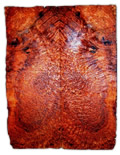
Hard, heavy wood, varying from golden-brown to crimson in colour with a darker figuring.
It was imported to Britain from the Andaman Islands in the Bay of Bengal and from Burma from the 18thC, and used for decorative woodwork such as fretwork, and occasionally for chairs. amboyna is a variety of padouk from the East Indies.
pair-cased (clocks & watches - watch - british)
A pocket watch with a glass-fronted inner case containing the movement, which fits into an outer metal case. Very widespread in the UK from c.1670 to 1830.
paisley pattern (decorative motif - boteh - cone or almond shape)
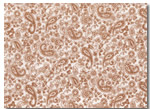
A cone or almond-shaped motif which originated in 17thC India, and is derived from the Oriental boteh. The name comes from Paisley, a Scottish cotton centre where shawls decorated with the motif were made in the 19thC .
paktong (chinese - white copper - bells & gongs)
Chinese for 'white copper' -the name given to a silvery-coloured alloy of copper, zinc and nickel. It was made in China from ancient times for money, hinges on furniture, domestic items and - because of its ringing quality - for bells and gongs. Although its export from China was illegal, some reached Britain in the 18thC; a similar alloy was made in Britain which led to the development of nickel silver.
bernard palissy (ceramic - potter - french renaissance)
French Renaissance potter whose distinctive designs in multicoloured, lead-glazed earthenware were extensively imitated in the latter 19thC. Busy natural history themes are most characteristic of Palissy's style - dishes and plates with reptiles, shells, fish and animals moulded in high relief on a pond-like ground, and blues, greens, browns and yellows as the predominant colours
palladian (style - venetian - andrea palladio - inigo jones)
Classical architectural style inspired by the 16thC Venetian architect Andrea Palladio, which influenced later furniture and interior decor styles throughout Europe.
The style was brought to Britain by architect Inigo Jones. Grand-scale architectural designs were translated into furniture and interiors by 18thC architect-designers such as William kent. Typical features are pediments and columns, and Classical motifs combined with baroque decoration, such as marbling and gilding.
sven palmqvist (glass - art glass - orrefors )
A designer, glassmaker working for Orrefors glass.
pandora (doll - french - model)
Early 19thC French doll used to model dresses and hair styles.
panel (furniture - frame - wood)
Flat surface set within a grooved framework as used in furniture or to cover a wall. It may sit proud of or flush with the frame.
Simon Pantin (metalware - silversmith - d1728)
London-based huguenot silversmith who produced dinner pieces for the aristocracy and much domestic silverware in Queen Anne style with traces of ornate Huguenot decoration.
pap-boat (metalware - silver - vessel)
Small, boat-shaped, silver or ceramic vessel used for feeding infants and invalids in the 18th and 19th centuries.
Paperweights (glass - decorative weight)
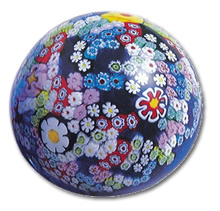
Small, heavy, decorative objects, usually of glass, but also of bronze or semiprecious stone, used to stop papers blowing away.
The earliest glass paperweights were made in Italy and bohemia c1843, but the most ornate and valuable examples were made in France at baccarat, clichy and st louis.
From 1848 they were produced at many British glassworks, the best being made by bacchus. see Paperweights for Sale
papier mache (furniture - material - paper)
Material made of a mixture of pulped paper, glue, chalk and sometimes sand, which is moulded, then baked and decorated to make ornaments and lightweight furniture.
It was first used in Europe in France during the 17thC the term is French for pulped paper and was developed and patented in Britain by Birmingham furniture maker Henry Clay c1772, then further developed in the early 19thC by the Birmingham firm of Jenners & Betteridge.
Clay produced small items such as tea trays and panels for tea caddies, as well as larger pieces of furniture. The papier mâché surface is ideal for painting or japanning and can also be inlaid with materials such as mother-of-pearl.
parcel gilt (metalware - silver - gilding)
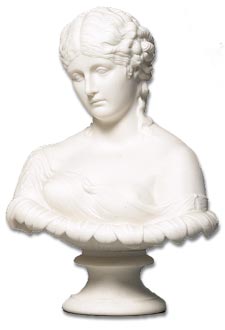
Term used to describe silverware or furniture, parts of which are gilded, such as areas of carved or moulded decoration.
parian (ceramic - marble imitation - porcelain)
Fine-grained, hard-paste white porcelain with marble-like appearance. The name comes from Paros, an Aegean island where Greek and Roman marble was mined. Parian ware was developed in Britain at either copeland or minton in the 1840s. It is usually unglazed and uncoloured and was used to make dolls' heads and slip-cast to make busts and figures.
Parisienne (toys and dolls - french - doll)
French fashion doll of the mid to late 19thC. Parisiennes are elegantly dressed, often with a wardrobe of clothing and exquisitely made miniature accessories.
parquetry (decoration - geometric - inlay
A form of marquetry with a balanced, geometric pattern.The designs rely on the contrasting grains or colours of different woods.
Oyster parquetry consists of small branches cut transversely to produce circles or ovals reminiscent of oyster shells, which are laid in rows.
Parquetry was used by British cabinet-makers from c1660, and was particularly fashionable in 18thC France and Italy.
Partners desk (furniture - desk for two)
Large flat-topped desk at which two people can work facing each other, made from the mid- 18thC. The desk has drawers and cupboards on each side and stands on two pedestals.
partridge wood (wood - parquetry - inlay)
Hard, dense, straight-grained wood from South America. Its name comes from the brown and red, feather-like pattern of its markings. 17thC cabinet-makers used the timber for parquetry and inlaid decoration; in the late 18thC it was used sparingly as a veneer.
parure (jewelery - matching set)
Matching set of jewellery, usually including a necklace, brooch, bracelet and earrings. Parures were first worn in the 16thC and came into vogue again in the 19thC.
Pashmina (textile - wool - carpets)
Literally little wool, used in the context of Oriental carpets for cashmere
The wool of the Kashmir goat in some 16th and 17thC Indian weavings.
paste (gemstone - cut glass - costume jewelery - ceramics)
Cut glass used to simulate gemstones in costume jewellery. Paste is usually colourless but may be tinted by a foil backing. Strass is a particularly fine-quality paste made with lead crystal. Paste is lighter in weight and more easily scratched than a true gemstone.
Also - The term used for the unfired mixture of clays and other substances used to make a ceramic body.
pastel (art - drawing - sketch - crayon)
A drawing or sketch executed in crayons made of ground colour pigments, chalk, water and gum. A fixative is necessary to seal the powdery pastel colours to the base material, which is usually paper.
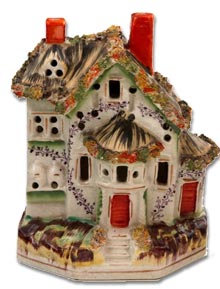
pastille burner (ceramic - vessel - aromatic)
Vessel for the burning of pastilles - tablets of aromatic infusions bound in gum arabic.
The burners have been known since Elizabethan times and were usually of silver until the 19thC.
In the 1830s and 40s, pottery and porcelain burners, often in the form of model buildings, were popular; the aromatic fumes escaped through chimneys and windows.
patch marks (ceramic - firing - Derby Porcelain)
Discoloured circles on the unglazed base of a porcelain figure where balls or pads of clay were placed during the firing to prevent dribbles of running glaze from cementing the figure to the kiln floor. Patch marks typically occur (in threes or fours) upon derby figures.
patchbox (militaria - ammunition - skin cover)
Storage compartment in a rifle butt for small cloth or leather patches used to wrap around the bullet to ensure its tight fit in the barrel, common on US and continental rifles of the 18th and 19th century.
Also - Small object of vertu, a box for holding the patches used in the 18thC to disguise spots on the skin.
pate (toys and dolls - dolls wig fixing)
The circular piece of cork, card or composition which covers the hole in the crown of a doll's head and to which the wig is usually fixed.
pate de verre (glass - layered - decoration)
Literally glass paste, a substance made from powdered glass, often coloured, mixed with water and a flux to help the ingredients to fuse.
The paste was applied to a mould in successive layers and fired, then sometimes carved when cool. The technique was perfected in France during the 19thC, the translucent glass being ideal for ornaments.
Patek Philippe (watchmaker - art deco - keyless)
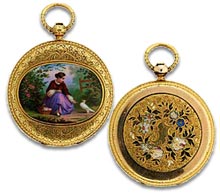
Swiss watchmaking company, established as a partnership between Polish watchmaker Antoine Patek and Frenchman Adrien Philippe c1844.
In the late 19thC the partnership replaced Abraham-Louis breguet as the most prestigious continental maker.
Patek Philippe is known particularly for its art deco designs of the 1930s, but also pioneered the first stem keyless-winding watch in the 1840s, and the first perpetual calendar wristwatch in 1925.
patent furniture (furniture - mechanical )
19th and 20th-century furniture with mechanical devices that adjust or transform the size or function of the piece - such as adjustable chairs and expanding tables. The furniture was often, but not invariably, made under official patents in Britain and the USA.
patera (decorative motif)
Small circular or oval ornament in low relief, usually resembling a flower or acanthus leaves.
pate-sur-pate (ceramics - decoration - slip - Sevres)
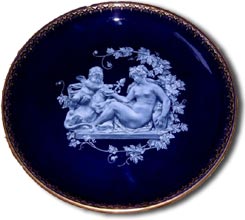
Literally translated as paste-on-paste. The process of building up layers of porcelain slip to give a translucent, three-dimensional effect in low relief.
The operation involves painting a thin wash of slip onto a coloured but unfired piece of porcelain. Subsequent layers, sometimes in different colours, are added when the earlier layers are dry, gradually, sometimes over weeks or months, building up a design in varying thicknesses and intensities.
The design can then be sharpened by engraving and the piece fired.
The technique was developed at Sevres c1850-75 and perfected by Minton c1870.
patina (furniture - metalware - aged finish)
The surface colour and finish built up by age, wear and polishing.
A patina on wood furniture shows depth and grain and helps indicate its age.
A patina on metals such as bronze or copper results naturally from oxidisation or can be artificially induced by chemical treatment.
pattern (coins - sample)
A sample coin made to evaluate its design.
pave (jewellery - setting)
The French word for paved, referring to a jewellery setting in which gemstones, typically in groups of seven, are set very close together like paving stones to hide the backing metal. The technique was popular in the late 18th and 19th centuries.
pear (wood - furniture - ebonised)
Pink to yellowish-white timber used in country furniture and often stained black (ebonised), as it takes a stain well. In the late 17th and early 18th centuries, pearwood was widely used for picture and mirror frames and cabinet stands.
pearl (jewellery - organic - nacre)
Pearls form when foreign particles are covered by organic tissue, called nacre, or mother-of-pearl, in the shells of certain molluscs.
A wild or true pearl occurs naturally, whereas a cultured pearl forms around an artificially implanted particle.
Pearls vary in colour according to the habitat of the mollusc, ranging from shades of pink to black. They are often named after the mollusc in which they were formed, as in clam or mussel pearls.
The finest pearls are Oriental pearls from the pearl oyster.
Pearls are classified according to their shape and lustre. The most valuable being spherical and drop-shaped specimens with a satin-like lustre.
Other valued pearls include the irregularly shaped baroque pearls, tiny seed pearls, and blister pearls which grow attached to the interior of the shell.
pearl satin-glass (glass - art glass - thomas webb)
Type of art glass with trapped-air decoration developed in both France and the USA in the late 19thC.
The glass has a pearly appearance and was sometimes decorated with acid engraving. It went under several names, including verre de soie, mother-of-pearl satin-glass and pearl ware.
A British version made by Thomas webb & sons and Stevens & Williams c1880 is known as quilted-cushion glass.
The molten glass was blown into a diamond-patterned mould. When cool the patterned glass was covered with a thin layer of clear glass to create an air space around each diamond. Finally the object was given a satin finish by treating it with hydrofluoric acid.
Pearline glass (glass - translucent - pressed)
Translucent, usually blue, pressed glass developed in Britain in 1889. It is seen mainly in ornamental wares and has raised opalescent decoration.
pearlware (ceramic - body -
See creamware.
Dagobert Pêche (designer - artist - wiener werkstatte)


Dagobert Peche studied in Vienna between 1908 and 1911. Starting with mechanical engineering at the Technical Institute, he switched to the Akademie der Bildenden Künste, where he studied architecture.
On completing his studies, Dagobert Peche designed carpets as well as china. Although his formal language at first revealed Baroque and Rococo influences, Dagobert Peche was soon keenly interested in standardising forms and the new possibilities afforded by industrial mass production of crafts objects.
In 1914 he showed work at the Deutscher Werkbund exhibition in Cologne.
In 1915 Dagobert Peche joined the Wiener Werkstätte. The Wiener Werkstätte had been founded in 1903 by Josef Hoffmann, Koloman Moser, and the banker Fritz Wärndorfer.
Moser had left the Wiener Werkstätte by 1907 and there was another upheaval in 1914, when Wärndorfer emigrated to the US. The Wiener Werkstätte found new financial backing from Otto Primavesi but by then it was no longer featuring such exclusive products.
In 1916 Dagobert Peche became a director of the Wiener Werkstätte. As one of its most creative exponents, Peched designed some three thousand objects, including china, furniture, book bindings, jewelry, fashions, textiles, and even Christmas tree decorations.
Until his death in 1923, Dagobert Peche continued to exert a strong pull on the designs produced by the Wiener Werkstätte. His work is typical of the rounded, more eclectic style predominating at the Wiener Werkstääte from 1915, which was directly opposed to the stringent geometry and clarity exemplified by the work of Josef Hoffmann and Koloman Moser.
Berta Zuckerkandl described Peche as, 'the greatest genius of ornament that Austria has possessed since the Baroque.
pedestal (furniture - stand - support)
A solid, moulded or carved support variously adapted to form stands for urns, sculptured figures, lamps and furniture.
pediment (furniture - curved gable - mount)
The triangular or curved gable surmounting the façade of a Classical-style building which has been much adapted in furniture design, especially in cabinets, bookcases and longcase clocks of the 18thC
pedometer (scientific - distance - measure)
Instrument for measuring walking distances used in the 19thC. The watch-like device was strapped to the leg and a weighted arm on a ratchet clicked up each step.
peep-show (toys and dolls - victorian - pictorial)
Optical toy popular in Victorian times. It is based on the camera obscura, usually in the form of a box containing a pictorial scene which is magnified by a small lens and viewed through an eyepiece when held up to the light.
Peep-shows could be large enough to be used by travelling showmen and viewed by four of their customers at a time, or small enough to be condensed into a peep-egg.
peg tankard (metalware - tankard - measure)
16thC tankard with a vertical row of pegs or studs inside to measure the contents.
Peg tankards are found in silver, silver-gilt or base metal. A few replicas were made at York in the 18thC.
peg wooden doll (toys and dolls - wooden doll - pegged limbs)
Small wooden doll of the 18th to late 19th centuries, with limbs pegged together at the joints for articulation.
William 'Quaker' Pegg (ceramic - artist - Derby - 1775-1851)
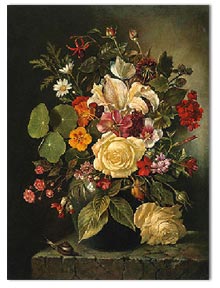
Porcelain painter responsible for some of the most lavishly decorated Derby ware of the early 19thC.
Large gilded urns, dessert services and tureens with richly coloured botanical designs often incorporating fruit, vegetables and insects were typical of his output.
Born near Newcastle under Lyme in 1775, the son of a gardener, William Pegg worked in a pottery from the age of 10 and by the age of thirteen was already an accomplished self taught flower painter on earthenware bodies.
He was employed at Derby from 1796-1800 and again from 1813-17; his first and second periods. read more
Peking enamel (decoration - high quality - copper)
Finely painted enamel on copper made for Imperial use, akin to canton enamel but of far higher quality.
Apsley Pellatt (glass maker - medallions - sulphides - 1791-1863)
English glass-maker based in Southwark, South London,
In 1819 introduced the French process of embedding ceramic medallions in clear glass (sulphides).
In 1831 and 1845 Pellatt patented methods of producing pressed glass.
In 1850 he revived the early Venetian process of making ice glass.
During his career Pellatt published a number of books about glass-making.
Pembroke table (furniture - table - countess of pembroke)
Small, light table said to have been introduced by the Countess of Pembroke (1737-1831) in the second half of the 18thC, with two drop leaves and one or more drawers set beneath the centre section.
Pembroke tables were used as ladies breakfast or writing tables.
They were often reproduced in the sheraton style during the late Victorian and Edwardian periods.
pendulum (clocks and watches - weight driven - Huygens - Fromanteel)
A rod with a heavy metal weight, or bob, attached to the end that swings under the influence of gravity and has a naturally isochronous motion or beat.
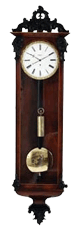
In a clock, the pendulum is linked to an escapement mechanism to regulate the action of the going train. The going train, in turn, gives an impulse to the pendulum on each swing, so maintaining its movement.
The pendulums potential was first recognised by Italian astronomer Galileo Galilei in the 16thC, supposedly as he watched a chandelier swinging in Pisa Cathedral. In 1657, it successfully used to regulate a clock by the Dutchman Christian Huygens.
The first British clock-maker to make pendulum clocks was John Fromanteel c1659.
The regulating capacity of the pendulum provided a breakthrough in accurate timekeeping. However, simple pendulums were also vulnerable to temperature changes; they shorten and beat more quickly when cold and lengthen and beat more slowly when warm.
An effective solution was provided by the incorporation of various temperature compensation devices. The two most common forms, both introduced in the 1720s, are George Grahams mercury pendulum and John Harrisons gridiron pendulum with the rod composed of alternating brass and steel.
Both work on the counterbalancing effect of the differing rates of expansion of different metals in opposing directions. At the beginning of the 20thC, Charles Edouard Guillaume introduced the nickel-steel Invar pendulum which isn't affected by temperature.
penny (coins - denarius - d)
Originally a standard silver coin used in medieval England which was derived from the Roman denarius hence the pre-decimalisation abbreviation 'd'.
Early pennies were sometimes cut in half or quarters to make halfpennies and fourthlings, or farthings, although these later became round coins in their own right.
The first copper pennies were minted in 1797.
penwork (furniture - decoration - wood boxes - fans)
A late 18th to early 19th-century style of decoration on furniture, boxes, fans and other wooden objects.
Black ink was used on pale wood such as pine or satinwood, and flowers, scrolls, arabesques or designs drawn on with a fine quill pen and protected by varnishing.
Chinoiserie penwork patterns are common on regency furniture.
pepperbox (militaria - revolver)
An early form of revolver which has a barrel block with several chambers. Both flintlock and percussion pepperboxes were made in the 18th and 19th centuries.
Charles Percier (architect - designer - French - 1764-1838)
Charles Percier together with Fontaine Pierre-François-Leonard (1762-1853) were French architects, interior decorators and designers of furniture, silverware and textiles.
They were leading architects to Napoleon I from the turn of the century until 1814 and largely responsible for creating the Classical empire style.
Their elegant furniture designs were regularly constructed by cabinet-maker Georges jacob from 1791.
percussion lock (militaria - gun - cap and ball)
A type of gun mechanism introduced in the early 19thC.
A small amount of explosive powder enclosed in a metal cap fits over a nipple in the breech and is detonated by being struck by the hammer when the trigger is pressed. This sends a burst of flame into the powder charge, which explodes and propels the bullet from the barrel.
An alternative name for a percussion-lock weapon is cap and ball.
Michelangelo Pergolesi , (engaver - designer - italian - d1801)
Italian-born engraver, decorative artist and designer. He lived in Britain for the last quarter of the 18thC, working with architect Robert Adam.
peridot (gemstone - faceted )
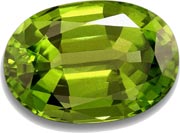
A gem ranging in colour from dark green to yellow-green. Peridots are usually faceted or polished and sometimes confused with emeralds and green corundums.
period (time - style )
Belonging to a particular time. ie, A Sheraton period table dates from Sheratons time but a Sheraton style table is a later piece made in the style of Sheraton.
Persian knot
See carpet knots.
perspective glass (scientific - telescope - 17thC)
A small hand-held telescope which was made for popular use during the 17thC.
petit feu (ceramic - muffle kiln - enamel)
Low-temperature firing of ceramics in a muffle kiln. A small, inner kiln, rather like an enclosed box within a main kiln that allows enamel colours to be fixed onto glazed pottery or porcelain.
petit point (textile - embroidery - stitch)
A very fine, small, diagonal embroidery stitch usually on a canvas ground.
pew group (ceramic - salt glaze - staffordshire - figure group)
Staffordshire salt-glazed stoneware or glazed earthenware group of two or three figures, sometimes playing musical instruments, seated on a church pew or high-backed bench.
Pew groups were produced in the 18thC and reproduced in the 19th and 20th centuries. See staffordshire potteries.
pewter (metalware - alloy - tin )
Alloy made from tin, with hardening agents such as lead, copper and more rarely antimony, added.
New pewter is silvery in colour, becoming grey as it oxidises, and eventually turning almost black.
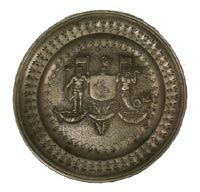
Quality pewter contains mainly tin and little lead.
English pieces made before the 17thC show little decoration. Lower grades of pewter were used for tavern ware and spoons. Before 1503, English pewter was marked with a guild mark either a hammer or crowned hammer, and later a rose or crowned rose. After 1503 the London Guild required individual makers marks.
Early examples of makers marks are simple initials, but from c 1600 these were placed in a circle, often beaded.
17thC marks are often pictorial, while 18thC examples are larger and more complex.
Over 6000 marks have been recorded on English pewter.
European marking systems include a town mark, a makers mark and a quality mark.
phenakistoscope (toys and dolls - magic disk - mirror)
A 19thC optical toy, also known as a magic disk or fantascope. Illustrated circular cards are fixed onto a disc with slits at intervals around its circumference.
A handle is fixed to the centre of the disc, and the disc is spun. The user looks through the slits at a mirror where the image is reflected and appears to be moving.
phonograph (scientific - recording - wax cylinder)
Early machine for recording and reproducing sound, using a wax cylinder. It was invented 1878 by Thomas Edison in the USA. See gramophone.
Duncan Phyfe (furninture - cabinetmaker - 1768-1854)
Leading US cabinet-maker. His furniture was beautifully made from the finest woods, usually based on designs from the pattern books of British cabinet-makers Thomas sheraton and Thomas hope.
Piano babies (ceramic - bisque porcelain)
Piano babies are bisque dolls made in Germany from c1910 and designed to sit or lie on a piano.
piano dolls (wood - ornament - mobile - spinet)
Miniature painted wooden dolls made in Germany c1800-1940, designed to dance on a piano or similar instrument.
The dolls actually stand on supports of wire or bristle, between which the real legs are suspended, the feet not quite coming into contact with the surface.
When the piano is played, the vibrations cause the figures to move as if dancing. They are also known as spinet dolls, bristle dolls and harpsichord dolls.
Pablo Picasso (artist - ceramic - painting - 1881-1973)
Spanish-born artist whose highly individual style greatly influenced 20th century European art and ceramics.
Picasso began his prolific ceramic work in 1947 in the Madoura pottery at Vallauris in southern France. Many of the his hand-modelled and hand-painted originals were replicated at the pottery and sold in limited editions.
Pablo Picasso was born on October 25, 1881, in Málaga, Spain. The son of an academic painter, José Ruiz Blasco, he began to draw at an early age. In 1895 the family moved to Barcelona, and Picasso studied there at La Lonja, the academy of fine arts. His visit to Horta de Ebro from 1898 to 1899 and his association with the group at the café Els Quatre Gats in about 1899 were crucial to his early
artistic development.
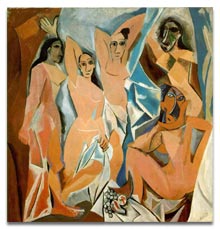
Picasso’s first exhibition took place in Barcelona in 1900, and that autumn he went to Paris for the first of several stays. Picasso settled in Paris in April 1904, and his circle of friends soon included Guillaume Apollinaire, Max Jacob, Gertrude and Leo Stein, as well as two dealers, Ambroise Vollard and Berthe Weill.
His style developed from the Blue Period (1901–04) to the Rose Period (1905) to the pivotal work Les Demoiselles d’Avignon (1907), and the subsequent evolution of Cubism from an Analytic phase (ca. 1908–11) to his Synthetic phase (beginning in 1912–13). Picasso’s collaboration on ballet and theatrical productions began in 1916.
His work was soon characterized by neoclassicism and a renewed interest in drawing and figural representation. In the 1920s the artist and his wife, Olga (whom he had married in 1918), continued to live in Paris, to travel frequently, and to spend their summers at the beach.
From 1925 to the 1930s Picasso was involved to a certain degree with the Surrealists, and from the fall of 1931 he was especially interested in making sculpture. In 1932, with large exhibitions at the Galeries Georges Petit, Paris, and the Kunsthaus Zürich, and the publication of the first volume of Christian Zervos’s catalogue raisonné, Picasso’s fame increased.
By 1936 the Spanish Civil War had profoundly affected Picasso, the expression of which culminated in his painting Guernica (1937, Museo Nacional Centro de Arte Reina Sofía, Madrid). Picasso’s association with the Communist Party began in 1944.
From the late 1940s he lived in the south of France.
Among the enormous number of exhibitions that were held during the artist’s lifetime, those at the Museum of Modern Art, New York, in 1939 and the Musée des Arts Décoratifs, Paris, in 1955 were most significant.
In 1961 the artist married Jacqueline Roque, and they moved to Mougins. There Picasso continued his prolific work in painting, drawing, prints, ceramics, and sculpture until his death on April 8, 1973.
pickelhaube (militaria - helmet - spiked)
A spiked helmet worn by German troops, introduced in the early 19thC and copied elsewhere.
pickled furniture (furniture - stripped - ash - pine)
Wooden furniture that has been stripped of paint using a coating of lime to reveal the plaster base coat beneath, resulting in a pale, white-veined finish. The process, used in the 20thC, is usually applied to furniture made of light-coloured woods such as ash or pine.
picture clock (clocks and watches - picture with working clock inset)
A framed picture in which a working clock face is incorporated - into a church tower or town hall for example. Some examples are linked to a musical movement or chime. Picture clocks were popular in the 19thC, and were mainly produced in continental Europe.
picture-back (metalware - teaspoon - decorated bowl)
A type of teaspoon mass-produced from sheet metal from 1740 to the end of the century, with fancy motifs stamped on the underside of the bowl. The spoons are Old English or Hanoverian in style (see cutlery) and motifs ranged from Rococo shells to flowers, birds, or politically inspired symbols of Liberty or Empire.
picture-frame clock (clocks and watches - wall clock - gilt border)
An Austrian or French beidermeier wall clock, dating from the second quarter of the 19thC. The enamel dial has a gilt surround set within a gilt border like a picture frame.
pieces of eight (coins - spanish - eight reales)
Large silver coins struck throughout the Spanish Empire from the 15thC with a face value of eight reales, the standard Spanish unit of currency of the time. Together with the gold doubloon, they featured importantly in international trade and pirate treasure.
piecrust (furniture - sliverware - decoration)
A scalloped decorative rim reminiscent of the crimped edges of a pie, which was popular on furniture and silverware (when it is known as a Chippendale rim) in the mid- 18thC, and much reproduced in the 19thC.
piefort (coins - commemorative)
A coin deliberately struck on an unusually thick blank, often as a collector's or commemorative piece rather than for general circulation.
pierced decoration (decorative style - openwork - fretwork - lacework - reticulated)
Intricate decoration made by cutting shapes through a solid surface such as metal, wood or ceramics to form a pattern.
In ceramics, the clay body is pierced or reticulated before firing.
Pierced decoration known as devil's work was practised in China by the 16thC and is a feature of some late 18thC British creamware. It was revived in a very intricate form by the Royal worcester factory in the 188os, notably by George Owen.
Piercing on silver is done by hand with a fine saw or by die-stamping. It can be practical as in sugar casters or potpourris, as well as decorative as in an outer casing for a cup or jug.
pietra dura (stone - semi-precious - mosaic)
Italian for hard stone, which has come to apply specifically to a mosaic of semiprecious stones and different coloured marbles used to create a patterned surface.
Pietra dura is built up piece by piece, each sliver of stone intricately cut and then glued edge to edge with the next, then laid on a backing stone such as slate.
It can take days for a fine wire-bladed bow saw to cut through some harder stones such as jasper and agate.
The finished surface is highly polished and used to decorate cabinets and table tops.
Pietra dura is also known as Florentine mosaic.
piggin (vessel - dipper - milk - cream)
A small, glass, silver or ceramic bucket-shaped container about 2-4in (50-100mm) high and used as a dipper for transferring milk or cream from a larger container known as a cream pail in the 18thC.
pilaster (architectural - decoration - column)
A flattened, rectangular in section, classical column topped by a moulded or sculptured capital.
Pilasters appear on chests, cupboards and chimney pieces of the 16th and 17th centuries. On cabinet-work throughout the 18th and early 19th centuries and as the tapering pilaster leg in furniture.
pile (carpets - pile / coins - obverse)
Raised, upper surface of carpeting or other textile such as velvet, also known as the nap, and made either by teasing or combing a woven surface, or by shearing looped ends that are woven or knotted into a fabric.
Also - The obverse die in coin-making.
pilgrim bottle (vessel - hanging - costrel - moon flask)
A flattened, spherical or pear-shaped vessel with loops on either side of the neck to which a chain is attached so that it could be hung from a belt.
The ceramic pilgrim-bottle shape was known in ancient China as well as in medieval Europe.
In both cases the form reflects original leather and metal shapes with no foot-rim, which were designed to sling from a saddle.
The bottles are also known as costrels, and Chinese versions as moon flasks.
Decorative pilgrim's bottles have been made since the 16thC, including elaborate embossed silver examples and similarly shaped scent bottles in the 18thC.
Pilkingtons Royal Lancastrian (ceramic - pottery - maker)
Pottery, established near Manchester in 1892 by the Pilkington family, who also owned coal mines and glass-houses.
The pottery initially manufactured tiles and, later, other ceramics, developing an innovative, hard, transparent glaze and lustre finishes.
Large-scale production began in 1903 and from 1913 the wares were known as Royal Lancastrian.
The pottery closed in 1957.
pillar carpet (carpet - pillar - column)
Chinese carpet without a border made from the mid-18thC to fit around a pillar or column, giving a continuous pattern.
Pinchbeck (metalware - alloy - rolled gold)
Alloy of zinc and copper that resembles gold. Often confused with rolled gold.
Invented by Christopher Pinchbeck, a watch and clock-maker, in London c1720.
It was used for many inexpensive items, such as watch-cases, snuffboxes, seals and clasps, but was superseded by gilded metal, rolled gold and 9 carat gold.
pine (wood - softwood - furniture)
General term for a family of coniferous softwoods widely used in furniture-making.
The wood is straw coloured to pale red-brown and often prominently grained.
Highly valued in the 16thC, particularly because of the wide planks which could be produced from it. The timber's smooth surface later led to its use as a base for gilding.
Its wide planks also made pine seem suitable for the carcasses of veneered furniture and it was cheaper than oak but tended to warp over time.
During the 19thC, pine was widely used to produce cheap, often painted, furniture.
pinion (clocks and watches - mechanism)
Small cog in clock mechanism which transmits the driving force to the next wheel in the train.
pipe stopper (tobacciana - pipe smoking)
An instrument with a flattened, circular end, and often an ornate handle, for compressing burning tobacco into a pipe bowl.
Pipe stoppers were popular in the 19thC and were made in a variety of materials, especially copper, brass, and hand-carved wood and ivory.
The handles often feature a grotesque bird or animal, or a human caricature.
pipkin (vessel - saucepan - silver)
Small, silver saucepan with a bellied, pear-shaped or cylindrical body, used since the 17hC for warming beverages.
The pipkin usually has a long, straight handle at right angles to a pouring lip or spout, and was occasionally accompanied by a spirit burner and stand.
Large examples can have hinged covers.
Most surviving pipkins are from the 18thC.
Brandy saucepans are small versions used to warm brandy.
Piqué (decoration - gold - silver - flawed diamond)
Inlaid decoration of fragments of gold and silver in tortoiseshell or ivory boxes, fans, buttons and jewellery.
Piqué was introduced in Italy in the mid-17thC.
In Britain, Matthew boulton mechanised the technique during the 1760s. It was revived by art deco craftsmen in the 1920s.
Piqué point is composed of tiny points of metal.
Piqué cloute has larger points arranged in a pattern.
Piqué pose has flakes of gold or silver.
In piqué d'or minute gold figures and ornaments are set into tortoiseshell.
Also - A piqué diamond is a flawed stone, containing inclusions which appear as spots sometimes visible to the naked eye.
pistol (militaria )
Small, hand-held firearm, introduced in the 16thC.
Benedetto Pistrucci (coins - artists - engraver - 1784-1855)
Italian gem engraver who produced superb coin designs for the British Royal Mint in the early 19thC. His St George and the dragon design is still used on modern sovereigns.
plane (wood - close grain - furniture)
A white, close-grained and tough timber often used by late 18th and early 19thC cabinet-makers as a substitute for beech, especially for the production of painted chairs and the underframing of card tables and pembroke tables.
planishing (metalware - smoothing - polishing)
Process of toughening, smoothing and polishing metal by hammering it with a broad, smooth-faced hammer. Planishing removes marks made by any previous shaping of the piece and ensures uniform thickness of the metal.
plaque (ceramic - porcelain - panel)
Ceramic panel with relief or painted decoration for walls or furniture. A tableau is a large, painted porcelain plaque with an integral frame.
plastic (toys and dolls - celluloid - bakelite)
Not normally asscoiated with the term antique, plastic is a man-made substance which can be moulded under heat and pressure and then hardens on cooling.
The first usable plastic, celluloid, was developed in the USA c1863, and used for making dolls heads and bodies and also in both the USA and in Europe for various objects such as combs and cutlery handles, but it was brittle and highly inflammable.
Celluloid is plant fibre treated with alcohol which is combined with other ingredients and compressed hydraulically, then moulded into shape by steam or hot air.
The first completely synthetic and relatively efficient plastic was bakelite, patented in 1907.
In the 1930s, PVC, polystyrene, acrylic and nylon were adapted to textiles and a wide range of useful wares.
In 1942, Earl Tupper introduced cheap plastic domestic ware in the USA.
In the 1960s plastics became widely used for furniture.
plate (metalware - gold - silver )
A term for articles made of gold or silver for ceremonial use, particularly in church, or for domestic purposes.
Not to be confused with silver or gold-plated wares such as sheffield plate and electroplate.
plate armour (militaria - hand beaten - protection)
Overlapping metal plates, usually hand-beaten and joined by rivets or leather straps, worn as protection against weapons.
plate bucket (furniture - pail )
A straight-sided, metal-hooped wooden pail, sometimes with a lining of metal, and about 1 -1½ft (30-45 cm) deep.
The buckets were used for carrying dirty plates from the dining room and have a vertical slot to allow easy removal of the contents.
Sometimes the slot was later blocked up so that the pail could be used as a wastepaper basket.
plate camera (scientific - imagery)
A camera which records an image on a light-sensitive plate of glass
plateau (furniture - stand - support)
Oval or circular plate or stand made of silver with a reflective glass or mirror surface, which was used as a platform for an epergne, candelabrum or other elaborate table-centre decoration in the late 18th and 19th centuries.
plate-warmer (furniture - support )
Metal or wooden stand for holding plates before an open fire, used in the 18th and 19th centuries. Plate-warmers vary in shape but often form a tripod. One type, known as a cat, comprises three crossed rods.
platinum (metalware - rare - precious - jewellery)
Valuable, rare and untarnishable, silvery-white metal-harder, stronger and with a higher melting point than gold.
Platinum was first used to make jewellery in South America from the 15thC, both in its pure form and mixed with gold.
It only appeared in Europe as a decorative medium in the mid-19thC when the oxy-hydrogen blowpipe made it possible to melt the metal for crafting.
It is often used in settings for diamonds or other stones, either pure or in the form of an alloy, usually with iridium.
Hallmarked platinum, must be at least 95 per cent platinum.
jan plichta (ceramic - wholesaler - wemyss)
Jan Plichta was a Czech who emigrated to England in the early 1900's and set up as an exporter and wholesaler of glass and pottery. He worked from the flat above his small warehouse at 37 Store Street, Bedford Square, London.
Plichta was a wholesaler and not a manufacturer or decorater of pottery.
From the end of the war he became one of the Bovey Pottery's best customers and had his name marked on Wemyss wares that he ordered from them
Plichta items from the Bovey Pottery were marked ‘Plichta', ‘Plichta, London, England' or ‘Plichta, London, Made in England' applied by stamp under the glaze.
Plique-à-jour (jewellery - decoration - enamel)
A technique similar to cloisonné enamelling that produces a translucent stained-glass effect.
Wire is soldered onto a metal base, or former, to form cells which are then filled with translucent enamel colours. After firing, the base is dissolved away to leave a coloured, glass-like shell.
Until the 19thC, the method was mainly used in Russia and Scandinavia, for ornamental tableware, but in the late 19thC it became popular with French and British jewellers, especially those working in the art nouveau style.
The Japanese developed a similar technique for vases and bowls c1900 using molten glass instead of enamels.
plum (wood - fruitwood - country furniture)
Hard, heavy, yellow to brown fruitwood used for the turned work on 16th and 17thC country furniture and inlaid decoration.
plumbago ( art - miniature -
A type of miniature popular in the late 17thC which was drawn in plumbago or graphite, the soft steel-grey or black form of carbon used in lead pencils.
Plumbagos are usually larger than other portrait miniatures, around 4-6in (10-15cm) high as opposed to 2-3in (50-75mm).
plush (textile - fabric - poor mans velvet)
Fabric similar to velvet but coarser and with a longer pile, sometimes called poor mans velvet.
Used for upholstery since at least the 18thC, but in the 19thC was especially popular for table coverings and curtains.
High-grade plush was woven from silk, cotton or a combination of both.
In the 20thC plush was used for teddy-bear fur.
Plymouth (ceramic - hard paste porcelain)
The Devon town where, in 1768, Britain's first hard-paste porcelain was made by pottery owner William cookworthy. Production was moved to bristol two years later.
plywood (wood - composite - layered - bentwood)
Wood composite made of at least three layers, or plies, of wood veneer glued together under pressure.
The grain of each sheet is laid at right angles to that of the layers above and beneath to increase strength and prevent warping.
Plywood was used in 18thC furniture-making, but its potential was only fully explored by beidermeier craftsmen and the Vienna furniture-maker Thonet in the 19thC for making bentwood furniture.
During the 1920s and 30s plywood became a natural look alternative or addition to tubular steel, and was used by designers such as Alvar Aalto, Gerrit Rietveld and Marcel Breuer.
pocket watch (clocks and watches -
General term for a portable timekeeper carried in the pocket. First made in the mid to late 16thC.
Earlier watches had been worn on a chain hanging around the neck.
Pocket watches were replaced by wristwatches from the 1920s.
Pointille (decorative technique - book binding)
Technique for decorating leather with impressed gold dots used in bookbinding from the 17thC.
poker work (wood - decoration - burning )
Means of decorating woodwork, using a hot tool to burn patterns into a surface, practised since at least the early 17thC in Italy. It was particularly popular during the Victorian period in Britain and during the arts and crafts movement which encouraged home crafts. It also appears on cottage-style furniture of the early 20thC.
pole screen (furniture - screen - shield from heat)
A small adjustable screen mounted on a pole designed to shield a lady's face from the heat of the fire.
Another type of adjustable pole screen is the banner screen, with a panel of needlework or painted wood hanging from a horizontal bar which can be raised or lowered on a vertical pole of wood or metal.
A writing firescreen combines writing table and firescreen. Some are in the form of a slim writing desk with a drop front above a cupboard, and supported on raised feet so that the furniture piece itself formed the screen; a gap at floor level allowed heat to reach the writer's feet.
A simpler version is a table fitted with a sliding screen of pleated silk at the back.
polearms (militaria - pike - spear - halberd)
Long-staffed weapons with a blade used for cutting or thrusting. They include the earliest spears and pikes, the half-moon-bladed gisarme used until the 1500s, the partisan, with its long, tapered blade, used from the mid-14thC, the halberd, glaive and poleaxe or ravensbill.
Polearms became redundant on the battlefield with the advent of gunpowder, but many survived as parade arms and emblems of rank.
The spontoon was carried by British Royal Artillery sergeants until 1845, the boarding pike was used by navies until the early 20thC.
Halberds and partisans are still carried today by the Yeoman Wardens of the Tower of London, and the Swiss Guards of the Vatican.
pomander (vessel - aromatic container)
Small, spherical or apple-shaped container with a pierced lid used to carry aromatic herbs. Pomanders were originally worn around the neck or wrist as a means of guarding against odours, and have been known by this name since the 16thC. See also vinaigrette.
Pomona glass (glass - art glass - engraved)
Frosted art glass developed in 1885 in the USA. Clear glass was blown into a mould and when the object cooled the surface was acid-engraved to create the frosted appearance. The surface was then stained amber or rose and decorated with painted fruits and flowers. Pomona glass is mainly seen in the form of decorative tablewares.
Gio Ponti (designer - architect - domus - 1891-1979)
Italian designer-architect and founder of the Italian architecture and design magazine Domus (1927).
Ponti designed furniture, notably his Superleggera chair which became a familiar sight in Italian restaurants.
The designer is also known for his art deco style ceramics and silverware, and light domestic goods ranging from door handles to coffee machines and cutlery and bathroom fittings. more
pontil (glass - hand blown - tool)
The iron rod the glass maker uses to attached the molten glass for the final stages of shaping.
pontil mark (glass - hand blown - tool mark)
Circular mark on the bottom of a glass object left by the pontil, the iron rod to which the glass is attached for the final stages of shaping. See: Collecting Antique Glass & History of Antique Glass
On early glassware the mark was left rough, or pushed upwards to make a kick, but this was also done on forgeries.
A pontil mark or punty, does not provide definitive proof that a glass object was handmade, as it is sometimes seen on some pressed glass.
Pontypool ware (metalware - ironware - japanned - allgood)
18thC tin-plated ironware with a japanned finish.
The objects, which include trays, vases and boxes, are richly decorated with flowers or country scenes and gilding.
Thomas Allgood and his sons produced the ware at Pontypool, South Wales, using a coal-based varnish and applying it in many coats with firing between each. A long process that made the products expensive.
Similar but lower-quality items made in Birmingham and elsewhere are often wrongly called Pontypool ware.
Poole Pottery (ceramic - art pottery - stabler adams)
Art pottery studio in Poole, Dorset, producing hand-decorated earthenware and stoneware, established 1921.
Poole Pottery was founded by potters John and Truda Adams, designer Harold Stabler and ornamental pottery manufacturer Owen Carter of the Dorset tile company Carter & Co. See: Collecting Poole Pottery
poplar (wood - close grained - inlay - marquetry)
A hardwood produced by a genus of trees native to Britain. It is creamy-white to yellow or grey in colour with a close grain. It is liable to shrinkage and unsuitable for cabinet-work, but is seen in late 16th and early 17thC inlaid decoration and in some late 17thC marquetry.
poplin (textile - furnishings - avignon france - papeline)
Plain style of woven fabric, used for soft furnishings, in which the weft passes in turn under and over the warp, as in darning. However, the wefts are fewer and thicker than the warps, giving the fabric a ribbed finish.
Any type or mix of yarn, wool, silk, cotton, for example can be woven in this way, but the original had silk warp and wool weft and was made at Avignon in France, which for a time was the seat of popes (1377-1408), hence its original name papeline (papal).
porcelain (ceramic - hard paste - soft paste)
True or hard-paste porcelain is a white, translucent material, non-porous, strong and heat-resistant. The secret of its manufacture lies in the essential ingredients of china clay and china stone particles which fuse at high temperatures, binding the clay into an impermeable paste.
Hard-paste porcelain was produced in China from about the 8thC, but not achieved in the West until the 18thC as the ingredients were unknown. Meissen was the first European factory to succeed, c1708, and by the middle of the century Austrian, Italian and other German factories were also in production, using German clay.
The first British hard-paste porcelain was made at plymouth in 1768, following the discovery of Cornish china clay.
True porcelain cannot be marked easily with a file; its glaze is thin, and enamelled colours can be felt slightly above the surface.
Soft-paste or imitation porcelain attempted to reproduce the quality and appearance of the true porcelain made in China without access to the same ingredients. It is a mixture of white clay and other ingredients, such as ground bones, flint, glass, soapstone and china stone.
Unlike true porcelain, the surface can be marked with a file, the glaze is coarser, less glittering, and sometimes uneven, and the enamelled colours sink into the surface, sometimes completely.
Soft-paste porcelain was first made in Europe for the medici family in 16thC Italy. In the early 18thC it was produced by Sèvres and other French factories and c1745, by Chelsea and Bow in Britain.
Bone china, a variation of hard-paste porcelain which contains bone ash, was introduced in 1794 and used for tea and coffee services and other tableware.
porringer (vessel - pottage -
Small bowl or cup with or without a lid and a single or pair of tab or flat handles, set horizontally.
The term is derived from pottager, a vessel for pottage or stew.
Porringers were made throughout the 17th and 18th century, in silver, pewter and delftware, and revived in the late 19thC.
Americans use the term to describe a shallow, one-handled bleeding bowl.
porters chair (furniture - armchair - georgian)
Hooded armchair with high back and wings and leather upholstery, for the porter or page boy to sit in. The chairs were popular in the georgian period.
portfolio table (furniture - library - artowrk display)
Item of drawing room or library furniture designed for the display of artwork. The 18thC version was simply a small easel, like a bookrest, that stood on a table.
In the 19thC, when Victorian homes had pretensions to artistic taste, a folio stand was a familiar sight. It is a small table with an adjustable top; a stand with two slatted panels hinged on one side forming a V which could be opened on a ratchet to take more folios; or incorporated into a music canterbury.
Portland Vase (glass - duchess of portland - roman)
Blue and white cameo glass vase dating from about the 1st Roman Empire, once owned by the Duchess of Portland, and now in the British Museum.
Josiah Wedgwood made copies in his popular jasperware.
The best glass replica was made by John northwood in 1876.
posset pot (vessel - slip ware - delft ware - punch)
Two-handled, 17th to early 18th-century cup used for holding posset - a hot, spicy milk drink curdled with ale or wine.
Posset pots were usually lidded, and spouted versions were made in order to draw off the liquid from below, avoiding the floating ingredients.
Posset gave way to punch in the second half of the 18thC.
The pots are found in slip-ware and delftware, and in ornamental glass and silver.
posted-frame movement (clocks and watches - mechanism - birdcage)
A clock movement, also known as a birdcage movement, which is held in a cage formed by four corner posts as opposed to one held by front and back plates. It was universally used in the earliest mechanical clocks, and usually in non-portable clocks to c1650; in lantern clocks to c1800 and in turret clocks to c1850.
pot lids (ceramic - containers - staffordshire - prattware)
Decorative lids, originally for shallow, circular pots containing bear grease (used for mens hair dressing), toothpastes, potted savoury pastes or relishes.
Pot Lids were a speciality of F & R Pratt, a Staffordshire pottery (see prattware) 1846-80, and were typically decorated with transfer-printed landscapes, portraits, buildings or reproduction paintings.
Bases are usually plain and have no bearing on the value of the lid, the scarcity of the printed scene being the major factor.
Potichomania (glass - decoration - porcelain)
The 19th century fashion for decorating glass so that it resembles porcelain. Prints were glued to the inside of glass vases which were then overglazed in white.
pot pourri (containers - aromatic - scent)
A mixture of flower petals and spices, or their essences, used for scenting the air. Pot pourri containers were popular from the mid-18thC and made in silver or pottery.
pottery (ceramic - earthenware - stoneware)
General term covering items made from any ceramic material, that is anything made of clay.
Also - Specific term referring only to items made from either earthenware or stoneware.
pottery marks (ceramic - makers mark - identification)
Identification marks on ceramics, which may include details such as pattern name, initials or symbols of manufacturer and craftsmen, and dates of manufacture or establishment of factory.
Usually found on the underside of a piece, but are occasionally incorporated into the decoration itself.
Pottery marks are no longer totally reliable indicators of origin as forgery has been and was rife, especially during the 18th century. See: Antique Marks & Victorian Design Registration Marks
pouffe (furniture - victorian - ottoman )
Term introduced in Victorian times for a low upholstered ottoman or a large solidly stuffed, frameless, footrest that is also large enough to be used as a seat.
pounce (coins - design - writing parchment)
The process of making a design on the reverse side of silver or other metal to make a pattern of small relief dots. The result being referred to as pounce work.
Also - A fine powder which was rubbed into parchment to slightly roughen it for writing and make it receptive to ink.
Pounce was also used before the invention of blotting paper in the 18thC to dry the ink. It was sprinkled from a small pounce pot or pounce box which had a perforated cover.
Pounce was also sprinkled through a perforated paper pattern to reproduce a design on fabric or ceramic which was placed beneath.
Pound (coins - british currency
British currency with a face value of 100 pence (20s), first struck in the form of gold coins in the reign of Queen Elizabeth I.
Silver pounds appeared during the Civil War (1640s). The first £1 banknotes were issued as an emergency measure by the Bank of England between 1797 and 1826 but were not commonly seen until the introduction of the Treasury £1 note in 1914.
The present £1 coins were issued in 1983.
Also - Unit of weight. See troy weight.
poupard (toys and dolls - wooden doll - marottes)
Small carved wooden doll, made throughout Europe from the late 17thC.
Simple versions are carved in one piece, and represent a baby in swaddling clothes. Later dolls have separately made limbs attached to a turned body and head, and are often found in family, farm, village or Noah's ark groups.
Poupards with a musical movement, triggered when the doll is twirled, are also called marottes.
Powder-blue (ceramic - decoration - colour)
Cobalt-blue ground colour applied to ceramics in powdered form, prior to glazing.
In China the blue powder was blown on through a bamboo tube with a piece of silk over the end to diffuse the powder.
The insufflating technique was copied at Meissen in the first half of the 18thC, at Bow, Worcester, Lowestoft and Caughley in Britain and at Sèvres in France where it was known as bleu soufflé.
Wedgwood imitated the effect on bone china by stippling the freshly painted surface with a fine-grained sponge.
powder-decorated glass (glass - art glass - john davenport)
British art glass developed by John Davenport in 1806.
The process involved applying a paste of powdered glass to an object and scraping a design into it with a pointed tool.
The design, often inspired by sport or heraldry, was then fused onto the glass.
Michael Powolny (ceramic - potter - cubist - 1871 -1954)
Austrian potter, a founder in 1905 of the Wiener Keramik (Vienna Ceramic) workshop which was closely linked with the Vienna secession and Wiener Werkstatte.
Powolny made figures with simple lines and a cubist style of decoration, mainly in black on white. His later pieces include stoneware animal figures with rich coloured glazes.
Prattware (ceramic - pot lids - FR Pratt)
Creamware or pearlware ceramic body decorated in a distinctive group of inglaze colours associated with, but not limited to, the Staffordshire family of Pratt, c1789-1820.
The glazes in green, yellow, black, ochre and blue, are seen on many commemorative wares of the Napoleonic Wars.
praxinoscope (toys and dolls - victorian - imagery)
Optical toy popular in Victorian times, which consists of a cylindrical or polygonal box, open at the top, with a series of pictures arranged along the inside. Mirrors inside the box reflect the images of the pictures. When the box is rotated the reflections blend together giving an illusion of movement.
prayer rug (carpets and tapestry - oriental - mihrab)
Term applied to any Oriental rug with a mihrab, the stylised representation of the Mecca facing prayer niche inside a mosque as the prominent motif. The rugs were often used as wall-hangings.
precious stone (gemstone - diamond - emerald - ruby - saphire)
Term limited to diamonds, emeralds, rubies and sapphires; pearls are also usually included. Other gemstones are generally termed semiprecious. The value of precious stones depends on rarity, size and quality, and on workmanship, such as faceting.
precision clock (clocks and watches - regulator - marine chronometer)
Timepiece for accurate timekeeping rather than decoration, such as a regulator or marine chronometer. Those with finely cut wheels and pinions to reduce friction were made from the second quarter of the 18thC.
Pre-Raphaelites (period - style - brotherhood - italian)
Group of artists who set up the Pre-Raphaelite Brotherhood in order to evoke the style and spirit of Italian painting prior to Raphael.
The society, which included Dante Gabriel Rossetti, Holman Hunt, John Everett Millais and others, was short-lived c1848-52, but had a lasting influence.
press (furniture - cupboard - linen)
Tall cupboard used for storing linen and clothes, typically with two doors enclosing shelves, mounted on a base containing drawers. It was a familiar household item from the 17th to the 19th centuries.
pressed glass (glass - mass produced - moulded)
Glassware made by pressing molten glass into a patterned iron mould. The technique was in widespread use from the mid-1820s in the USA and from the 1830s in Europe, and speeded up the mass manufacture of household wares. It was often used to make cheap reproductions of cut glass but can be distinguished by the lack of sharp edges.
press-moulding (ceramic - plaster moulds - figures)
A means of creating ceramic shapes, mainly figures, using plaster moulds. Clay or porcelain paste is pressed by hand into a mould, left to harden and shrink and then freed.
The technique was used in China during the Tang Dynasty (618-906), for making animal and human figures for furnishing tombs.
During the early 18thC the method was used in Europe to make the small relief ornamentation which was applied, or sprigged, onto the main body with a liquid clay slip before firing. Dishes with ridged or incised decoration were made by pressing the clay onto convex moulds with the patterns cut into them, and parts of figures could be press-moulded and later joined together with slip.
pricking (metalware - marks - decoration)
Decoration formed by pinprick marks forming initials, dates or other inscriptions on metalware. It was less skilled and cheaper than engraving, and practised mainly in the 16th and 17th centuries.
prie-dieu (furniture - praying chair - victorian)
A low-seated, upholstered chair with a high straight back popular in Victorian times. Also known as a praying chair. The chair was used for both praying and sitting and were well-suited for womens voluminous skirts popular at the time.
Also - A desk with a low platform on which to kneel in prayer and a shelf on which to put devotional books, in use from medieval times.
print (art - engraved transfer - aquatint - mezzotint)
A design or picture transferred from an engraved plate, woodblock, lithographic stone, or other medium.
In printing processes such as etching, line engraving, aquatint and mezzotint, the design to be printed is cut into a ground such as a metal plate and when ink is applied it collects in the cut parts.
In relief processes the ground is cut away around the area to be printed leaving a raised surface, as in a woodcut.
In the lithographic process the ink is held on a flat, water-repellant surface.
prismatic cutting (glass - cut glass - prism)
Cut glass pattern, developed in the 19thC and made using a disc with a V-shaped edge to cut close-set horizontal, or vertical, grooves. The resulting sharp ridges act as prisms, twinkling in the light.
projection clock (clocks and watches - night clock - projected image)
Early 19thC development of the night clock produced in Britain and on the Continent. A lantern, housed inside a bronze or tin-plate clock case, threw an image of the clock dial and hands onto the facing wall.
proof (coins - superior quality)
A coin carefully struck from specially prepared dies on a pre-polished blank, resulting in a coin of superior quality and finish.
proof marks (militaria - gun - testing marks)
Stamped marks indicating that a gun barrel has been tested and found to be safe.
provenance mark (coins - origin )
A mark denoting the origin of the metal from which a coin is made. It may be lettering, such as 'EIC', on a coin struck from gold imported by the East India Company, or a symbol, such as the Prince of Wales's feathers on a coin struck from Welsh silver. See: How to Authenticate Coins in Your Coin Collection
prunt (glass - decoration - blob)
Decorative blob of glass, applied to a glass object, either randomly or in patterns. Prunts featured on Italian, German and British glassware from the 16th to 19th centuries. They may be pointed or globular, raspberry-shaped or impressed with a lion's head.
puff box (vessel - powder container - dressing table set)
Covered container deep enough to hold face powder and a powder puff, often part of a lady's dressing-table set or toilet service. Puff boxes are usually round in shape and made of silver, glass and porcelain; some examples have a hinged lid fitted with a mirror. They date from mid- 19thC.
Augustus Pugin (architect - designer - english - 1812-52)
vEnglish architect, designer and leading figure of the early Victorian revival of 14thC gothic style.
Jean Puiforcat (silversmith - art deco - 1897-1945)
French silversmith who exhibited at the 1925 Paris exposition des arts décoratifs. His early art deco-style pieces are streamlined with geometrical decoration, but his work after the 1920s, such as tea services and soup tureens, is functional, almost without ornament and with a smooth, hand-produced finish.
punch glass (glass - vessel - punch)
In the 19thC, a stemless, cup-shaped glass with a handle, for drinking punch and sometimes part of a set with a punchbowl.
punch pot (globular - teapot - brewing punch)
Silver or ceramic pot, like an oversized teapot, usually with a globular curved spout and handle. The pots were made in the mid-18thC for brewing and serving punch. Some rest on a stand.
punched work (metalware - decoration - indentation)
Style of decoration on metalware, common in the 16th and 17th centuries and popular again in the 19thC. It is made by tapping a blunt-ended punch into the surface and making several indentations in rows or clusters.
purdonium (container - coal - wood - metal)
Box-shaped coal scuttle, often of japanned wood or metal, named after the Mr Purdon who either devised it, or was the first person to have one, in the mid-19thC. The coal is held in an inner box (which is removed for filling). A small shovel is held in a slot on the back of the box. Some purdoniums have padded tops.
Puritan style (style - plain - cromwellian)
Plain, utilitarian, yet often elegant style, also called Commonwealth or Cromwellian, prevailing in England after the execution of Charles I and the abolition of the monarchy in 1649.
Luxury and ornament were avoided in furniture, tableware and dress.
Furniture in typical Puritan style was straight-lined with decoration limited to minimal turning or carving on the legs.
The style was abandoned with the restoration of Charles II in 1660.
purl (decoration - picture - gold - silver)
vCoiled, gold or silver coloured wire often tinted in shades of blue or green, used to form foliage on 17thC embroidered pictures. The hollow wire was coiled by winding it tightly around a thin rod, then cut into short pieces. These were then sewn in place like beads.
purpleheart (wood - hardwood - veneer)
Tropical hardwood from Central and South America which is naturally brown and is a purplish colour when freshly cut. It has an open grain and smooth texture and was used mainly for veneer banding and inlaid decoration in the 18thC.
putto (decoration - sculpture - painting - figure)
A nude boy, cherub or winged boy's head portrayed in garden statuary, sculpture, painting and ornamentation from the 15thC.
puzzle jug (ceramic - novelty - vessel )
Jug with several spouts and holes pierced in its neck, designed to make both pouring and drinking without spillage virtually impossible.
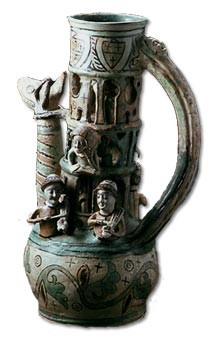
A puzzle jug is a puzzle in the form of a jug. The challenge of the puzzle to drink the contents without spillage is often written on the jug. This is certainly impossible to do in the conventional way because the neck of the jug is perforated.
Example inscriptions include: Fill me up with licker sweet for it is good when fun us do meet; Gentlemen now try your Skill I'll hold your Sixpence if you Will That you dony drink unless you spill. and Here Gentlemen come try your skill, I'll hold a wager if you will, That you don't drink this liquor all, Without you spill and let some fall.
The earliest example in England is the Exeter puzzle jug, a fine example of medieval pottery in Britain. The Exeter puzzle jug dates from about 1300 AD and was originally made in Saintonge, Western France.
Puzzle jugs were popular in homes and taverns and most popular during the 18th and 19th centuries. The quality of pieces varies from quite basic to very fine.
The solution to the puzzle is that the jug has a hidden tube. What looks like the spout is, in fact, one end of a tube which usually runs around the rim of the jug and then down the handle to open inside the jug near the bottom. To obtain the contents, one has to suck on the tube. To make the puzzle more interesting, it was common to provide a number of additional holes on the tube that must be closed off before the contents can be sucked up.
The puzzle jug is a descendant of earlier drinking puzzles, the fuddling cup and the pot crown; the solution to the conundrum being different in each case.
Puzzle jugs were popular throughout Europe from the 17th to 19th centuries, and made in earthenware and stoneware.
Pyrex (glass - type - borax - Corning Glass works)
Trade name of a type of glass that withstands heat-shock, first made in 1912 to prevent railway workers lanterns from shattering when the lamps were lit in cold conditions, and today identified as a future collectable.
The glass, toughened by its high borax content, was developed in the USA by the corning glass works.
Trial of The Pyx (coins - weight - purity)
Periodical monitoring of the weight and purity of coins and coinage metal. From early times the coins for sampling have been stored in a sealed box called the pyx, a practice which continues today. See: How to Grade Coins and Coin Grading Systems.
Leave a Reply
You must be logged in to post a comment.