
Contents
The Antique Marks Glossary featuring antique terms beginning with A.

Covering everything from Acanthus to Ayrshire and Air Twist to Art Deco.
Below you will find antique related words or antique terms begining with 'a'. Our antique terms list is not exhaustive but we will add to it as time goes by.
The descriptions detailed are only intended to be relevant to how the word or term relates to antiques and although the same word may have other meanings in other contexts, we have not and do not intend to detail those meanings here.
In some instances we have included pictures to enhance the meaning of the word or term and we have also tried to index each term so that you may link to the explanation when the word or term appears in other pages on the site.
alvar aalto (architect - modernism - 1898-1976)
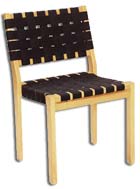
The most important Finnish architect of the 20th century, Alvar Aalto was a central figure in international modernism. His greatest buildings, like the 1927 Viipuri Library and 1928 Paimio Sanatorium, fused the naturalism of Finnish romanticism with modernist ideals: as did his influential furniture and glassware.
Born Hugo Alvar Henrik Aalto in 1898 in the Finnish town of Kuortane, he graduated in architecture from the Helsinki University of Technology in 1921 before assisting the Swedish architect Arvid Bjerke. Back in Finland in 1924, he opened the Alvar Aalto Office for Architecture and Monumental Art in Jyväskylä, and emblazoned the name beside the entrance in two-foot-high letters
abacus (calculator - column)
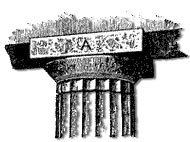
The word abacus has meaning in Greek architecture as the name for a slab of marble on top of the capital of a column. The column capital is at the top of the column and so the square block of marble that is the abacus rests right under whatever the column is supporting
An abacus is also a calculation tool, often constructed as a wooden frame with beads sliding on wires. It was in use centuries before the adoption of the written Hindu-Arabic numeral system and is still widely used by merchants and clerks in the People's Republic of China, Japan, Africa, and elsewhere
abbotsford style (decoration - walter scott)
Term introduced in the late 19th C. for imitation jacobean, tudor, stuart and gothic furniture made in the 1830's. It was named after Abbottsford the Scottish home of the 18thC. poet sir Walter Scott, who furnished the house in that style
abrash (carpets - decoration - oriental)
Term used to describe the faint banding of colour shades usually found in vegetable dyed oriental carpets. abrash 'shading' is so common as to be an identifying characteristic of the so-called 'Mohtaschem' group of Kashan rugs from the 1890-1910 period.
acacia (wood, also robinia)
Acacia is a durable whitish-yellow wood with brown veining. Used veneer in late 17th and 18th centuries; as a decorative crossbanding in 19th century furniture and in chairs and boxes in the arts and crafts movement.
acanthus (decorative motif - foliage)
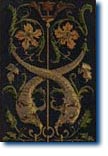
The acanthus is one of the most common ornaments used to depict folliage. Architectural ornaments are carved in stone or wood in the appearance of leaves from the Mediterranean acanthus spinosus plant, with some resemblance to thistle, poppy and parsley leaves. Acanthus leaf ornamentation is also used in furniture, particluarly in borders, and in ceramics too.
accordion pleat (cloth decoration)
A series of narrow machine made, overlapping, pleats often used in lightweight fabrics and furnishings.
achromatic lens (John Dollond - 1758)
Used in telescopes and microscopes an 18thC. development combining flint glass and crown glass to remove distorting colour fringes from the image. It was patented by Englishman John Dollond in 1758.
acid etching (glass decoration - engraving)
A process, mainly used for glass decoration, where the glass surface is treated with hydrofluoric acid. Acid-etched glass has a distinctive, uniformly smooth and satin-like appearance
acid gilding (ceramic decoration - gilding)
A process used on ceramics to give a contrasting matt and polished gilt surface. The technique was introduced by Minton in the late 19thC. and later used by other firms. When the ceramic body is gilded and polished the acid treated areas are left matt.
acid polishing (glass decoration - engraving)
This chemical process restires the polished surface to glass after cutting. The glass is dipped in an acid solution which rmoves a fine surface layer.
acorn (ornament)
An ornament of wood or metal resembling an acorn. Mainly found in Jacobean furniture as finials on chairs and bedposts
acorn flagon (York flagon)
A pewter vessel about 12" (30cm) in height. It's base isthe shape of an acorn cup and it has a domed acorn like cover, capped by a finial. Used for serving wine or ale in Yorkshire in the 18thC. Also known as a York Flagon.
act of parliament clock (clock - tavern clock)
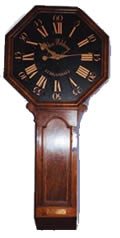
Large Georgian wall clock with a weight driven movement.
Formerly a tavern clock but the name changed after a 1797-8 act of parliament taxed clocks and timepieces, resulting owners putting clocks away and relying on public clocks.
The act was repealed after a petition by clockmakers.
robert adam (architect - 1728-92)
Principle Neo-classical architect and designer. The ambitious son of a leading Scottish architect who developed his own classical style and introduced classical motifs such as garlands, husks, palmettes, anthemion, urns and cameos to architectural design.
adjustment marks (coins)
File marks found on some pre-19thC. coins, which have been filed down to the correct weight. A common practice undertaken since ancient times. Excess metal was filed off overweight blanks before the coins were struck to ensure a consistent weight.
adlerglas (humpen)
Large 17thC. German drinking vessel. Cylindrical in shape and often lidded and with enamel decoration.
adze (furniture - wood working tool)
A long handled axe with the blade set at right angles to the shaft. Used in furniture making for heavy trimming and shaping. Windsor chair seats are shaped with an adze.
aerography (ceramic - stencil decoration)
A late 19thC. technique for applying colour to cermics through a stencil using an airbrush or atomiser. Results in soft edged, slightly granular images and was often use to dress cheap porcelain.
aesthetic movement (decorative arts c1870 - 1880)
A decorative arts movement with a strong Japanese influence, that flourished in the UK from c1870. Declined in the late 1880's and was recognised in the USA but not in France or other parts opf Europe. Overlapped with the arts and crafts movement and was just before the art nouveau period.
affenkapelle (ceramics - meissen - monkey band)
German for monkey band. A set of porcelain monkey musicians introduced by meissen in the mid-18thC. and comprising some 20 figures. Copied and reproduced by other European factories in the 19thC.
agate (semi-precious stone)
A fine grained quartz used as a semi-precious stone in cameo and intaglio work and in some signet rings and brooches. Displays as variegated tones of browns and oranges or greys or greens, usually with milky bands, when polished.
agate ware (ceramics - staffordshire pottery)
Produced in the 18thc. a staffordshire pottery imitating the veinign and colouring of agate. Produced by wedgwood and whieldon in two types. Solid agate; by kneeding two or more types of clay to produce a marbling effect throughout the body and surface agate; using a coloured liquid clay slip over a plain earthenware body.
aide-memoire (decorated case for notes)
A slim decorated case complete with pencil and note pad, usually pocket sized. 18thC. aide-memoires could have ivory leaves. The cases were usually decorated in gold, silver, ivory, enamelling or tortoiseshell.
aigrette (decoration - gold or silver ornament)
A gold or silver hair or hat ornament in the shape of a feather or a holder for a feather. Fashionable in the 17thC. and 18thC. with revived interest in the late 19thC. to early 20thC.
air-beading (glass - decoration - bubbles)
Bubbles of air either circular or tear shaped as decorative motifs within glassware. The molten glass is pricked with a metal point and glass drawn over the point. The tear shape is formed as the glass is drawn into shape.
air twist (glass - decoration - stem)
A form of decoration using a column of trapped air incorporated in the stem of a drinking glass. Usually 18thC. Also -- opaque twists
aka-e (ceramics - japanese - decoration - imari)
A Japanese term meaning "red painting" and referring to over-glaze enameled decoration. Japanese aka-e was influenced by Chinese over-glaze enamel decoration from the late Ming dynasty periods of Jiajing, Wanli and Tianqi. The Japanese wares of Imari, Arita, Kakiemon, Nabeshima, and Kutani are well known for aka-e.
john akerman (glass - merchant - 1719-1755)
The London glass merchant that introduced cut glass to the UK.
alabaster (mineral - marble type)
A dense finely grained mineral with marble like qualities. A form of gypsum, normally white, yellow or red. Translucent when finely cut, easy to carve and used in the late 18thC. for fashionable pedestals, vases and clock cases.
albarello (ceramics - maiolica - drug pot)
A cylindrical ceramic drug pot with a slight waist and a groove around the rim for securing a parchment cover. Albarelli originated in Persia in the 12thC. and maiolica versions were made in Spain and Italy in the 15th and 16th centuries. Dutch and English delftware versions appeared in the 19thC.
albert (colocks & watches - pocket watch chain)
A single or double, usually silver or gold, chain with a bar at one end for seating in a buttonhole and a swivel attachment at the other for holding a pocket watch. Named after a chain presented to Prince Albert in 1845.
album quilt (textiles - personalised quilt)
A personalised patchwork quilt, where the design is significant to the recipient. May have names and dates stitched into some patches. Fashionable in the USA in the mid-19thC..
alburnum (wood - sapwood)
The soft white wood, newly formed, between the outer bark and the heartwood.
alder (wood - country furniture)
A durable north European wood that polishes to a knotty finish. Flesh coloured and used in the 18th & 19th centuries for country furniture. Sometimes for turned members on Windsor chairs.
ale glass (glass - dwarf - short ale)
A stemmed glass used for drinking ale and dating to the 18thC. Similar to wine glasses but with an elongated bowl. After 1740 some were engraved with hops and barley or ocassionally enamelled. Short stemmed versions are known as dwark or short ales. 19thC. glasses are similar to modern champagne flutes.
alencon lace (textile - venetian - needlepoint)
Established in North West France in 1675, the Alencon lace factory flourished under Napoleon. Point d'Alencon refers to needlepoint lace with distinctive filling between the mesh.
alentours (tapestry - gobelins - france)
A wide tapestry with a central image surrounded by a border simulating gilded wood, then bordered by rich ornamentation of flowers and figures. First intorduce in 1714 at Gobelins factory in France.
ale warmer (metalware - cup - copper or brass)
A copper or brass cup used for warming ale over an open fire. Usually with a wooden or iron handle. 18thC. examples were shaped like large boots or shoes. Cone shaped, donkey ear, cups appeared in the late-18thC. and modern reproductions are common.
alexandrite (gemstone - russian - corundum)
Discovered in the Ural mountain sof Russia in 1830, a green/brown gemstone that glints with varying shades of red under artificial light. Corundum, sold in the middle east, exhibits similar colour changes but is of little value.
alexandrite glass (glass - art glass - thomas webb)
A transparent art glass patented by Thomas Webb & Sons in 1866. The glass has colour gradations of citron-yellow through to rose and blue, produced by reheating individual parts of the glass during production. Later designs are cut through an outer layer of rose and blue glass to reveal a clear yellow base.
alloa glassworks (glass - scottish factory - 1750)
Established in 1750 a scottish glass factory specialising in dark green bottles, that were roughly stipple engraved with commemorative names and dates. Common dates are 1830 and 1850.
all over (carpets - decoration)
A carpet design or pattern based on a repeating motif covering the main area or field and stopping within the borders.
alloy (metalware - bronze - pewter - brass)
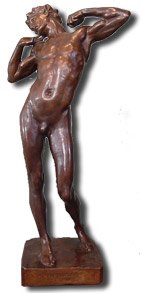
Formed by melting together two or more elements such as copper, zinc and tin, to produce a more durable or more easily worked metal such as bronze, pewter or tin.
Also sterling silver which can contain a proportion of copper or some other base metal.
aluminium (metalware - light silver - 1920s)
Discovered in 1827 aluminium is a very light, silver coloured metal and was used occasionally in the 1850's for figurines and plaques and was sometimes combined with gold for jewellery. Became very fashionable in the 1920's during the Art Deco period for cocktail equipment, ashtrays, jelly moulds, tea and coffee pots.
amalgam (metalware - mercury alloy)
An alloy where mercury is combined with another metal. Usually tin, silver or gold.
amatory (jewellery - amorous love tokens)
Brooches, rings and other jewellery decorate with amorous motifs or inscriptions and designed to be given as love tokens. Very popular in the 17thC. and sometimes set with a lock of hair. Great demand for brooches in late Victorian times.
amber (gemstone - fossilised resin)
Usually pale yellow fossilised resin from the prehistoric pine tree. Can range in colour from pale yellow to honey, reddish brown and brown. the most sought after and best quality is clear. Rare samples contain insects although they can be introduce artificially. Also Sea amber from the Baltic Sea and pit amber mined in Burma, Poland, Mexico and other places. Amber was popular among Celtic Britains and Victorian Britains.
amberina (glass - decorative art glass - joseph locke 1883)
Art glass developed by Joseph Locke at the New England glass Co. in 1883. Produced in shades from golden amber to deep red. Widely produced in the USA and in north east England.
amboyna (wood - est indies - padouk)
A mottled-reddish brown, durable wood with a tight grain, found in the East Indies. Used by 18thC. cabinet makers for high quality decoration in veneers, inlaid decoration and banding.
ambulante (furniture - table - 18thC)
General tem for a light portable occasional table such as a work table or bedside table that had no fixed position. Used during the 18thC. in France.
amen glass (glass - jacobite - wine glass)
A rare british wine glass with a drawn stem and the bowl engraved with a Jacobite hymn ending in amen. Produced circa 1745.
american colonial style (style - north american)
Furniture and architectural design in north america, dating between the early 17thC. pioneer settlements and the setup of the federal government in 1789.
american federal style (style - north american)
Furniture designed in the early years of American independence, 1789-1830, usually decorated with patriotic or military symbols.
amethyst (gemstone - semi-precious quartz - citrine)
A semi-precious quartz ranging in colour from pale mauve to deep purple. Turns golden yellow when heated to form citrine.
amorini (furniture - decoration - ornaments)
Italian reference for the winged cupids used as ornamental subjects during the renaissance period and later. A common feature of crestings and stretchers of chairs, cabinet stands and tables. Used on ceramics from 1660 to 1680.
amphora (ceramics - decorative jar)
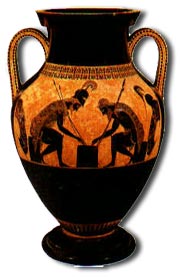
A twin handled jar with a large round body and a narrow neck. Used in ancient Greek, Roman and Chinese times for storing wine and oil.
Popular ornaments in neo-classical Europe during the 18thC. especially in silverware.
Also as a decorative motif on Antwerp lace.
ampulla (ceramics - roman - amphora)
An ancient roman two handled container used for wine or water. Later as a decorative ornament. A smaller version of an amphora.
anatolia (carpets - turkish area)
An area of Turkey which is part of the Asian continent, referred to when dealing with carpets.
andirons (metalware - decorative log burning grate - firedogs)
Widley used prior to the establishment of the traditional grate, and consited of a pair of metal fir irons placed at either end of an open hearth to support the burning of logs. Mainly replaced by coal burning stoves in the 17th and 18th centuries except in country areas. Decorative versions introduced in the 19thC. Also known as firedogs and sometimes cast in the shape of seated hounds. Mutli-footed versions are known as firecats s they land on their feet when dropped.
anemometer (scientific - wind - instrument)
An instrument for measuring wind force.
aneroid barometer (scientific - barometer - vacuum)
Introduced c1850 as a domestic barometer. It utilises disc like flexible bellows that contain a partial vacuum instead of the typical column of mercury. As air pressure changes the bellows enlarge and move a pointer set against a dial. Aneroid comes from the Greek meaning liquid-free.
angel (coins - hammered gold)
A British 15th to 17th century hammered gold coin that depicts St Micheal spearing a dragon. First issued in the UK in the 1460's and replaced the noble. Initial value was a third of a pound or 6s 8d. Later revalued to 11 shillings.
joseph angell II (metalware - silversmith - c1816 to 1891)
British silversmith producing elaborate claret jugs, centrepieces and coffee sets decorated in the the rococco style with complex chased relief work. Exhibited at the great exhibition of 1851.
angle barometer (scientific - barometer - signpost - diagonal)
A barometer where the upper part of the mercury tube is almost horizontal. The visible part of the scale is longer than in a stick barometer and readings are clearer. Introduce in the 18thC. and also known as signpost or diagonal barometers.
angle chair (furniture - chair )
18thC. chair with a single front leg and low back and top rail. Also known as a corner chair or writing chair.
anglo-indian furniture (furniture - indian colonial)
Furniture first manufactured on the Indian sub-continent in the mid-18thC. Usually European designs and often inlaid with ivory. Production continued until the end of the 19thC.
angouleme sprig (decorative - chantilly porcelain)
18th and 19th century porcelain decoration used at the Paris factory owned by Louis, Duke of Angouleme. Originally a feature of Chantilly porcelain and later copied by Derby, Worcester and Lowestoft. Also known as barbeau, French for cornflower..
an hua (ceramics - chinese - secret decoration)
A delicate design incised or scored on a porcelian body before glazing and only visible when the finished piece is held up to the light. Sometimes occurs in the Ming dynasty from the early 15thC. and the Qing dynasty 1723 to 1735.
aniline dyes (carpets - chemical dyes)
Chemical dyes introduced in 1870 and used in carpets and other textiles. Tended to run and replaced by colour-fast chrome dyes in the early 20thC..
animal furniture (furntiture - taxidermy)
Furniture fashioned around birds and animals fresh from the taxidermist, produced to fuel demand by late-victorians. Typical items being elephant feet stands, stuffed bird lamp bases and tiger skin covered chairs.
animaliers, les (metalware - bronze sculptors - french)
19thC. French sculptors specialising, usually in bronze, in the manufacture of small lifelike models of birds and other animals.
animal interlace (decorative ornament - celtic)
An ornament or motif representing an intertwined, elongated and stylised animal form usully seen in celtic work.
annealing (glass - strengthening)
A process involving the repeated heating and cooling of glass to add strength without cracking. Also use with some metals.
annulet (architecture - cabinet making - heraldry)
In archecture and cabinet making a narrow band circling a column. In heraldry a small circle or ring in a coat of arms.
anthemion (decorative motif)
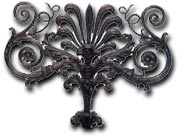
A styilised honeysuckle motif.
antimacassar (textiles - protective covering)
A piece of loose material used to protect an upholstered chair back from stains. 18thC. silk versions were used to protect against powdered wigs and greasy make-up. Victorian versions usually made of white crochet. Named for macassar oil used as a hair dressing by 19thC. gentlemen.
antimony (metalware - hardening pewter)
An element with hardening properties used in some alloys, including pewter.
antique (period - over 100 years)
Principally an object valued for its age, workmanship, or rarity. Usually an object that is more than 100 years old.
antwerp (textiles - tapestry and lace making)
Originally in the Nehterlands and in Belgium from 1832, a centre for tapestry and lace-making. The tapestry industry peaked in the 17thC. with superb designs emulating the paintings of Rubens.
antwerp pottery (ceramics - tin glazed earthenware)
16thC. tin glazed earthenware inspired by Italian maiolica. Suffered a decline as Delft beacme established.
ao (ceramics - japanese - kutani ware)
Green Japanese kutani porcelain with a straw coloured stoneware body. The assymetrical brocade or geometric panels outlined in black and filled with translucent enamels. Deep green is most common but smokey yellow, aubergine, blue and iron red are also seen. Some piece have completely green bottoms. some date form the 17thC. but most pieces in Europe from the 19thC.
aogai (decoration - japanese - mother of pearl)
Japanese mother-of-pearl decoration used on lacquered pieces and introduced c1620. In the 18thC. the japanese somada school introduced a style of mosaic work using fine aogai slivers, which was widely copied throughout the 19thC.
apostlehumpen (glass - humpen - drinking vessel)
Large 17thC. German drinking vessel. Cylindrical in shape and often lidded and with enamel decoration depicting religious scenes.
apostle spoons (metalware - silver - 13 spoons)
Usually a set of thirteen silver spoons decorated with figures of christ and the twelve apostles mounted on the top of the handles. The figures identified by different emblems held in their hands. Also seen in pewter and brass. Earliest versions c1460. Common to see mass produced 19thC. coffee spoon versions made in the UK with a single apostle figure.
apple (wood - fruitwood)
A very hard reddish brown fruitwood with an irregular grain. Particularly suited to turning and mostly used for chair legs, stretchers and spindles on country furniture in the late 17th and 18th centuries. Often ebonised (stained black) or gilded and used for applied carvings, inlay or picture frames.
applied decoration (decorative ornaments)
A surface ornament, carved or modelled then fixed to the surface of an item.
apron (furniture)
The lower front edge of a piece of furniture. Sometimes bordering the surface of a table or the seat of a chair.
aquamarine (gemstone - beryl)
A blue green variety of the gemstone Beryl, produce by heat treatment. Greenish styles fashionable in the 19thC. and sky-blue popular since the 1920's.
aquatint (print - etching 1760's)
An etching process invented in the 1760's that enables several tones of varying depth to be produced on a print. Tiny particles of resin are dusted onto a printing plate and fused by heat then areas not to be printed are coated with a special varnish. The plate is exposed to acid which bites into the exposed metal producing tonal areas like those in an ink wash drawing.
AR (coins - argentum)
Used in coin catalogues to depict silver. An abbreviation of the latin argentum.
arabesque (decorative motif)
An interwoven, symmetrical pattern of branches, tendrils and scrolls. Often used in islamic and hispanic designs and popular in Europe c1760 to 1790.
arbalest (militaria - crossbow)
A bow mounted on a wooden tiller, with a cord drawn by hand or by mechanical means. The arbalest is usually known as a crossbow and fired quarrels. Popular with hunters and target shooters.
arbor (clock and watches - mechanism)
A shaft, axle or spindle that carries a wheel and pinion in a clock, watch or music-box mechanism.
andre leon arbus (art deco - designer - 1903 - 1969)
After graduating from the Ecole des Beaux Arts, Arbus joined his father's Toulouse cabinet making firm, which he later headed. Exhibiting in the Paris Salons from 1926 onwards, he moved to the capital in I930. Arbus was awarded the Prix Blumenthal in 1935 and exhibited at the great International Exhibitions in Brussels (1935), Paris(1937) and New York (1939). He ended the firm's production of eighteenth century style furniture, and his own designs were very much inspired by the more stylised classicism of the French Empire. He rejected the rhetoric of the UAM, continuing his workshop system and incorporating luxurious veneers, bleached animal hide vellum and gilt mounts in his furniture.
arcadian (ceramics - crested ware - stoke-on-trent)
A 19th and 20th century Stoke-On-Trent pottery producing crested ware as militaria, animals and particularly black cats in various poses.
arcading (furniture - decorative motif)
A decorative motif consisting of a series of arches often found on furniture backs and on panelsfrom the late 16th and the 17th centuries.
arcanum (ceramics - european porcelain formula)
The secret composition and method of producing hard-paste porcelain. Discovered by Bottger and Trim working under the direction of Augustus The Strong.
The arcanum was a closely guarded secret at meissen by was eventually distributed by ex-meissen employees (arcanists) who left to start their own porcelain factories or to work for other heads of state who financed the set-up of their own manfactories.
architects table (drawing board)
An 18thC. table used by artists, draughtsmen and architects, where the top tilits on a ratchet to form a drawing board.
architectural style (furniture & clocks - style)
The usual term for furniture and clocks decorated with architectural features such as columns and pediments.
architrave (furniture - doors and windows)
The description given to the moulded frame around windows, doorways and panelling in furniture.
argand lamp (oil lamp - adjustable burner)
An oil lamp invented in Geneva in 1782 widely made in the USA and in Europe. Fitted with adjustable burners from 1810.
argentan (metalware - nickel silver)
A marketing name for nickel silver. a white alloy of nickel, copper and zinc often used as he base metal for electroplating.
argentan lace (textiles - french - needlepoint)
French needlepoint lace often showing flowers on a hexagonal background. First seen in the late 17thC.
argyle (metalware - silver - argyll - gravy container)
An 18thC. gravy container usually made from silver or Sheffield silver plate. Gravy is held in an inner cavity and kept warm with hot water housed in an outer cavity. Reputed to have been invented by the Duke of argyll.
ariel glass (glass - art glass - swedish - bubbles)
Devloped in sweden in 1936 a form of art glass that contains trapped channels or bubbles of air. Patterns are sandblasted onto a glass core which is then covered by another layer of glass, trapping the air where the pattern has been cut away.
arita (japanese - imari and kakiemon ceramics)
The centre for Japanese ceramics form the early 17thC. Known as the home of imari and kakiemon porcelain.
ark (furniture - chest)
Usually an oak chest with a canted cover and made by an arkwright. Used for storing flour or meal and common in the north of England until the 19thC..
armada chest (furniture - strongbox - German)
An iron-bound strong box usually of german manufacture and used for storing valuables in the 16th and 17th centuries. Often used by officers at sea and bolted to the deck of the owners cabin. Named for the chests suposed to have been used by the spanish armada.
armchair (furniture - chair)
Any single chair with arms as distinct from a side chair or a corner chair.
armet (militaria - armour - medieval helmet)
A medieval helmet enclosing the wearers head and with a pivoting visor
armillary sphere (scientific - astronomy - spherical globe)
A scientific globe used for teaching astronomy and cosmography from c1500 onwards. 16thC examples show the movements of the planets and often came in pairs with one showing the earth centred (ptolematic) universe and the other the sun centred (copernican) universe.
armoire (furniture - french cupboard)
A large two door French cupboard or press from the 16thC. German versions are known as kas.
armorial (heraldic - coat of arms)
Usually refers to a heraldic coat of arms but also refers to anything with heraldic motifs such as armorial porcelain. Chinese export dinner services were often commisioned by European aristocracy and ordered with family crests or armorials as decoration in the 17th and 18th centuries.
john arnold (clock & watchmaker )
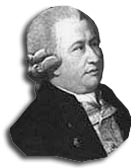
A British clock and watchmaker known for his work on pocket and marine chronometers and for precision watches.
Arnold made very accurate regulator clocks for the royal observatory at greenwich.
His firm subsequently run by his son John and then by Edward Dent from 1830 to 1840 and Charles Frodsham from 1843.
arras (textiles - tapestry - lace)
From the top quality French tapestry centre where superb wall hanging tapestry was made in the 13th to 16th centuries and why the word arras is associated with tapestry. In the 17th and 19th centuries arras lace in pure white and gold was much sought after.
art deco (style - decorative arts)
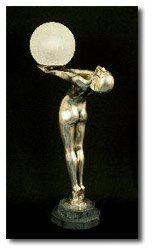
The art deco style affected all forms of design in the 1920's and part fo the 1930's.
The name derived from the french arts decoratifs following the paris exposition des arts decoratifs in 1925.
art furniture (furniture - style - aesthetic)
Part of the 19thC. British and US aesthetic movement when designers rejected the opulence and decandence of victorian times in favour of simpler shapes showinf japanese influences. The name was invented by Charles Eastlake and designers associated with the movement included Christopher Dresser, William Burges, Charles Voysey and Bruce Talbert.
art glass (glass - art glass - decorative style)
The usuall term for late 19th and early 20th century glassware produce for decorative effect and utilising agate, alexandrite and tortoiseshell glass.
art nouveau (style - decorative arts)
The art nouveau decorative arts style is renowned for organic flowing curves and lines; assymetry and leaf motifs. Prevalent between 1880 and the first world war.
arts and crafts (style - decorative arts movement)
Late 19th and early 20th century British craftsmen rejected machine made goods in favour of hand crafting and the arts and crafts movement was born. The movement was apparent in the USA until WW1 but died out in Britain after 1900 due to the high cost of goods. William de Morgan was a keen arts & crafts exponent.
charles robert ashbee (architect designer - 1863 to 1942)
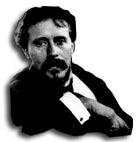
A British architect and designer who became a leading light in the arts and crafts movement.
He founded a school of arts and crafts in London and eventually recognised the inevitble role machinery would play in arts and crafts.
Ashbee designed furniture in a lighter style to the movements country style and produced art nouveau silver and metal ware.
asmalyk (carpets - weaving)
A five or seven sided weaving made by turkoman nomads and designe dto hand on the flansk of camels.
aparagus tongs (metalware - silver - tableware)
18thC. scissor action tongs used for gripping asparagus. Usually of ornamented silver of sheffield silver plate. Also known as chop tongs as they could be used for serving meat as the bottom jaw was serrated and had an upturned end..
asparagus eaters (metalware - silver - tableware)
Introduced in the 20th century and are like small sugar tongs but for eating asparagus.
aspidistra stand (furniture - jardiniere stand )
A wood, wickerwork or ceramic stand usually with three or four legs, used to hold a plant or flower pot. Fashionable in victorian times when aspidistra's were popular.
asprey (meatlware - silver - gold - jewellery)
A London retailer founded in 1781. Apsreys dealt in and produced gold and silver jewellery and other luxury items. Known for elaborate vanity cases containing gold or silver topped bottles and mirrors mounted in chased silver and gold. The firm is based in New Bond Street, London.
assay (metalware - gold and silver - hallmarks, purity)
An assay office is set up to test the purity of gold, silver and now platinum according to government set standards. The UK currently has four operational assay offices at London, Birmingham, Sheffield and Edinburgh. Other regional offices at Chester, Exeter, Glasgow and other towns have closed over the years. The assay office will usually mark the item tested with a set of marks usually referred to as hallmarks. The term assay is also used to refer to a sample of work submitted by a craftsman on registering with a guild.
astbury ware (ceramics - john astbury 1686-1743)
Lead glazed earthenware by Staffordshire potter John Astbury and his contemporaries. With relief decoration sprigged onto a red or brown body covered by a thick honey-brown, yellow or green glaze. Astbury is credited with adding ground flint and white devonshire clay to staffordshire earthenware and improving it's colour and plasticity. Thomas Whieldon was an Astbury apprentice and astbury style pottery with whieldon coloured lead glazes is called Astbury-Whieldon Ware. .
astragal (furniture - decorative motif - beading)
The small semi-circular beading or moulding used on the glazing bars of glass cabinet doors.
angelo asti (decorative arts - royal vienna - art nouveau)
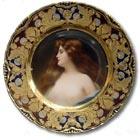
Angelo Asti (1807-1903) was a well-known french artist who specialised in portraits of beautiful women.
He is considered to be the father of pin-up art as his work was widely used in calendars and postcards.
Asti's portraits are in the art nouveau style and were widely reproduced on royal vienna porcelain plates.
astrolabe (scientific - astronomical)
A circular instrument with a moveable arm used to calculate the altitude of the sun and plotting star positions for astronomical and navigational purposes. Used since the 2nd century until the 18thC. in Europe. Forgeries are now common.
astronomical dial (clocks and watches - dial)
A clock or watch dial that show sthe movements of the sun, moon, stars and planets as well as the time.
athenienne (furniture - urn)
Invented by Frenchman J H Eberts in 1773 and athenienne is a multi-purpose lidded urn supported on an ornamental three legged stand. It can be used as a plant stand, a wash stand a perfume burner or a candelabra.
atlas (books - map - architectural figure)
A book or volume of tables, charts or pates that systematically illustrates a subject. Usually land or sea geography. Also the singular of atlantes; male figures used as columns in architecture or furniture making.
atmos clock (clocks and watches - atmospheric)
A clock that is wound by changes in atmospheric pressure. Devised by JE Reutter in 1928 and produced by the swiss firm of Jaeger-le-Coultre.
aubusson (france - carpets - tapestry)
Aubusson is a town in central France and its tapestry woven carpets in Louis XVI and Empire styles were widely used in the late 18th and 19th centuries. Tapestries with scenes from the fables of la fontaine and contemporary prints were popular in the 18thC. and designs by Raoul Dufy and Graham Sutherland are popular now.
ault pottery (ceramics - art pottery - william ault)

A British art pottery manufacturer founded by William Ault at Swandlicote in Derbyshire in 1887. Producing ornamental earthenwares with aventurine glazes including items by Christopher Dresser.
aumbry (furniture - medieval cupboard)
A simple cupboard dating from medieval times consisting of a recessed shelved area in a wall and enclosed by wooden doors. Later as a free standing cupboard for storing food, with pierced ventilation in the doors. Used until the 16thC. and also known as an ambry or almery..
AV (meatlware - gold - abbreviation)
Commonly found in coin catalogues as an abbreviation for gold. From the latin aurum.
automata (mechanical - figures - clockwork)
18th and 19th century mechanical figures mainly produced by clockmakers. Created for adults and for display. Often elaborately dressed and apable of complex movements such as drinking and smoking. Later replaced by mass produced mechanical toys marketed for children.
autoperipatetikos (dolsl - USA - walking doll - 1862)
a smooth moving walking doll patented in the USA and Europe in 1862. It had brass leg castings shaped like boots and the movement was made by a rotating curved bar concealed within the legs or appearing briefly beneath the feet. Named for the Greek for self-propelling.
aventurine (glass - lacquer - japanning)
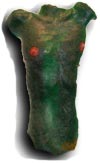
A translucent glass containing metal specks.
Developed in the 17thC. and owing its appearance to copper oxide used in manufacture.
Adding chromium in the 1860's gave green aventurine and chrome and tin led to pink aventurine.
Also a term used to describe a lacquer or glaze resembling aventurine glass.
Also the name given to minute gold clippings sprinkled on furniture during the japanning process.
axminster (carpets - devon - huguenot)
Hand knotted carpets made for the luxury market in the 18th and 19th centuries at the axminster carpet factory in Devon. The factory founded in 1750 by two French Huguenot refugees who worked at the Savonnerie factory. Merged with the Wilton carpet factory in 1835. Also mechanically woven double-wefted carpets made at the wilton factory after its takeover of the axminster factory.
ayrshire work (textiles - embroidery - scottish)
A form of cutwork embroidery found on white muslim from ayrshire in scotland. Widely used during the mid-19thC. for christening robes, womens collars, caps and cuffs.
Leave a Reply
You must be logged in to post a comment.