
The Arts and Crafts Artists from William Morris to Gustav Stickley, William de Morgan and Christopher Dresser.

In 1861 the english designer william morris started the arts and crafts movement in an effort to improve the tastes of the victorian public.

A great many artists and designers supported the movement and looked upon the mass produced industrialised wares as bland, inferior and without soul. These artists and designers helped create an ethos in which many workers guilds rose and in which evening school classes and socially based craft projects sprang up and thrived.

Willaim Morris (1863 to 1942) - author of the arts and crafts movement.

Arts and Crafts Artists - William Morris and the arts and crafts movementWilliam Morris was born in Walthamstow in 1834 and studied theology at Oxford. As a student he was drawn to the ideologies of socialism; when he embarked on a career as an artist, it was his intention to apply socialist philosophy to his work -- from conception to design to production. This goal led him to abandon painting in favor of architecture and then to the decorative arts.

During university and after, Morris associated with the Pre-Raphaelite artists of the period, men such as Dante Gabriel Rosetti and Edward Burne-Jones. These relationships would bolster his allegiance to socialist values and influence his roles as poet, artist, and businessman.Arts and Crafts Artists - Jane burden wife to william morris - painted by rosetti with whom she had an affair

In 1861 he formed Morris, Marshall, Faulkner, and Co.-- which was essentially Britain's first design firm. The group included many of Morris' Pre- Raphaelite peers. Together they set out to disrupt the world of Victorian design.

Morris’ company produced all manner of materials for home décor: wallpaper, stained glass, tiles, carpets, furniture, and upholstery. Inspired by Medieval art Morris covered surfaces with spiraling vine patterns, and carved Celtic-looking animals onto furniture legs. Organic forms, rather than classical motifs or Victorian curlicues, prevail in his work. Each piece also revealed the handicraft of its maker. There was no machine-produced regularity at Morris' design firm.

It's an irony that only the wealthy could afford Morris' hand-crafted products. Still, Morris spoke out on behalf of socialism in his utopian writings and through his support of the British Labour Movement. While the works of the designer and his company may not have been available to the masses, his struggles to preserve the individual identity of the craftsman, and to emphasize simplicity and utility of design, left an important mark on modern design.

Morris's wallpapers were his best-known output, with complex designs incorporating plants, flowers and birds.

Morris married Jane Burden, a beautiful model who appears in many Pre-Raphaelite paintings (she sat for nearly all Rossetti's later works, had an affair with him and appears above right in his Astarte Syriaca ).william morris arts and crafts wallpaper using acanthus leaves

Jane, together with her sister Bessie, did embroideries for Morris's firm. Philip Webb designed much of the furniture, metalwork, and many tiles. For stained glass, Morris generally designed the backgrounds and Burne-Jones drew most of the figures, with Rossetti and Ford Madox Brown also contributing designs. Burne-Jones also collaborated with Morris on tapestries, designed many tiles, and drew for the books produced by the Kelmscott Press, founded by Morris in 1891.

Morris was described by Walter Crane as the first to approach the craft of practical printing from the artists point of view.

The most important book of the Press was the Kelmscott Chaucer, which has been described as the most beautiful book to be produced since the Renaissance. This had typography and borders by Morris, with 87 illustrations by Burne-Jones. Other artists working as designers for the Kelmscott Press included C. M. Gere, Arthur Gaskin, and E. H. New, all from the Birmingham School of Art, and the Birmingham illustrators were in general much influenced by Morris's books.

original arts & crafts interiorMorris's novels are still available from second hand bookshops and the Kelmscott Press books are very precious. A complete set is held at the William Morris Gallery in Walthamstow, London. The Kelmscott Chaucer has been reproduced several times.

In 1996 there were many large exhibitions of Morris's work, marking the centenary of his death, and for this reason there are many catalogues and books currently available.

Morris left few paintings but his Guinevere and Sir Tristram and Iseult's Dog (in the Tate Gallery) are a few.

Examples of Morris's work can be found in stained glass windows, in many churches up and down the country, and in various museums such as the V&A and in Birmingham.

Hiis wallpaper designs and tilework are found in reproductions and rare originals.

The country home of William Morris from 1871 until his death in 1896 was Kelmscott Manor in the Cotswolds.

william morris's kelmscot manor in the cotswoldsWilliam Morris chose it as his summer home, signing a joint lease with the pre-Raphaelite painter Dante Gabriel Rossetti in the summer of 1871.

Morris loved the house as a work of true craftsmanship, totally unspoilt and unaltered and in harmony with the village and the surrounding countryside.

He considered it so natural in its setting as to be almost organic, it looked to him as if it had "grown up out of the soil"; and with "quaint garrets amongst great timbers of the roof where of old times the tillers and herdsmen slept".

Kelmscott Manor is owned and managed by the Society of Antiquaries of London.

Gustav Stickley (1858 to 1942) creator of the american craftsman arts and crafts furniture and the Craftsman magazine

Gustave StickleyGustav Stickley was a hardworking, dedicated man, and achieved success in the early 1900s as the leader of the Arts & Crafts Movement in America.

In 1891, the brothers Albert and Leopold Stickley founded the original Stickley Brothers Company in Grand Rapids, Michigan.

gustave stickley craftsman rocking chairThey also established operations in England which exposed them to the European arts and crafts movement that proved so influential. They manufactured simple yet finely crafted furniture in the arts and crafts style for the European market, but soon were also importing these styles into the United States as U.S. consumers developed a more sophisticated taste for well designed and well crafted items.

Gustav Stickley, was born in Wisconsin, the son of German immigrants. He began working with his father as a stone mason, and gained a sound appreciation for craftmanship.

In 1870, Gustav began working in his uncle Jacob Schlaeger's chair factory in Brandt, Pennsylvania, not leaving until 1884 to establish his own business with his two brothers Charles and Albert in Binghamton, NY.

Gustave stickley - craftsman easy chairIn 1897 during a trip to England, Gustav was inspired by British reformers, John Ruskin and William Morris and subsequently created a new line of handcrafted furniture based on honesty and simplicity. He returned to the US and established United Crafts which later became known as Craftsman Workshops.

In 1898 he opened United Crafts in Eastwood, New York where he introduced his Craftsman line which, by 1900, reflected an indigenous American Arts & Crafts philosophy.

His quarter sawn oak furniture incorporated overt structural details such as tenon-and-key construction, chamfered boards, and exposed tenons.

His recti-linear shapes were free of any excessive ornamentation except for what occurred naturally in the construction, design and material. This revealed not only the excellent craftsmanship that went into each piece, but also the beauty, simplicity, and utility of the design.

Gustav occasionally decorated his tabletops with Grueby tile and often used Grueby vases in his displays.gustave stickley - kitchen table

His trip to the 1900 Paris Exhibition confirmed his bias against reproductions, but while taking his philosophical inspiration from the European Arts & Crafts movement, Stickley took his artistic inspiration from America. Stickley felt that art should represent the everyday lives of everyday people.

In 1901, Gustav published The Craftsman magazine, a chronicle of the arts and crafts movement and its design principles.

gustave stickley 
            craftsman magazine The Craftsman promoted simple honest style in home design, decorating, and even gardening, and become the best known and most widely read publication of arts and crafts design.

In 1903, Harvey Ellis was hired to write for The Craftsman, but soon began working directly with Gustav to design a wider variety of the simple, finely crafted furniture and accessories for which Stickley Brothers is still known today. Where Gustav's designs were somewhat more substantial, Ellis retained the simplicity and fine craftsmanship while evolving a more comfortable, elegant style reminiscent of the Scottish designer Charles Rennie Mackintosh.

In 1915, however, as with most arts and crafts productions, the labor intensity and limited market of Stickley designs coupled with the approach of World War I led to the bankruptcy of the company. At that point, Gustavs younger brothers Leopold and John George assumed Gustav's debts, took over his workshops and formed the L & JG Stickley Company.


gustave stickley - craftsman settee The L & JG Stickley Company followed the same principles of furniture design pioneered by Gustav, but they also fostered a greater sense of design freedom among their craftsmen and this led to a more diverse production.

By this time, many U.S. manufacturers were copying the Stickley designs, creating an entire industry around the mission style furniture that Stickley's work had come to be known as.Gustave Stickley - craftsman umbrella stand

While Stickley furniture always had a degree of machine involvement in creating the design, Gustav and his brothers really looked to machining more as a precursor for hand crafted details. This balance provided the foundation of the American arts and crafts movement, where machines were used to a limited but productive degree in the furniture designs, bringing down the cost sufficiently to open up the market to the middle classes.

This is a distinction unique to the American movement, for in England any dependence whatsoever on machinery was shunned and made English arts and crafts designs too costly for most people. Designs were simple yet elegant, free from ornamentation and allowing the craftsmanship itself to show through in the structural elements such as mortise & tenon and tongue & groove joints in the furniture.

The Stickleys always appreciated the inherent beauty of wood and leather, and they did not feel the need to embellish the cleanliness of the design.

In 1974, L & JG Stickley was sold by Mrs. Louise Stickley to Alfred and Aminy Audi whose family still own and operate the company today

Charles Robert Ashbee (1863-1942).

Charles Robert 
            Ashbee English Arts-and-Crafts designer, celebrated for his metalwork, but also an architect, with some sixty buildings, most of them houses, to his credit.

Born in London, the son of a prosperous city merchant. Articled to GF Bodley between 1883 and 1885 and lived at the pioneer University Settlement at Toynbee Hall. Where he developed a Ruskin reading class, which developed into an art and craft class, which in turn became the nucleus of the School Of Handicraft and the Guild of Handicraft.

He was influenced by Morris, Ruskin, and idealistic socialism and worked for a time with Bodley. charles ashbee 
              muffin dish

In 1887-8 he founded the School and Guild of Handicraft, which exhibited at the 1889 arts and crafts exhibitions. The guild worked for a while in the East End of London and is chiefly known for the metalwork and jewellery designed by Ashbee himself, and for the furniture and metalwork made for the Grand Duke of Hesse in conjunction with the designer MH Baillie Scott.

In 1893 Ashbee designed a house, which was destroyed in 1968, for his mother at 37 Cheyne Walk, London, the interiors of which were decorated by the Guild. Other houses followed, notably 72–3 (destroyed) and 38–9 Cheyne Walk, in the Queen Anne Revival style (1897–1903).

In 1898, the guild designed furniture for Baillie Scott's house and for the reigning Grand Duke of Hesse at Darmstadt.

In 1900, he exhibited at the Vienna Secession.

In 1902, the guild moved to Chipping Campden in the cotswolds and was eventually forced into liquidation in 1907.

Charles Robert Ashbee 
            chairsAshbee was in the forefront of conservation, and carried out many restorations, new buildings, and extensions in Chipping Campden, all of which were carefully considered in order to respect the character of the place. His sensitivity was well tested when he adapted a ruined chapel of c1100 as a dwelling-house at Broad Campden (c1906–7).

He was one of the first British architects to realise the significance of Frank Lloyd Wright, and he was in the vanguard of the endeavour to bring order and care to the planning of towns and cities.

Mindful of the huge losses of historic buildings through redevelopment, he began a process of surveying London buildings that led to the important Survey of London volumes.

In 1906, Ashbee published A Book of Cottages and Little Houses (1906)

Charles Francis Annesley Voysey (1857-1941).
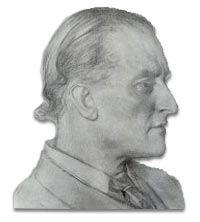
arts and crafts designer 
            charles voysey CFA Voysey was the architect and designer son of the Rev. Charles Voysey, founder of the Theistic Church.

Originally trained as an architect, and after working as a pupil in the offices of JP Seddon, he set up his own design practice in 1882 where he concentrated initially on decorative work, including his own designs for fabrics and wallpaper.

In 1881 he joined the Arts and Crafts ArtWorkers Guild.

In 1888 he built his first house, a commission for MH Lakin at Bishops' Itchington.
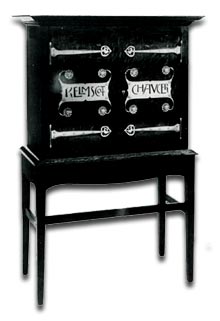
charles voysey 
              kelmscott chaucer cabinetHe soon developed his own characteristic style; linear, simple and with virtually no surface decoration. His designs were published widely, exhibited at the Arts & Crafts Exhibition Society from 1888 and were highly influential.

Voysey's furniture was made by F C Nielsen. His metalwork by Thomas Elsley & Co. and his textiles by Alexander Morton, GP&J. Baker, AH Lee, JW&C Ward, Stead McAlpin, Thomas Wardle, Turnbull & Stockdale, Donald Brothers, Foxton's, Templeton's, Tomkinson & Adam and sold to the shops Liberty & Co., Story's and Wylie & Lochead.

In 1900 he completed his own house, The Orchard at Chorley Wood, Hertfordshire, for which he designed most of the furniture.

In 1914 at the outbreak of WW1, his architectural practice virtually ceased but he took up decorative designs again in the 1920's.

Given his Quaker background there is, in his best work, an almost Shaker spareness to which he added simple elegance well suited to todays minimalist, clean lines philosophy.

Voysey furniture designs are still being reproduced by a number of manufacturers in England and America.

Walter Frederick Cave (1863-1939).

Walter cave was articled to Sir Arthur Blomfield and after a time spent travelling abroad set up his own practice in London in 1889.

He was a member of the inner circle of the Art Worker's Guild and used forms of expression very close to those of CFA Voysey.

In 1897 he took over one of Voysey's commisions, a house in Steatham Park, London.

Other Voyseyesque houses followed but he later changed his style to a more French Classical look. He also designed furniture, light fittings and painted.

Mackay Hugh Baillie Scott (1865-1945).

Born in Kent, the eldest son of fourteen children of a Scottish Laird. Originally sent to agricultural college, being groomed to take over the family holdings in Australia. However his aptitude for drawing led him to be articled to Charles Davis, Bath City architect. Married in 1889 and went to the Isle of Man and set up practice as an architect.

There he met the designer Archibald Knox and later collaborated with him on the design and execution of stained glass, iron grates and fireplace hoods for the houses he designed there.

In 1897 he collaborated with CR Ashbee on the refurbishment of the grand Ducal palace at Darmstadt.

In 1901 he moved to Bedford, England and through the furniture manufacturer John P White issued a catalogue of furniture. This was retailed thorough Liberty's as well as White's own showrooms in Bond St, London.

Scott rRetired in 1939

William Arthur Smith Benson (1854-1924).

Born in London, the son of a prosperous lawyer. Founder member of The Art Worker's Guild.

Persuaded by William Morris in 1880 whom he had met at Oxford, to open a workshop in Hammersmith, London, specialising in metalwork.

Moved to larger premises in 1882 and in 1887 opened a showroom in Bond St, London.

His famous lamp and lighting designs were on show at Samuel Bing's Maison de l'Art Nouveau in Paris.

Benson also designed wallpaper and furniture for Morris & Co, becoming their Managing Director in 1896. He also made furniture designs for JS Henry & Co.

William AS Benson retired in 1920.

Christopher Dresser (1834-1904).

Arts and Crafts Artists - Christopher DresserBorn in Glasgow, the son of an excise officer.

Dresser studied at the Government School of Design and then lectured at The Department of Science & Art at South Kensington, specialising in botany.

He published a number of works, continuing to explore the relationship between botany and design with a later interest in Japanese art.

In the late 1860's he included designs for furniture by Burges and Bruce talbert.

Christopher Dresser BowlIn 1871 he made his first designs for the Coalbrookdale Co

In 1875 he began designing for Elkingtons.
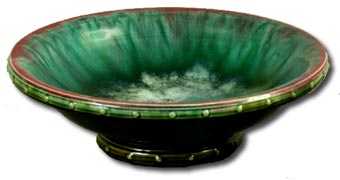
In 1876 Dresser went to America and then onwards to Japan, collecting examples of Japanese manufactures on behalf of Tiffany & Co of New York.

He designed for various manufacturers in subsequent years, including Hukin & Heath, James Dixon & Sons, Ault, Linthorpe, Mintons, Benham & Froud and William Couper amongst others.

His range of designs covered almost all aspects of interior design & furnishing

Antiques Home » Arts & Crafts » Arts and Crafts Artists

Antiques Glossary

A B C D E
F G H I J
K L M N O
P Q R S T
U V W XYZ  

Antique Ceramics

Doulton Antiques
Worcester Antiques
Wedgwood Antiques
Derby Antiques
Moorcroft Antiques
Meissen Antiques

Antique Glass

Whitefriars Glass
Vaseline Glass
Carnival Glass
Rene Lalique Glass
Georgian Glass
Victorian Glass
Art Deco Glass
Art Nouveau Glass