
Contents
Your Guide to Collecting Arts & Crafts antiques and the Arts and Crafts Style
The Arts and Crafts movement, its style and its influences, from William Morris to Gustav Stickley and William de Morgan.
In 1861 the english designer William Morris started the arts and crafts movement in an effort to improve the tastes of the victorian public.
William Morris hoped to overcome the banality and inferior quality of industrially produced decorative arts by promoting a return to medieval style craftsmanship.
The arts and crafts movement was the parent of art nouveau, but it persisted into the new period and after 1900 merged into the mainstream of the newer style.
Another development that influenced art nouveau was the aesthetic movement, an english decorative arts style created by followers of william morris during the 1880s.</p.
The aesthetic movement took its sources from medieval art, as did its arts and crafts counterpart, but it adapted the newly discovered arts of Japan as well. It survived for only a decade, and much of the style was absorbed into Art Nouveau.
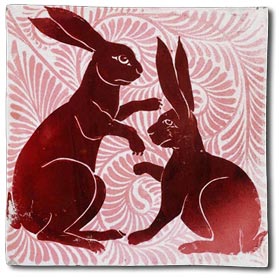
Some of the William Morris inspired fabrics and wallpapers of Walter Crane, Charles Voysey, and Arthur Macmurdo (1851-1942), designed in 1882, could easily be mistaken for Art Nouveau circa 1895.
The art and architectural criticism of Ruskin, laid the foundation of the arts and crafts movement
And lectures on the decorative arts of William Morris were available at the Boston Athenaeum and other American libraries as soon as they were published in London.
In 1873 William Morris & Company began to sell their wallpapers in Boston and by the mid-1870s had representatives for their growing line of wallpaper, fabric and carpet, in many major American cities.
The Arts & Crafts Movement also shaped American architecture
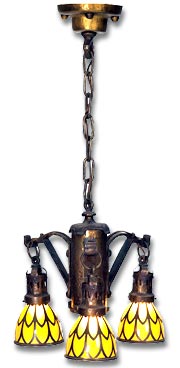
Especially with the development of the Queen Anne Revival, and with emerging styles that were based on the "old-fashioned homes" of the American Colonial period: the Shingle Style and the Old Colony Style.
The first generation of arts & crafts employed a diverse expression of styles, which drew inspiration from England, but also from Japan and from the regional crafts and architecture of America
Arts & Crafts Movement ideas were given an even wider audience during the 1882 American tour of Oscar Wilde.
He championed Morris, the Pre-Raphaelites and the design and art-manufacturing philosophy in lectures presented in over 120 North American towns and cities.
By the mid-1880's, English designs and locally made Arts & Crafts products were specified by trendsetting American architects and selected by affluent homeowners for the most stylish and fashionable American townhouses, suburban cottages and country villas.
It was the children who grew up in these artistic homes of the 1880s who became patrons of Gustav Stickley, who subscribed to the Craftsman Magazine, and who built bungalows for their first homes.
What to look for when designing your authentic arts & crafts interior.
Colour schemes - Use natural creams, terracotta, mustard yellow, olive green, deep blue and a deep crimson.
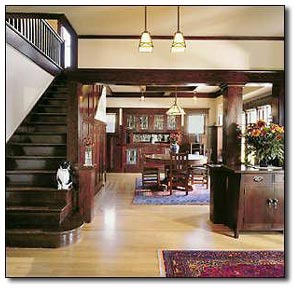
Walls - Wood panelling to be truly authentic and it should be painted a muted green or greeny-blue. Sherwin-Williams have a range of historic palettes, including an arts & crafts range that shows good combinations of colours.
Wallpaper - was the key decoration. Original patterns used vegetable dyes and wood blocks. However, hundreds of original William Morris designs are still manufactured by the major companies like Sanderson. Patterns should be on a large-scale with repeats. Sanderson bought the original printing blocks from Morris's firm when it closed down.
Floors - Should be natural wood in either parquet or boards in oak and give a rustic feel. They should be polished or stained to a dark gloss finish that reflects the light.
Furniture - Handmade natural wood furniture. Oak is the wood to look for. Decoration should feature cut-outs of upside down hearts; pieces with copper inlays and leather straps. Chairs should have rush or leather seats.
Fireplaces - An original arts and crafts fireplace should dominate a room with huge wide hearths set in an inglenook or recess. The mantelpiece should be carved oak, often with a motto above it.
Tiling - should be art nouveau in style with brighter colours - cobalt blue, turquoise, greens and reds. Typical motifs include galleons and stylised flowers. Originals are available in salvage yards. Reproductions are available from large outlets.
Oriental Influences should feature and add a sense of the Orient by adding blue and white china, palm leaf fans, screens and oriental rugs.
Stained glass - was a very popular addition and enhanced the medieval feel. There are still stained glass designers around or the modern equivalent is available as an option from double glazing companies.
Curtains - Should be supported by plain wooden or brass curtain poles. Curtains shouldn't have any frills or flounces.
Lighting - Well made plain wall sconces with good lines and well formed glass shades. Nothing dangling or overly ornate.
Flowers - Enhance the decoration using simple flower arrangements or use green house plants such as potted palms or cheese plants.
Follow the William Morris Codex -
Have nothing in your house that you do not know to be useful or believe to be beautiful
A chronological history of the arts and crafts movement.
1819 - Birth of John Ruskin.
1834 - Birth of William Morris.
1848 - Pre-Raphaelite Brotherhood formed and first Pre-Raphaelite works exhibited.
1849 - Paris: 11th Trade Exhibition. Visited by Henry Cole, and Matthew Digby Wyatt, who had been asked to prepare a report on the Exhibition for the Society of Arts. It was this exhibition which was the inspiration for the Great Exhibition organized by Henry Cole and Prince Albert.
1851- London: the 'Great Exhibition' (the Great Exhibition of the Works of Industry of All Nations), held under the direction of the Prince Consort and Sir Henry Cole. Allegedly visited by Morris, then aged 17, who was nauseated by the tasteless and materialistic display.
1853 - Great Industrial Exhibition, Dublin.
- World's Fair of the works of Industry of all Nations, New York.
1854 - Working Men's college started in London by F.D. Maurice
1855 - Paris: L'Exposition Universelles des Produits de l'Industrie de toutes les Nations, included the works of the Pre-Raphaelites which had a considerable influence on the French Realist School.
1856 - Owen Jones' 'The Grammar of Ornament' published, the first book to have full colour plates coloured by chromolithography.
1857 - American Institute of Architects founded in New York.
- October: An exhibition of British painting opened in New York, going on to Washington, Philadelphia and Boston, including Pre-Raphaelite works assembled by Ernest Gambart.
- Rossetti undertook the decoration of the Oxford Union Library with the assistance of William Morris and other members of the pre-Raphaelite circle.
1859 - Planning and building of Morris' Red House by Philip Webb at Upton in Kent.
- Furniture designed, especially made and decorated for the house by Morris, Web, Rossetti and Burne-Jones. The interior was decorated with fresco painting.
1861 - Morris, Marshall, Faulkner & Co. founded to provide the type of furniture so conspicuously lacking in the mid nineteenth century - solidly constructed and without superfluous ornament. Madox Brown, Rossetti and Burne-Jones all worked for the firm, as did Arthur Hughes, another Pre-Raphaelite, albeit briefly. The foreman glass worker was George Campfield, a recruit from the Working Men's College.
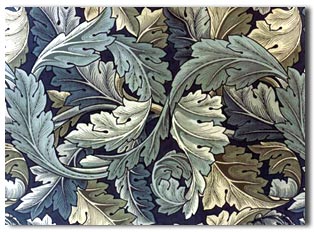
1862 - London: International Exhibition. Included a stand furnished by Morris & Co. which was praised for archaeological exactness of their imitation of the style of the Middle Ages, and the first Japanese art and crafts works to be widely seen, which had an immediate and widespread effect on the design of the period.
1866 - Morris & Co. undertook two important commissions; the decoration of the Green Dining Room at the South Kensington Museum and of the Armoury and Tapestry Room at St. James's Palace.
1867 - Paris: L'Exposition Universelle
1871 - 1st South Kensington Exhibition.
- Ruskin's 'Fors Clavigera' began to appear in instalments and was eagerly read by A.H. Mackmurdo, amongst others.
1872 - 2nd South Kensington Exhibition.
- William De Morgan, who had been working since the early days of the firm for Morris & Co., set up his own pottery in Chelsea.
1873 - 'Martin Brothers' pottery established by the brothers Robert, Wallace, Edwin and Charles Martin in Fulham.
- Vienna: Universal Exhibition.
- 3rd South Kensington Exhibition.
1874 - Morris began his experiments with fabric design.
- 4th South Kensington Exhibition.
1875 - Formation of 'Liberty & Co.', a shop specializing in Oriental art and artifacts. Patrons of the new shop included E.W. Godwin, D.G. Rossetti, Burne-Jones and Whistler.
- Christopher Dresser, after his visit to Japan, attempted to open a business selling Oriental goods (Dresser and Holme set up in 1878 in Farringdon Road) and in 1880 was appointed Art Manager of the Art Furnishers' Alliance. Both businesses failed. Dresser's son Louis, however, later worked for Liberty & Co.
- Jonathan T. Carr began the building of Bedford Park, Chiswick, employing E.W. Godwin and Norman Shaw as architects. Completed in 1881, it was an attempt to create a colony of artistic interiors. W.B. Yeats was among the first to live there.
1876 - Philadelphia: Centennial Exposition. The displays of both Oriental pottery and E. Chaplet's 'Limoges' glazes influenced studio potters in America, especially Hugh C. Robertson and M. Louise McLaughlin.
- Christopher Dresser lectured in Philadelphia and his influence can clearly be seen in the change of style of Daniel Pabst's work, which had been exhibited that year.
- Dresser was commissioned to make a collection of Japanese artifacts, including glass, for Tiffany & Co. while he was in Japan in 1877.
1877 - M. Louise McLaughlin developed 'Limoges' underglaze painting.
- New York Society of Decorative art founded 24th February.
- Martin Bros. Move from Fulham to Southall.
- Morris founded 'Anti-Scrape', the 'Society for the Protection of Ancient Buildings'
1878 - Herter Brothers of New York designed the interior of the Mark Hopkins House in San Francisco, to which the California School of Design moved in 1893.
- Paris: L'Exposition Universelle.
- London: International Exhibition at South Kensington.
1879 - C.H. Brannam Ltd. Established in Barnstable, Devon by Charles Brannam for the production of art pottery, known as 'Barum Ware', which was featured in later Liberty & Co. catalogues.
- Louis C. Tiffany & Co., Associated Artists, founded in New York with the co-operation of Candace
Wheeler and the Society of Decorative Art. - Women's Pottery Club founded in Cincinnati to provide useful and artistic means of gaining an income for women.
- London: International Exhibition at South Kensington.
1880 - Rookwood pottery founded in Cincinnati.
1881 - Fourth American edition of Eastlake's 'Hints on Household Taste' published. It was first serialised in 'Queen', 1865-6 and proved incredibly successful in America, giving rise to the 'Eastlake Style'.
- Aller Vale Pottery re-organised for the production of art pottery after a fire had destroyed the old factory.
1882 - Partnership of Henry Tooth and William Ault established the Bretby Art Pottery.
- Messrs Wilcox of Leeds began the manufacture of Burmantofts Faience which continued until 1904.
- Oscar Wilde, undertook a wildly successful eighteen months lecture tour of America, preaching the Aesthetic ideal of art and decoration.
- Century Guild founded by A.H. Mackmurdo, Selwyn Image and Herbert P. Horne.
- The architect H.H. Richardson traveled to Europe and visited Morris at Merton Abbey and here he met Burne-Jones and showed 'unbounded enthusiasm' for De Morgan's work.
1882/3 - L.C. Tiffany & Co., Associated Artists, decorated the White House.
1883 - Mackmurdo's book on 'Wren's City Churches' published with the famous title page, now seen as a seminal influence on Art Nouveau.
- The Ladies Home Journal founded in America: it was later to contain articles on Art and Crafts design.
- The American Exhibition of the Products, Arts and Manufactures of Foreign Nations in Boston, U.S.A.
1884 - First appearance of 'The Hobby Horse', a quarterly magazine of the Century Guild. Printed on hand made paper with the advice and assistance of Emery Walker it is a precursor of Morris' experiments with fine printing at the Kelmscott Press.
- Art Workers Guild formed by the pupils and assistants of Richard Norman Shaw joining together with the 'Fifteen', a group launched some four years earlier on the initiative of Lewis F. Day.
- Keswick School of Industrial Arts founded as an evening institute by Canon and Mrs. Rawnsley.
1885 - Home Arts and Industries Association established by Mrs. Jebb with the support of A.H. Mackmurdo.
- The annual exhibitions held at the Royal Albert Hall show work of all the local classes and guilds.
1886 - Liverpool Exhibition. Mackmurdo's stand provided yet more inspiration for the Art Nouveau artists of the 'fin de siecle'. The elongated roof supports ending in wide flat ornamental finials are the prototypes of many later architectural decorative features.
1886/7 - Charles Robert Ashbee went to live at Toynbee Hall, the pioneer University Settlement in the East End of London. He lectured at places such as Deptford or Beckton, 'of Gas Works fame' to recruit men for Toynbee Hall. There he started a Ruskin reading class which he expended into a class of drawing and decoration. He supervised the decoration of the Toynbee Hall dining room by members of his own class, and it was from these pupils that the nucleus of his Guild of Handicraft was drawn.
1888 - Guild of Handicraft founded with three members and a working capital of fifty pounds. Despite Morris' doubts, he met Ashbee's plans with a great deal of cold water, the Guild was remarkable successful for many years, only running into financial difficulty in 1907.
- Arts and Crafts Society founded by splinter group from the Art Workers' Guild. The founder members included Walter Crane, Heywood Sumner, W.A.S. Benson, William De Morgan, Lewis F. Day and W.R. Lethaby. It was another of their number, T. Cobden Sanderson that coined the felicitous phrase 'Arts and Crafts' to replace the clumsy title originally used of 'The Combined Arts Society'. The first exhibition was held at the New Gallery in October.
- National Association for the Advancement of Art in Relation to Industry formed. At both the first Congress in Liverpool, and at Edinburgh the following year, Morris and Crane spoke on socialist issues and were said to have spoiled the Congress.
- Glasgow International Exhibition.
1889 - Paris: Exposition Universelle Internationale.
- An exhibition of American work was held at Johnstone, Norman & Co. Galleries in New Bond Street; it included decorative designs by John La Farge and Rookwood Faience.
1890 - Establishment of the Kelmscott Press, the venture that was to dominate Morris' last years.
- Birmingham Guild of Handicraft founded with Montague Fordham as first director.
- Vittoria Street School for jewelers and silversmiths opened in Birmingham.
- Kenton & Co., the furniture firm, founded by Ernest Gimson, Sidney Barnsley, Alfred Powell, Mervyn Macartney, W.R Lethaby and Reginald Blomfield.
- Charles Rohlfs opened his furniture workshop in Buffalo, USA
- Walter Crane visited America.
- The work of C.F.A. Voysey first began appearing in American journals.
1891 - Kenton & Co. exhibition at Barnard's Inn, the premises of the Art Workers Guild. The Company failed in 1892.
- Arts and Crafts exhibition held in Brussels, inspired the foundation of ' L'Association Pour L'Art'.
- Chelsea Pottery opened in Chelsea, Mass, by Hugh C. Robertson.
- George and Albert Stickley established Stickley Bros. Co. in Grand Rapids.
- Voysey's work exhibited at the Boston Architectural Club.
1892 - Walter Crane lectured at the Art Institute of Chicago.
- Elbert Hubbard, the founder of the Roycrofters, visited Morris at Hammersmith and saw the Kelmscott Press which was to inspire his own experiments in fine printing.
1893 - Chicago: World's Columbian Exposition; World's Fair. Included exhibits by Tiffany & Co.
- The first number of 'The Studio' was published in April, including an interview with C.F.A. Voysey, articles on Morris' decoration at Stanmore Hall, the work by students at Birmingham Town Hall, and work by Walter Crane, A.H. Mackmurdo and Frank Brangwyn. It was this propagandist magazine which disseminated the activities and ideals of the Arts and Crafts movement.
- Frank Lloyd Wright set up his own architectural practice in Chicago.
- Voysey's work first appeared in the 'International Studio' and was also exhibited at the Chicago World's Fair.
1894 - Della Robbia pottery established by Harold Rathbone in Birkenhead.
- Grueby Faience Co. started in Boston.
- First Arts & Crafts society founded in San Francisco; it was called the Guild of Arts & Crafts of San Francisco or the San Francisco Guild of Arts & Crafts.
- The First mission style furniture was made in San Francisco; the first item was a chair for the Swedenborgian Church in San Francisco, followed by a rocker and probably other furniture made by Forbes Co.
1895 - Samuel Bing published his 'La Culture Artistique en Amerique', the result of his observations made during a trip to the United States in 1893 to visit the Chicago World's Fair. At the end of the same year he altered his shop which had previously concentrated on the sale of objects imported from the Far East, into a showcase for modern designers and craftsmen; now known as the 'Galeries de l'Art Nouveau'
- Birmingham Guild of Handicraft became a limited company with the Right Hon. William Kenrick M.P. as director.
- Newcomb College Pottery established in New Orleans for women students.
- Chalk and Chisel Club organised in Minneapolis, which later became the Minneapolis Arts and Crafts Society in 1899.
- Venice: Esposizione Internationale d'Arte (1st Biennale)
- Liege: L'Oeuvres Artistiques exhibition.
1896 - Death of William Morris in October.
- Foundation of the Central School of Arts and Crafts with W.R. Lethaby and George Frampton as joint principals.
- Charles Rennie Mackintosh Art Nouveau Artist won the competition to provide the design for the new Glasgow School of Art.
- The Song of Songs completed at Roycroft by Elbert Hubbard.
- C.R. Ashbee visited New York and Philadelphia.
- Dedham Pottery opened in Dedham, Massachusetts with Hugh C. Robertson as director after the failure of the Chelsea Pottery.
- First issue of 'House Beautiful' published in Chicago.
1897 - Pilkington's, the glass manufacturers, established their pottery, manufacturing tiles and other wares designed by Walter Crane, Lewis F. Day and C.F.A. Voysey.
- First major Arts and Crafts exhibition held at Copley Hall, Boston in April.
- On June 28th the Boston Arts and Crafts Society was founded.
- Chicago Arts and Crafts Society founded on 22nd October.
- Charles Rennie Mackintosh undertakes the designing, decoration and furnishing of a number of tea-rooms in Glasgow for the Misses Cranston. The tea-room movement had begun in the 1870s to combat day time drunkenness by providing billiard rooms, smoking rooms etc. Mackintosh collaborated on the Buchanan Street and Argyll Street rooms with George Walton but had complete control over the Ingram Street (1901) and Willow (1903-4) tea-rooms. The work was not completed until 1916.
- Brussels: International Exhibition.
- The first article on Frank Lloyd Wright appeared in 'House Beautiful'. A second followed in 1899.
1898 - The artists colony at Darmstadt set up by the Grand Duke of Hesse. Furniture designs commissioned from M.H. Baillie Scott and C.R. Ashbee and made by the Guild of Handicraft.
- The Ruskin Pottery established by W. Howson Taylor, son of the remarkable headmaster of the Birmingham School of Art, E.R. Taylor, who provided some of the decorative designs for the pottery. W.H. Taylor was throughout his career preoccupied with the use of experimental glazes and the interest of Ruskin pottery lies solely in the use of glaze effects.
- Omar Ramsden and Alwyn Carr set up in partnership in London establishing a recognizable style of elaborated 'Arts and Crafts' inspiration. Much of the work was carried out by assistants.
- Gustav Stickley Co. founded in Syracuse, New York in May. That year he also visited Europe, meeting Voysey, Ashbee, Samuel Bing and others.
- William H. Grueby introduced matt glazes at his pottery, influencing many of the American studio potters.
- Vienna: 1st Secession Exhibition. Walter Crane exhibited.
1989/9 - Libertys Cymric silver range established. Many arts and crafts artists employed as designers, among them Arthur Gaskin, Bernard Cuzner and Reginald (Rex) Silver, but the most prolific and consistently used was the Manxman, Archibald Knox.
1899 - Adelaide Alsop Robinea, an associate of the University City Pottery, Missouri, began publication of 'Keramic Studio' in Syracuse, to provide good designs for other potters.
- Industrial Art League founded in Chicago; disbanded in 1904.
- Vienna: 3rd Secession exhibition. Walter Crane exhibited.
- Venice: Eposizione Internationale d'Arte (3rd Biennale, twenty Glasgow School exhibits).
1900 - Paris: L'Exposition Universelle. This exhibition provided an unrivalled showcase for the work of Art Nouveau designers. The work of the obscure Bromsgrove Guild, founded in the early 1890's by Walter Gilbert, cousin of the sculptor Alfred Gilbert, was by some organisational oversight, practically the only English craftwork to be seen.
- John Ruskin and Oscar Wilde die, one mad, the other disgraced.
- L. and J.G. Stickley from their own company in Lafeyetteville, New York.
- Guild of arts and Crafts of New York organised.
- C.R. Ashbee on a lecture tour of America; he met Frank Lloyd Wright at Hull House, Chicago.
- Paris: Centennial exhibition.
- Vienna: 8th Secession exhibition. It included rooms by the Glasgow School and Ashbee's Guild of Handicraft.
1901 - Ernest Gimson established his furniture workshops in Cirencester, where he was joined by Peter Waals.
- Artificers' Guild founded by Nelson Dawson.
- Buffalo: Pan-American exhibition.
- Artus Van Briggle started his own pottery studio in Colorado Springs.
- Rose Valley Association incorporated at Moylan, Pennsylvania by W.L. Price and M. Hawley McLanahan based on the ideals of Morris' 'News from Nowhere' which had been published in England in 'The Commonwealth', 1890.
- 'The Craftsman', first published by Gustav Stickley at Syracuse in October.
- Furniture shop started by Roycrofters in East Aurora.
- Glasgow: International Exhibition.
- Venice: Esposizione Internationale d'Arte.
1902 - Handicraft, first published in Boston.
- Handicraft Guild established in Minneapolis.
- Society of Arts and Crafts founded in Grand Rapids.
- Gimson's permanent workshop opened at Daneway House, Sapperton, which formed a focal point for the activities of the Cotswold School. The same year the Guild of Handicraft moved to Chipping Campden in the same neighbourhood as Sapperton.
- J. Paul Cooper appointed head of the metalwork department at the Birmingham School of Art.
- Van de Velde opened a craft school in Weimar, the first of the activities leading eventually to the Bauhaus.
- Tobey Furniture Co. of Chicago held an exhibition of Morris fabrics, reviewed in 'House Beautiful' by an Englishman,
- Joseph Twyman. Marshall Field & Co. of Chicago stocked Morris & Co. goods.
- Vienna: 15th Secession exhibition. It included Jewellery by Ashbee and Edgar Simpson.
- Turin: Esposizione Internationale delle Industrie e del Lavoro.
1903 - William Morris Society founded in Chicago, 7th May, by Joseph Twyman.
- Rose Valley Association began publication of 'The Artsman'.
- Henry Wilson published 'Silverwork and Jewellery'.
- Artificers Guild acquired by Montague Fordham, one time director of the Birmingham Guild of Handicraft.
- Vienna: 17th Secession exhibition. It included Jewellery and silver by Ashbee.
1904 - Alexander Fisher set up a school of enamelling in his Kensington Studio.
- St. Louis: Louisiana Purchase International Exposition, The Art Palace.
- Voysey was commissioned to design a courtyard in Massachusetts.
1905 - Tiffany pottery first sold to the public.
- Buffalo: Pan-American Exposition.
- Liege: Exposition Universelle et Internationale.
- Ernest Batchelder visited England and went to Chipping Campden where he noted a 'spirit of discontent' among Guild members. He wrote an article on his visit,
- 6th Biennale in Venice, the English section designed by Frank Brangwyn.
1906 - C.L. Eastlake died.
- Californian earthquake and fire.
- The furniture Shop and Philopolis Press founded in San Francisco by A.F. and L.K. Mathews. The publication of the press, including Philopolis, were dedicated to the rebuilding of San Francisco.
- Della Robbia pottery closes.
- Vienna: 24th secession exhibition. It included silver and Jewellery by Ashbee.
1907 - Founding of the Deutsche Werkbund by Hermann Muthesius who had been sent in 1896 by the Prussian Board of Trade to England to make a study of English architecture and decoration.
- National League of Handicraft Studies organised in Boston in February.
- Last issue of 'The Artsman'.
- Greene and Greene begin work on the Blacker House in Pasadena.
1908 - Ashbee visited America to lecture. After his visit he contributed articles to 'House Beautiful'.
- Dick Van Erp opens the Copper shop in Oakland.
- Saragossa. L'Exposicio Hispanico-Francesca.
1909 - Guild of Handicraft disbanded.
- 'Modern English Silverwork' and essay by C.R. Ashbee, printed at his Essex House Press.
- Only issue of 'Arroyo Craftsman' published in Los Angeles in October.
- Rose valley Community bankrupt.
- Frank Lloyd Wright undertook his first West Coast commission.
- Ashbee visited California and met the Greenes , comparing their adaption of Japanese architectural details favourably with the work of Frank Lloyd Wright.
1910 - Fulper Pottery Co., New Jersey began production of art pottery.
- Frank Lloyd Wright's 'Augefuehrte Bauten und Entwuerfe' published in Berlin with a foreword by Ashbee. That year he stayed with Ashbee in Chipping Campden.
- Stickley was forced to admit in 'The Craftsman' that not only had he never built the Craftsman Houses, which he had designed and published, but that he knew that their cost would be much higher than his estimates. 'The Craftsman's' circulation began to drop from what had been its peak.
- Brussels: Exposition Universelle et Internationale.
1911 - Turin: International exhibition. University City pottery won the Grand Prize of Europe for Mrs. Robineau's 'scarab' vase.
- In August 1911 and November 1912 articles on and by Voysey appeared in 'The Craftsman'.
1912 - Archibald Knox visited Philadelphia and New York.
- 'Imprint' Founded by Gerald Meynell, with Edward Johnston, Ernest Jackson and J.H. Mason as editors. W.R. Lethaby contributed to it. This magazine only survived for a year, but demonstrated Britain's lead in printing and typography, following on form the Kelmscott Press.
1913 - Omega Workshops opened in Fitzroy Square by Roger Fry with work by Duncan Grant, Vanessa bell, Wyndham Lewis, Frederick Etchells and Cuthbert Hamilton. They specialized in interior decoration with murals, painted furniture, pottery and rugs. The venture, influenced by Poiret's Paris workshops survived until 1919.
- Ghent: Exposition Universelle et Internationale.
1914 - Deutsche Werkbund exhibition in Cologne.
- Paris: Exposition de l'Art Decoratif de la Grand-Bretagne et d'Irlande. Held at the Louvre, and organised by the Board of Trade, the exhibition featured work of all the leading arts and crafts artists.
1915 - Gustav Stickley enterprises declared bankrupt.
- Alice and Elbert Hubbard perish on the Lusitania, 7th May.
- Founding of the Design and Industries Association. Many of the leading Arts and Crafts figures were instrumental in its formation, including Harry Peach of the Dryad Workshops, Harold Stabler, Selwyn Image, W.A.S. Benson, W.R. Lethaby and Ambrose Heal.
- San Francisco: Panama-Pacific International Exposition.
- San Diego: Panama-Californian Exposition.
1916 - Last issue of 'Philopolis', September.
- Last issue of 'The Craftsman', December.
1919 - The Bauhaus founded in April in Weimar by Walter Gropius, who had studied architecture under Peter Behrens.
Leave a Reply
You must be logged in to post a comment.