
Contents
Tips and Advice on Caring for, storing and repairing your antique paintings, pictures and prints
In caring for antique paintings pictures and print material, how and where a painting is hung is crucial to keeping it in good condition.
Photographs, books and stamps also benefit from proper display, storage and constant care.
Always hang antique paintings or pictures securely, in a spot that is neither damp, above a fire or radiator, nor in too bright a spot.
Make sure air circulates around it by letting it lean away from the wall. If necessary glue cork pads to the lower corners of the frame for extra insulation.
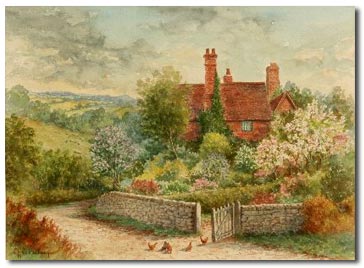
Only use metal picture wire and one or two steel or brass picture hooks depending on the size and weight of the painting.
Heavily glazed antique pictures may also need to be supported at the base on brackets fixed to the wall.
Screw eyehooks onto the frame, never into the stretcher or back board.
With a heavy picture, put a pair of hooks on each side, fastening the wire and running free through the upper pair. Then if one hook gives way the painting will still be supported.
Framing your valuable antique painting, picture or print.
Whether you learn to mount and frame pictures yourself or go to an expert, it is important to understand how framing and mounting will help to conserve your works of art.
Antique Oil paintings must be set in a frame deep enough to accommodate the painting on its stretcher.
The frame can be lined with velvet ribbon or inert foam-rubber strips to protect the edges of the painting. If the rebate is too deep, it can be padded out with cork or balsa-wood strips. If it is too shallow, the frame can be built up with strips of wood.
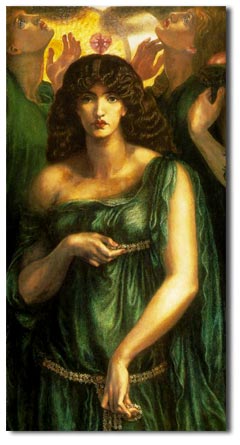
Mirror plates or brass plates screwed into the frame and overlapping the stretcher, hold both picture and stretcher firmly in place.
Antique Oil paintings are coated with varnish and do not usually need to be glazed.
However, if you feel more comfortable glazing the painting to protect it further, then do so.
Works of art on paper must be mounted on acid free board.
Check whether an existing mount is acidic by looking at the bevelled edges of the window; if there is a brown stain around the line of the window, the board is likely to be made from poor quality wood pulp and should be replaced.
The mount separates the glass from the painting or picture and this not only prevents the work from being rubbed and from sticking to the glass but also provides a thin layer of air, which deters mould.
Your antique frame must be strong enough and deep enough to hold the backing board, mounting board and glass.
The backing board helps keep dust and insects out – especially if it is sealed with gummed paper tape around the edges, and secures the picture firmly in its frame. As it is often made of wood or hardboard and acidic, it should not touch the back of the picture and should also be coated with polyurethane varnish or lined with acid-free paper.
Paintings on paper do not have that protective layer of varnish, and should be glazed.
The glass will also keep out insects such as silverfish, thunderflies or thrips, which feed on the paper then die and leave stains.
Acrylic (Perspex) sheeting is lighter and less fragile than glass but scratches easily and attracts dust more readily.
Clip-frames, cuts of glass and (acidic) hardboard clipped together, are neither dust proof nor insect proof and are unsuitable for long-term mounting.
Cleaning your antique paintings, pictures and prints.
Beyond removing surface dust with a soft squirrel brush, or lightly dusting the case of a miniature, the cleaning of pictures, either oils or on paper is a job for the professional repairer or restorer.
The dangers of lighting your antique painting incorrectly.
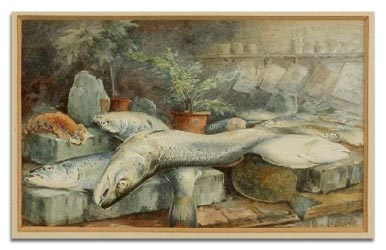
Most pigments used for antique works of art on paper are extremely sensitive to light and fade dramatically; for this reason, precious items should never be photocopied.
Oil paints are less likely to fade but will dry and crack with heat from direct light.
Beware of purpose-made picture lamps.
The bulbs are usually ordinary incandescent lights which will overheat the area they illuminate.
Even cool beam lamps should not be left on for long.
Storing your antique paintings and pictures.
Store framed antique paitings and pictures in a cool dark clean dry place. Remove hooks or any protections that may harm the frames or pictures.
Stand the pictures on wooden blocks to raise them above floor level and place acid-free board between each one.
Ensure the largest, heaviest pieces take the weight at the back and place a weight in front of the stack.
Cover the lot with a clean sheet – never polythene as this encourages mould.
Unframed antique works of art on paper should be stored in an acid-free box or folder.
Place acid-free tissue between each work and hold horizontally.
Sulphur vapour from certain substances, including some plastic folders, causes paper to discolour
Storing and displaying antique books.
Display books on a shelf that has been painted or varnished, and lined with acid-free card. Don’t forget that strong light will fade the spines. If the shelves are within a cabinet, make sure there is adequate ventilation.
Book-ends should be as large as the books they confine so that pressure is spread equally over the surface. Volumes should never be packed to tightly on a shelf. To remove a book, reach over the top of it, and ease it out from the back of the shelf, or part it
from the volumes either side and grasp it by the side.
Boards that have fallen off the sides of books can be temporarily held in place by tying cotton or crepe bandage around the book from top to bottom. This should not be visible when the book is on the shelf with other volumes.
Rebinding may de-value a rare book. A skilful craftsman can ease off an old spine, re-joint the original boards and re-attach the original spine. But even this process known as ‘re-backed with spine laid on’ may reduce the value.
If broken bindings are repaired or renewed, the original pieces should be kept safely as documentary evidence.
Storing and displaying your valuable stamp collection.
Only remove a stamp from its original envelope or card if you are sure its postmark is of no value.
Never steam the stamp off, but ‘float’ stamps off in lukewarm water and then dry them between layers of acid-free white blotting paper. Any mounting material that actually touches the stamps must also be acid free.
Chemically inert PVC sleeves are useful for mounting complete envelopes or cards, but make sure they do not seal completely as condensation may form.
Loose leaf albums combined with transparent photo mount corners are ideal, the stamps displayed on one side of each leaf only, in order that facing pages do not rub or catch.
Never use the adhesive tape or the gum of the stamp itself to fix it to a surface. Rather use 'gummed stamp hinges' and use the minimum amount of moisture at the top of the stamp. You should always be able to peel the stamp off again without damaging it.
Hinges should not be used for mint stamps, as this could reduce their value. Use hawid plastic mounting strips instead.
How to mend a tear in your antique painting with starch paste.
Never use adhesive tape on any work of art on paper. Starch paste and Japanese tissue paper can be used to mend tears and for mounting.
To make starch paste;
- Combine one pint (570ml) of de-ionised water with five teaspoons of calcium hydroxide (available from most chemists).
- Add a little of this solution to three ounce (85gms) of wheat flour and blend into a smooth paste, then add the rest of the liquid.
- Pour the mixture into a warm saucepan then boil for exactly five minutes, stirring continuously.
- Simmer for a further fifteen minutes then decant the paste into a clean bowl and leave in a cool place until it solidifies.
- The paste should keep for a few days in a refrigerator but if it starts to go mouldy do not use it.
To use:
- Lay the work of art face down on a clean smooth surface with a piece of backing paper beneath the tear.
- Tear a piece of Japanese tissue paper slightly longer and wider than the tear and lightly coat it with the paste.
- Place the patch over the tear and a piece of acid-free backing paper over the patch.
- Cover the area with a piece of white acid-free blotting paper and place a weight evenly, on top of it.
- Leave to dry for up to twenty four hours
Conserving Your Antique Paintings, Pictures and Prints
Conservation of oil paintings
Conservation work of any sort should be left to a professional. For instance, go to a restorer at the first signs of paint lifting or flaking, for once it starts, deterioration can be rapid. Remove the painting from the wall and lay it face up, so that the paint does not fall off.
The varnished surface on oil paintings often yellows with time and may need to be removed (without dissolving the paint layers beneath) and renewed.
A whitish bloom on the surface of an oil painting, brought on by a damp atmosphere, can be treated.
Bitumen, which is used in some 19th century oils, can form deep cracks with age. These are difficult to treat beyond a little filling and retouching to make the problem a little less obvious.
Photographs
The light sensitive silver salts in photographs are particularly vulnerable to chemicals. Photographs should ideally be displayed in albums with highly alkaline paper and mounted on corner mounts or stamp hinges, or in closed frames or transparent, acid-free polyester or polythene envelopes.
Conservation of works of art on paper
For most works of art on paper including watercolours, drawings, prints, photographs and books, there are common conservation problems associated with the paper rather than with the printing or painting process.
The more acidic a paper is the quicker it deteriorates, turning brown and crumbly in light, or in damp conditions developing mould or little brown spots known as foxing.
Overall discolouration is usually due to low-grade paper which becomes increasingly acidic with age. The problem is aggravated if the paper is in contact with other acidic materials such as cheap mounting board, so displaying or storing valuable paintings, pictures, stamps or books in acid-free materials is an absolute must.
NOTE: Stains and foxing of watercolours can sometimes be professionally removed by a skilled washing process. The carbon printing ink used for books and most European prints is quite stable, and can also be washed by a conservation specialist without harming the density.
Leave a Reply
You must be logged in to post a comment.