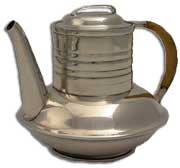
When caring for antique silver and other metals you should be aware that they react at different rates and in different ways to natural conditions, and their care, handling and restoration varies accordingly.
Despite their apparent toughness, metals can be scratched, dented or fractured, and may corrode.
If metals are combined with other materials, as in jewellery or furniture, your care should be adapted to fit the weaker material. If possible you should detach metal parts form other materials, such as sculpture, and clean them separately.
Always cover your work surface with a soft cloth and always try to wear clean cotton gloves as fingerprints can leave deposits that can cause tarnishing.
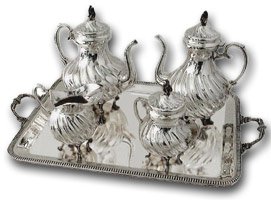
Before cleaning any item, check for loose parts or splits in the metal.
Use proprietary, of the shelf, metal polishes as little as possible as they work by removing a small amount of metal.
Dust regularly with a soft cloth and use a soft bristled brush for awkward places, it reduces the need for major cleaning.
For grime or light tarnish on metals, except for bronze and iron, wash in warm water with a little mild detergent added. Only immerse your object if it is all metal with no weaker materials. Cotton buds are useful for getting into and cleaning small areas. Always rinse the item and dry thoroughly with absorbent paper.
Never put precious metals in a dishwasher
as the salts and detergents may pit and stain the surface.
For heavier duty cleaning on antique silver, brass and copper only, you can use long term metal polishes that have a built in tarnish inhibitor.
Firstly, use a soft brush to remove dust and dirt that can scratch the surface if rubbed against it. Never be tempted to dislodge stubborn stains from metal with wire wool or an abrasive cloth. Then apply your cleaner with a soft cloth or soft brush in gentle circular movements. Rinse and dry the item once with an absorbent paper towel and remove polish from crevices with a dry soft brush.
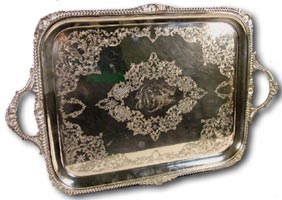
Seal antique silver, copper and brass
against corrosion with a lacquer. Remember though thet this not
only stops the item obtaining a patina but the lacquer is easily
scratched and marked by fingerprints and it can soon look patchy.
Preferably, use a light coating of microcrystalline wax applied after cleaning as an effective and less radical barrier.
Lacquer is worth considering for display items with intricate decoration that would wear away with too much cleaning.
To reduce tarnishing on antique silver that is not on display, wrap it in acid-free tissue or undyed cotton or linen.
Sulphurous foods such as egg and brussels sprouts cause tarnishing so the sooner the table silver is washed after contact with them, the better.
Although tarnishing is not actually harmful to silver, over-zealous
cleaning is. Especially with a plated item were too much polishing
or rubbing will eventually expose the base metal.
Metal polishes should be avoided on pieces that are worn, or niello work or on clocks or watches, where they could seep into the mechanism.
Silver or jewellers cloths, and silver dip or foam that can be wiped on large objects with cotton wool swabs, are the least abrasive cleaners. Try to limit the number of items treated per jar of dip, as particles of silver from cleaned items can be deposited on other items and cause unsightly marks that are difficult to remove.
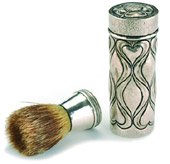
Silver that contains a large proportion of copper can corrode if it is kept in a damp atmosphere. This causes a green crystalline deposit (verdigris). This verdigris can be wiped off silver plate with methylated spirits but if it appears on solid silver it should be chemically treated by a professional metal conservation specialist.
Worn electroplate (EPNS) can be re-silvered either professionally or by using a proprietary re-plating agent.
However, the attractions of a bright new surface must be balanced against the possibility that the finish and colour may not be true to the original and the sharpness of any engraving may be dulled. The process may well de-value an antique piece particularly in the case of old Sheffield plate.
Make sure you establish whether your gold item is solid, plated, silver-gilt or ormolu, as gold is soft and the thinner the surface layer, the more easily it will be rubbed away.
Gold also scratches very easily, but doesn’t tarnish unless it has a high silver content, as in some 9ct gold.
Light dusting will usually be enough, but gold objects can be washed as long as no weaker materials such as porous gemstones are present in the piece.
Bronze
The dark or greenish brown patina that forms on bronze is highly
desirable and should be preserved; so don't use metal polish or
solvents on any bronze or any water on indoor bronzes. Dusting alone
should suffice. 
A dull patina can be revived by a very light coating of microcrystalline wax. Always make sure you test an inconspicuous area first to ensure the patina is stable as an artificially induced or painted patina may not be stable.
Apply the wax with a soft bristled brush and burnish gently with a soft cloth.
Archaeological bronzes or items that have been exposed to salty air may develop ‘bronze disease’ – small powdery green spots on the surface. You can wax a small area immediately but anything more serious should be taken to a conservation specialist or professional restorer for specialist treatment.
Spelter
Spelter is softer and more brittle than bronze and is prone to corrosion about which very little can be done.
Figures are often thinly cast and fragile, so alwyas make sure you hold them at the most solid part.
Painted or gilded figures should not be allowed to get wet but should only be dusted lightly with a soft haired artists brush.
Unpainted spelter can be waxed as per bronze above.
Lead
Lead is heavy but very soft, easily dented and scratched.
It is also poisonous so always wash your hands after handling.
Corrosion appears as a white powdery coating.
Dust indoor lead regularly.
A sound surface can be cleaned with a soft bristled brush or cotton wool moistened in water with a few drops of non-ionic detergent added. Rinse immediately and dry well. Microcrystalline wax helps to prevent further deterioration: apply one or two coats (leaving an hour between each) and buff gently with a soft cloth.
The
patina that forms naturally on copper and brass is a much sought-after
and valuable asset.
Brass carriage clocks for example, should never be cleaned with metal polishes.
Copper tarnishes to brown and corrodes to a relatively stable green patina; brass eventually acquires a matt greenish-brown surface.
Both metals scratch easily.
Regular light burnishing with a soft cloth or chamois should be adequate, or use a long term silver polish for light tarnishing.
For heavier stains long term brass and copper cleaners or impregnated wadding can be used.

Pewter is easily dented and scratched.
Antique pewter usually has a high lead content that reacts and corrodes more quickly in acid conditions, so avoid keeping the metal in oak furniture that is particularly acid, and always wrap in acid free materials for long term storage.
Whether you prefer pewter to be allowed to develop a matt tarnished surface or polished to a silvery finish is up to the you as the owner. A dull gleam introduced by regular, light buffing with a dry cloth is a good compromise.
If the surface is heavily stained or very dull, try gently wiping it with a rag impregnated with linseed oil and talcum powder. Remove this mixture with cotton wool swabs moistened with methylated spirits and then wash, rinse and dry thoroughly.
If watery spots or powdery corrosion appear; usually caused by the lead reacting with the acid in the atmosphere, pewter should be treated by a professional metal restorer
If exposed to damp, iron and steel will rust rapidly and will then pit, flake and eventually disintegrate completely.
Cast iron and wrought iron can be given a barrier coating of paint or graphite, but overpainting the original finish may reduce values. A microcrystalline wax or light penetrating oil are suitable for steel. Bear in mind that direct heat cracks paint, so iron grates and fire backs that are in use should be black leaded.
Before cleaning iron or steel, make sure the metal is absolutely dry, if the object is tough enough remove loose rust and paint with wire wool or a wire brush followed by a commercial rust remover or wire wool soaked in paraffin. Wipe clean and dry thoroughly then coat with a commercial rust inhibitor.
Remove minor rust spots with a mild abrasive cloth and a few drops of a light penetrating oil or gently scrape them off with a scalpel. Methylated spirits or white spirit are also useful cleaning agents.
Severe rust needs professional treatment such as sandblasting or chemical stripping to restore the surface to good metal before a protective coating can be applied.
Antique Marks Home » Caring for Antiques » Caring for Antique silver
| A | B | C | D | E |
| F | G | H | I | J |
| K | L | M | N | O |
| P | Q | R | S | T |
| U | V | W | XYZ |
• Doulton Antiques
• Worcester Antiques
• Wedgwood Antiques
• Derby Antiques
• Moorcroft Antiques
• Meissen Antiques
• Antique Glass
Great Deals on Antique Georgian Silver ...