
Contents
Early Derby Marks and newer Royal Crown Derby base marks.
Derby marks are many but most follow the same theme, with a cypher surmounted by a crown.
Dating early Derby is slightly more difficult than the more modern Royal Crown Derby, but dating Derby porcelain is much easier than many of the early English porcelain factories.
Derby porcelain was produced at three main factories.
Those being ...
Nottingham Road from 1756 to 1848
King Street from 1848 to 1935
And; Osmaston Road from 1877 to modern times.
Nottingham Road, Derby Marks (1756 to 1848)
In 1775, George III granted Derby Porcelain the right to incorporate the crown into the Derby backstamp.
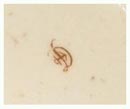
c1770 Derby Chelsea interlinked D and Anchor mark. William Duesbury fully acquired the famous Chelsea Works factory in 1770 and the Chelsea anchor mark and Derby 'D' were merged to form the Chelsea-Derby mark. |
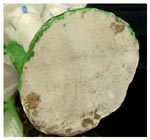
Patch Period c1756-1765 Marks on the bases of early soft paste Derby figures indicate the |
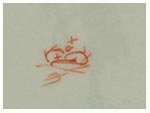
c1782-1825 Painted mark with Crown and D. Blue / Puce - 1782-1800 |
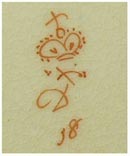
c1806-1825 Painted mark with Crown above crossed batons and D below. Blue/Puce - 1782-1800 |
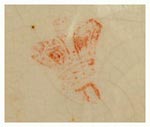
1820s' Large crown in red with large D below. |
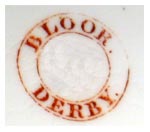
1825-1848 The earliest Bloor Derby Mark Robert Bloor took control of the Derby factory in 1811 and immediately began to build a team of very fine painters. |
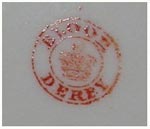
1825-1848 Later variation of the Bloor Derby Mark with crown in the centre. |
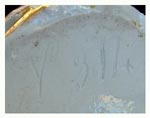
Incised Marks Derby also used incised marks on their early figures, consisting of No and a number. The mark pictured showing No314 on a seated figure. |
King Street, Derby Marks (1848 to 1935)
A group of former employees set up a factory in King Street in Derby, and continued to use the moulds, patterns and trademarks of the original business, but not the name. No mechanical processes were used and no two pieces produced were exactly the same. Among the items preserved was the original potters wheel used by the Duesburys.
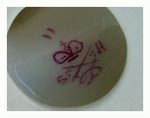
1863-1866 Stevenson and Hancock mark Showing Crown above crossed batons with S and H at either side. D below. Usually in red |
|
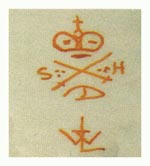
1916-1935 William Larcombe mark Showing Crown above crossed batons with S and H at either side. D below and interlinked WL beneath. Usually in red |
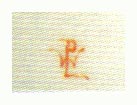
1917-1934 Larcombe and Paget mark. Showing Crown above crossed batons with S and H at either side and D below but with revised Larcombe monogram showing the L rising into a P. Usually in red |
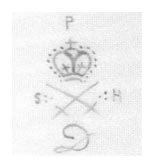
c1934 Paget mark. Showing P above Crown above crossed batons with S and H at either side and D below. Usually in puce. |
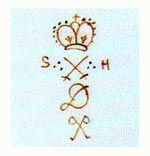
1934-1935 Later Paget mark. Showing Crown above crossed batons with S and H at either side. With D below and crossed P's below. Usually in red |
Osmaston Road, Derby Marks (1877 to modern times)
In 1877, Royal Crown Derby Porcelain moved to an impressive new factory at Osmaston Road and introduced new marks.
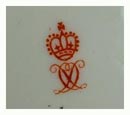
1877-1890 Showing Crown above interlinked D's. First mark to use the interlinked D's below the crown. More often seen with the year cypher below. |
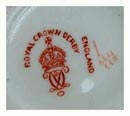
1891-c1940 Showing Royal Crown Derby in a circle above a Crown above interlinked D's with year cypher below. 1891-1921 with vertical ENGLAND at side |
|
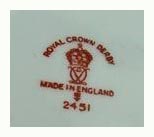
1921-1965 Showing Royal Crown Derby above Crown above interlinked D's with MADE IN ENGLAND below in red. This mark showing pattern number 2451. |
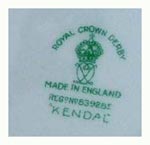
1921-1965 Showing Royal Crown Derby above Crown above interlinked D's with MADE IN ENGLAND below in blue. This mark with pattern name KENDAL and design Registration Number for 1909-1910. |
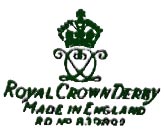
1940-1945 Wartime mark usually in dark green and without year cypher. Showing Crown above interlinked D's above ROYAL CROWN DERBY - MADE IN ENGLAND - Design Reg. No. |
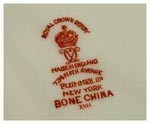
1921-1965 Showing Crown above interlinked D's with ROYAL CROWN DERBY - MADE IN ENGLAND This example with retailers details for 'Plummer of New York' and roman Numeral based year cypher of XVII for 1954. |
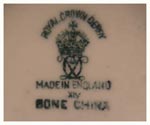
c1950 Showing Royal Crown Derby above Crown above interlinked D's with MADE IN ENGLAND (BONE CHINA) above pattern number and name. In blue. |
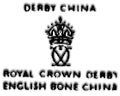
1964-1975 Showing DERBY CHINA above crown with interlinked D's above ROYAL CROWN DERBY - ENGLISH BONE CHINA. Often including pattern name and number and with Roman Numeral year cypher. |
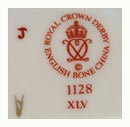
1976 to modern times The crown and interlinked D's are now within a circle of ROYAL CROWN DERBY - ENGLISH BONE CHINA. The © copyright character below the Derby logo. This mark including popular Imari pattern number 1128 and with Roman Numeral year cypher for 1982. |
|
Royal Crown Derby Year Cyphers (1880 to modern times)
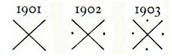
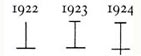
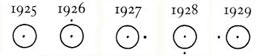
Derby porcelain also included a date cypher with most base marks produced at the Osmaston Road factory.
This took the form of a small graphic illustration below the main mark and later, from 1938, a Roman numeral. The V of 1904 can be confused with the Roman V of 1942 as can the X for 1901 and the Roman X for 1947. To differentiate both the earlier X and V you should check for ENGLAND or MADE IN ENGLAND, the later piece will have MADE IN ENGLAND.
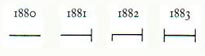
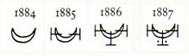
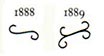
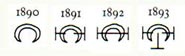
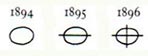
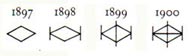




Derby Roman Numeral Year Cyphers :
| 1938 - I
1939 - II |
1940 - III
1941 - IV 1942 - V 1943 - VI 1944 - VII 1945 - VIII 1946 - IX 1947 - X 1948 - XI 1949 - XII |
1950 - XIII
1951 - XIV 1952 - XV 1953 - XVI 1954 - XVII 1955 - XVIII 1956 - XIX 1957 - XX 1958 - XXI 1959 - XXII |
1960 - XXIII
1961 - XXIV 1962 - XXV 1963 - XXVI 1964 - XXVII 1965 - XXVIII 1966 - XXIX 1967 - XXX 1968 - XXXI 1969 - XXXII |
| 1970 - XXXIII
1971 - XXXIV 1972 - XXXV 1973 - XXXVI 1974 - XXXVII 1975 - XXXVIII 1976 - XXXIX 1977 - XL 1978 - XLI 1979 - XLII |
1980 - XLIII
1981 - XLIV 1982 - XLV 1983 - XLVI 1984 - XLVII 1985 - XLVIII 1986 - XLIX 1987 - L 1988 - LI 1989 - LII |
1990 - LIII
1991 - LIV 1992 - LV 1993 - LVI 1994 - LVII 1995 - LVIII 1996 - LIX 1997 - LX 1998 - LXI 1999 - LXII |
2000 - MM Interlinked
2001 - MMI 2002 - MMII 2003 - MMIII 2004 - MMIV 2005 - MMV 2006 - MMVI 2007 - MMVII 2008 - MMVIII |
All Royal Crown Derby marks can be attributed to one of the three Derby factories.
Simply compare the style of the Derby mark and date the year cypher used to come as close as possible to the date of manufacture.
After dating you will want to then attribute the piece to an individual artist, if possible, and then assess how rare or sought after it may be based on it's age and the popularity of the artist.
Derby figures with the incised mark 'N' are particularly sought after and date to between c1765 and c1785.
The early Chelsea Derby marks can be attributed to the Nottingham Road factory and date to between c1770 and c1784.
The c1782 to 1825 marks of the Nottingham Rd factory can be quite untidy in appearance. They were handrawn in blue or puce until 1806 and in red after this
Some particularly fine painters worked at the King Street factory including Fredrick Chivers, Sampson Hancock, W Hargreaves and George Jessop. Any Derby piece by the above artists would be of great interest to serious Derby collectors.
Collecting Derby Porcelain ... try to focus your efforts on a particular factory, style or artist. Accumulating a good quality collection from one period or by one artist will help you become an expert in your chosen field.
Leave a Reply
You must be logged in to post a comment.