
Contents
Wedgwood's Fairyland Lustre Ware and those wonderful Daisy Makeig-Jones designs.
Daisy Makeig-Jones must surely have had fairies living at the bottom of her garden.
Where else could she have found the inspiration for the most magical of ceramic fairy wonderlands created for Wedgwood Fairyland Lustre? The pieces pictured here are products of Daisy's vivid imagination.
One of seven children, Susannah Margaretta 'Daisy' Makeig-Jones was born in 1881 in a small mining village near Rotherham, where her father was a GP.
From an early age, Daisy showed she had an artistic talent and when her father moved his practice to Torquay, she entered the towns School of Art.
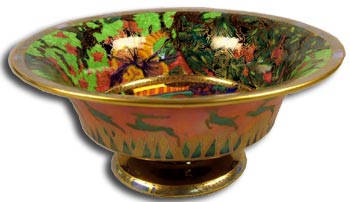
After a short spell at a London school of art, she managed, through a relative, to obtain an introduction to Cecil Wedgwood, at that time managing director of the company.
In 1909 Daisy joined Wedgwood as a trainee designer.
Despite fears that a doctor's daughter might find it difficult to adjust to factory life.
Wedgwood's rise to prominence in the 18th century was based on innovation in manufacture and designs that, despite being adaptations of classical motifs from the antique, were presented in a new form, which had broad based appeal.
However, during the 19th century Wedgwood lacked the innovation and energy provided by its founder Josiah I, and its wares became for the most part derivative, concentrating almost exclusively on production of its traditional basalt and jasper wares.
By the early 20th century, the Wedgwood factory was nearly bankrupt. The key to its survival to a very large extent was the development in the early 1900s, of a dazzling range of new glazing techniques, particularly the one that produced a multi-coloured iridescent finish.
The source of change at the Wedgwood Etruria works was those Daisy Makeig-Jones fairies.
They were loved by some and hated by others, indeed, some thought she was mad, but without doubt, they helped Wedgwood return to profitability after the First World War.
Daisy's art school training helped Wedgwood grow and by 1914, she was considered good enough to be given her own studio.
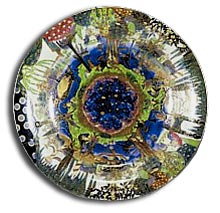
Fairies bring good luck they say. Daisy's run of luck began when she was placed in the studio next to where trials of new glazes were taking place. Glazes that were to add so much to her own inspired designs.
She was able to watch the painters at work and pass them watercolour drawings of her Fairyland ideas so they became part of those trials.
Daisy also carried out her own test firings using glazes of different colours and lustres that were adopted by Wedgwood when production on Fairyland lustre began, just nine months after Daisy was taken on as a staff designer.
The impact of fairyland lustre ware on the public was phenomenal and all the best shops clamoured to obtain pieces they could sell.
The first fairyland decorations featured butterflies, dragons, fish, birds and other naturalistic designs in stunning bold colour schemes. A bright welcome relief from the drabness of the war years.
However, these brightly decorated early pieces should not be confused with Daisy's true Fairyland Lustre, which first appeared in 1915.
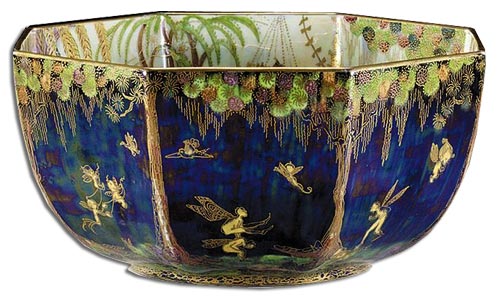
By that time Daisy's imagination was burgeoning with new ideas and a riot of colour followed.
Rich blues, purples, orange (her favourite colour), yellow, green and gold, were all worked in with with diminutive pixies, elves and sprites in ways reminiscent of book illustrations by Edmund Dulac and Arthur Rackham.
And, like all clever well constructed pictures, the harder you look the more you see: elves playing leapfrog; spiders spinning evil webs; gaudy rainbows over romantic castles; ghostly woods and apparitions in a mystical Land of Illusion.
Interestingly though, rather than being figments of an over active imagination many Fairyland Lustre designs have strong links with Celtic folklore, legend and tradition. Clearly though, Daisy's fairies do things their way.
The interest in Fairyland Lustre among today's Wedgwood collectors is, no doubt, fuelled by the urge to own a unique item of individual character.
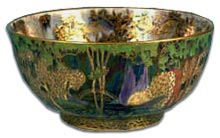
However, for those newer collectors, your search could prove long and expensive.
Prosperity was on the decline in the late 1920s and in 1930 a new chairman took the helm at Wedgwood, who could not appreciate the uniqueness of Daisy's fairyland lustre wares.
Daisy Makeig-Jones was first asked and then told to retire, and she did so under duress in 1931.
Daisy Makeig-Jones died in 1945, but her fairyland scenes have grown and continue to grow in popularity.
Because of her early retirement scarcity plays a large part in boosting saleroom prices for Fairyland Lustre and very little actually comes to the market.
Fairyland lustre ware is the type of item that can be overlooked at an auction, whether it's in the right place, or wrong place, it depends on how closely you look at it. Some designs are more subtle than others and only close inspection will show the depth and quality of the piece. Look closely and perhaps the fairies will bring you a little luck at the local jumble or yard sale.
Leave a Reply
You must be logged in to post a comment.