Royal Worcester porcelain, marks and artists - from antique-marks.com

Royal Worcester porcelain, marks and artists - from antique-marks.com
Royal Worcester porcelain, marks and artists - from antique-marks.com home Royal Worcester porcelain, marks and artists - from antique-marks.com antique marks classifieds antique marks auction calendar auction diary antique marks site blog rss rss antique marks
 
Royal Worcester porcelain, marks and artists - from antique-marks.com Royal Worcester porcelain, marks and artists - from antique-marks.com Royal Worcester porcelain, marks and artists - from antique-marks.com
Royal Worcester porcelain, marks and artists - from antique-marks.com antique marks  - everything you need to know about antique marks     antique marks  - all about antique pottery and porcelain marks
antique marks  - all about antique pottery and porcelain marks

antique marks  - all about antique pottery and porcelain marks

Valid CSS!


The foremost Royal Worcester Artists, with everyone from Baldwyn to Hadley, to Sebridge and Ricketts.

Royal Worcester History - from antique-marks.com Royal Worcester
Royal Worcester History - from antique-marks.com Royal Worcester fruit
Royal Worcester History - from antique-marks.com Royal Worcester Stinton family
Royal Worcester History - from antique-marks.com Royal Worcester Marks
Royal Worcester History - from antique-marks.com The Royal Worcester artists

Worcester Artists :
Royal Worcester Artists - from antique-marks.com Charles Baldwyn Royal Worcester Artists - from antique-marks.com James Hadley Royal Worcester Artists - from antique-marks.com Richard Sebright Royal Worcester Artists - from antique-marks.com Dorothy & Freda Doughty Royal Worcester Artists - from antique-marks.com Harry Austin Royal Worcester Artists - from antique-marks.com Harry Davis Royal Worcester Artists - from antique-marks.com Harry Stinton Royal Worcester Artists - from antique-marks.com James Stinton Royal Worcester Artists - from antique-marks.com John Stinton jnr

Royal Worcester Artists - from antique-marks.com The worcester fruit painters
Royal Worcester Artists - from antique-marks.com Royal Worcester Porcelain for Sale


antiques marks - royal worcester artist harry davis watercolour

Over the years royal worcester and all of its many incarnations have employed or been associated with some of the best and most innovate ceramics artists. The artists detailed below are currently a very small selection of these but we hope to grow this list extensively over the next few months.

Although worcester pieces take a great many skilled hands to manufacture, from around the year 1900 royal worcester allowed the painters to mark the work produced. The painters being the most notable member of the workforce as seen from the publics perspective and royal worcester allowed them to sign the work on the front face rather than include a monogram in the base marks. In addition most painters were encouraged to specialise in a particular theme and the best known of these include the following;

Painter Period Worked Speciality or Theme
Charles Baldwyn 1874-1909 Swans in flight & birds
Henry Chair 1872-1911 thistles, poppies, orchids & festoons of roses
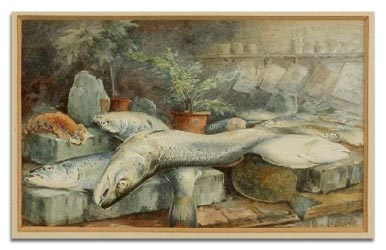
Harry Davis 1898-1970 fish, sheep, landscapes, architecture
George Evans 1914-1955 Corot style landscapes
William Hawkins 1874-1928 portraits, interiors & still life
George Johnson 1875-1914 game birds, flying swans & farmyard scenes
Ernest Phillips 1890-1932 neat flower groups & still life
William Powell 1900-1950 small British birds
Frank Roberts 1872-1920 flowers & fruit
Frank R. Rushton 1900-1953 landscapes, cottages & gardens
Edwin Salter 1876-1902 landscapes & fish
Richard Sebright 1882-1946 Fruit - viewed as the best fruit painter ever
Harry Stinton 1896-1963 Highland Cattle
James Stinton 1902-1951 Games Birds
John Stinton Jnr 1902-1938 Landscapes, castles, cattle & Highland Cattle

Charles Henry Clifford Baldwyn, 1843-1913

antiques a-to-z - royal worcester baldwyn swan vaseFew royal worcester artists are better known than Charles Baldwyn. (Charley). His paintings of swans in flight on royal worcester vases are instantly recognisable as his signature pieces.

He was born in 1859, the son of worcester piano tuner and skilled musician Henry Baldwyn.

Charles Baldwyn started work at the worcester factory at the age of fifteen and as with all young artists he spent his first year doing menial tasks around the factory. Highly sociable, he became great friends with William Hawkins and other members of the painters department. He was an active member of the works cycling club and took part in their social rides and races.

His great love was the local bird life. He would spend hours in the countryside with other members of the painters shop sketching birds in the wild and would buy or borrow captured birds to study. His social circle included the likes of Sebright, Hawkins, Johnson, Rickets and Greatbach, a who’s who of victorian ceramic artists.

Charles Baldwyn also became very popular among worcesters well to do customers and his renditions of small birds and landscapes were much sought after. Charley quickly developed his own speciality, notably paintings of flying swans and birds in moonlit scenes. They became his trademark or signature pieces and during his employment with the worcester factory, no other decorator was allowed to paint them. antiques a-to-z - royal worcester baldwyn  watercolour

Prior to 1900 decorators were forbidden to sign their work but baldwyns special talent was obvious and Charley was allowed to sign his work from a much earlier date and common signatures are ‘C Baldwyn’ or just ‘BY’.

Popular as Charley and some of the other painters were, the 1880s and 90s were a hard time. Peoples thoughts where elsewhere, Britain was defending its empire oveseas and money was in short supply. Quality sales were getting harder and harder to come by.

During these difficult years Charley and other artists would supplement their income by doing private work. There are records, as early as 1885, of charles baldwyn buying part tea services (in the white) from the worcester factory and decorating them at home for private sale. This was often done in the company of Thomas Bott junior (the famous limoges enamels artist) and with other artists from the factory. These privately decorated pieces were signed in order to make the most of his spreading reputation but would not carry the Royal Worcester factory mark or dating code.

Charley also did other work in the form of Watercolours on canvas and card. He would sell these where he could but he also submitted work to the great exhibitions and several of his paintings were shown at the Royal Academy. These were mostly of birds but with great emphasis on natural settings. His first and most notable exhibit in 1886, was of a group of birds set in a patch of teasels. This was his first ever submission to the Royal Academy and its acceptance for exhibition was a rare achievement. He eventually went on to have several others exhibited.

Charles Baldwyn married a local girl, Emily Hughes, on the 15th March 1897. His best man at the wedding was fellow Worcester painter William Hawkins. His first daughter, Stella, died of Meningitis in 1900 at the age of 23 months and another child, Bernard, died at the age of 12 months in 1907.

Hard times continued at the worcester factory and Charley finally left in 1904 to work as a freelance watercolourist. He employed an agent called Mr Weave, to sell his paintings for him.

As with any great artists work, Charley’s pictures of the flying swans were often imitated and worcester porcelain designs and finishes, especially, were widely copied throughout Europe and even in the USA and Japan. The quality was of the imitations is not as good, but to a casual glance or an inexperienced eye they did look very similar. The Worcester factory became so worried about imitations that they registered the designs on Charleys work.

Collectors should be aware that worcester made outline prints of the flying swans after Charley left the factory, and that these were coloured by other unnamed artists. This should be evident on close scrutiny, and they should not bear the charles baldwyn signature.


James Hadley (1837 - 1903)

antiques a-to-z - royal worcester james hadley vaseIn the 1850s James Hadley was apprenticed to Kerr & Binns of Worcester. He worked in the modelling department with Edward Locke and the young Thomas Brock. By 1870 he became the principal worcester modeller and in 1875 he left the factory and set up his own modelling studio at 95 High Street, Worcester.

He is reputed to have sold the complete output of his factories ornamental vases and figures to Royal Worcester and he inscribed his name on the base of his master models.

In 1895 worcester cancelled hadleys contract due to a drastic drop in the demand for elaborate luxury goods. Hadley then rented some factory space from his old friend Edward Locke, who had set up his own works at Shrub Hill, Worcester.

In 1897 with the support of partner Frank Littledale, hadley started to build a factory in Diglis Road, Worcester using land owned by his family. When complete early production concentrated on decorative art pottery with monochrome decoration and terracotta plaques.

Hadley wares were made using coloured clay mouldings in dark blue, green and brown which distinguished them from similar objects made by the Royal Worcester factory.

Hadley employed a group of young artists including William Jarman, Walter Powell, Arthur Lewis, Walter Sedgley, Albert Shuck, Kitty Blake and Mary Eaton to paint peacocks, game birds and flowers in a subdued palette. Softly painted roses in full bloom, painted in the Hadley style, later came to be known as Hadley Roses by collectors of Royal Worcester wares.

In 1900 Hadley & Sons became a limited company with shares held by James and his four sons, Louis, Howard, Harry & Frank, and Frank Littledale.

antiques a-to-z - royal worcester james hadley base mark after 1902In 1901 Royal Worcester tried to prevent Locke & Co. and Hadley and Sons Ltd. using the title 'Worcester' on their wares. The case against Locke was taken to the High Court, with the agreement that the finding would also apply to Hadley.

In July 1902 the court ruled and Hadley agreed to clearly distinguishing his goods from the goods of the plaintiffs. Hadley began using a new mark with a ribbon enclosing the words 'Worcester, England'’.

In June 1905, after James Hadley's death, Royal Worcester purchased the Hadley factory for £7500.

Until march 1906, worcester continued to produce wares at Diglis Road using the Royal Worcester mark with the additional word Hadleyware. After march 1906 the workforce, moulds and designs were moved to the main worcester site in Severn Street. Production of Hadley's designs continued, but the letter H was added to the shape design number on the underside of the pieces.


Richard Sebright () antiques a-to-z - royal worcester richard sebright fruit painted cabinet plate

Richard Sebright is possibly the most highly regarded fruit painter of all time. He worked at the Royal Worcester factory painting fruit for a total of fifty six years and during all of that time was never to make what you might call a decent living at it.

Royal Worcester Artists - from antique-marks.com Worcester fruit porcelain for sale

Worcester painters were paid piecemeal, that is, the more they produced the more they earned, but Richard Sebright was so painstaking in his work, so determined that each piece he did would be the best that he would produce, that he was never able to work fast enough to earn as much as many of the others.

It is said that he was a very religious man who never married.

His religion and work were all that mattered to him and the level of his earnings was considered to be of only minor importance.

He was considered to be the best living painter of fruit by his fellow fruit painters.


William Hawkins ()

William Hawkins was the foreman of the men’s painting room throughout most of the 1920s and until his retirement in 1928.

He is one of the most respected painters to have worked at Royal Worcester.

He is not renowned for his fruit paintings, although he was certainly more than competent.

His real love and his best work was in portrait and figural subjects.


Kitty Blake ()

Kitty Blake worked at the Royal Worcester factory for 48 years from 1905 until 1953. worcester fruit artist kitty blake She specialised in flowers and small fruits.
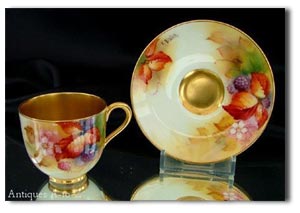
She also created several designs featuring blackberries and buttercups. she had previously spent time at James Hadleys factory in Diglis road and her Hadley style rendering of bunches of blackberries, have become the Kitty Blake signature pieces, much sought after by collectors and mouth-wateringly real.

Like so many other famous ceramic painters, Kitty Blake seems to have come from an artistically talented family, her brother Edward worked for the Locke factory as a painter of Pheasants.

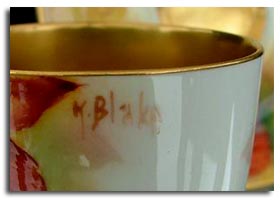
She was seen as a team player with a good sense of humour and Kitty Blake became very popular at the Royal Worcester factory. worcester fruit artist kitty blake signature mark

She was considered to be a bit of a live wire in her younger days and were the male painters of the time, had their terrible seven apprentices, then the female painters had their Saucy Six who would terrorise any male staff that upset them. Kitty Blake was a leading light in this group and they made their presence felt both inside and outside the Worcester factory.
Kitty Blake was a driving force at the factory throughout her long stay. Times were hard for much of it and she would spend her spare time making advertising posters for events held at the Royal Worcester works. She is said to have had that common touch and was never been seen without her red lipstick and cigarette.


Reginald (Harry) Austin (1890-1955)

Born in Worcester in 1890, Harry Austin trained as an artist from an early age and won many medals for the drawings he produced in his younger years. He is believed to have started at the royal worcester factory, with his younger brother walter, in 1910.
Harry Austin became a highly skilled and wide ranging artist, producing stunning studies of birds including a particular series of Australian birds for export market, fruit subjects, plants and flowers. He was also responsible for the newer versions of the old worcester Fancy Birds on the blue scale grounds.

In the 1920s, hard times came to quality porcelain market and a great many painters had to find ways to boost their meagre earnings. Harry turned to producing watercolours, of the same style that he painted at the factory, on canvas, card, paper or plywood. He then touted them around the local inns and cafes.

In 1930, during the great depression Harry austin left the worcester factory to concentrate on the freelance design work with his brother.

In 1931, after limited success with his freelance work he became resident designer for Paragon China.

While at paragon Harry produced a design featuring love birds with flowers, for Her Majesty Queen Elizabeth the Queen Mother, to commemorate the birth of her daughter Princess Margeret. However, unhappy with life in the potteries harry eventually returned to worcester, but not the worcester factory, to continue his freelance design work.

In 1955, Reginald (Harry) Austin died.


Dorothy (1892-1962) & Freda Doughty (-1972)

Dorothy and Freda Doughty, in their time, probably did more to ensure the future prosperity and stability of the Royal Worcester factory than any other modellers.

worcester dorothy doughtyRoyal Worcester Artists - from antique-marks.com Worcester figurines for sale

Born in San Remo, Italy, Dorothy and Freda were the daughters of Charles Doughty, the English poet and traveller (The author of 'Arabia Deserta'and the inspiration for Lawrence of Arabia ). They came to England when the sisters were still children and settled in Sissinghurst in Kent. Charles Doughty died in 1926 and the sisters, neither of whom had married, carried on in the same house by themselves.

Freda ran childrens modelling lessons from the house and always full of bright, hopefully and cheerful boys and girls, she would frequently use them as live models for the ceramic figurines that she fired in her own kiln.

Dorothy studied at the Eastboune College of Art where she became a keen naturalist and ornithologist and would paint plasticine models of local bird life.

The late 1920s were not a good time for the royal worcester and in an attempt to reverse their financial difficulties they decided to invest their efforts in the production of a brand new range of figurine and animal studies. worcester - freda doughty figure  happy days c1938

Following the employment of various freelance modellers ( Baker, Bray, Cane, Crofts, Lindner, Stabler, Williams and Freda Doughty ) an exhibition to show off the new figures, was set up in a London Art Gallery. Fredas models of young children at play were thought to be old fashioned, both by modellers and the factory workforce and they looked out of place compared to some of the more 'avant garde', almost abstract, figures produced by many of the others at the show.

However, people decide what they buy and they took Fredas little children to their hearts and they sold in good numbers whilst many of the other pieces remained unsold.

In 1934 Royal Worcesters art director, Mr Gimson, approached fine art publisher Mr Alex Dickens about producing a series of service or cabinet plates featuring images from the Audubon Birds of America book. These were to be issued in a limited edition and although a totally new venture for Worcester, it was a roaring success. Following the Audubon plate series Mr Dickens approached the company about producing a series of natural studies of American birds in their native settings. The birds had to be realistic figures and he insisted that they be done in a matt finish to maintain that realism. Mr Gimson agreed with the idea and, even though the idea of a matt finish was an unusual one, said that the factory could do it.

Freda had released many more models, all eagerly accepted by the public, and had become one of the factories most successful modellers. Her output was almost entirely figures of small children at play but as a very versatile sculptor Mr Gimson approached her about the preliminary models in the American birds series.

Whether or not Freda felt up to the task is not recorded but she introduced Mr Gimson to her sister Dorothy explaining that her knowledge of birds, artistic skills and memory for minor detail would make her the obvious choice for the job.

Dorothy was not used to producing models for later ceramic production and Freda had to show her how her own plasticine models were cut up to produce the required moulds for slip casting and how the pieces were then put together again. There was no thought, at this time, of Dorothy making life studies and her first model of Redstarts on Hemlock had to be produced from photographs of the birds and flowers. The outcome was adequate but lacked the vibrancy of her later models and only 66 pairs were ever made.

Worcester Dorothy Doughty - Double Knatcatcher on Dogwood limited edition of 500 Dorothy's next pair of birds, American Goldfinches on Thistles, were an improvement, 250 pairs were made and they were good enough to make Mr Gimson and Alex Dickens continue with the series. However, it quickly became apparent to Dorothy that the slip casting method of manufacture, while ideal for the birds themselves, had its limitations when used for the delicate flowers and foliage that had to accompany them. Dorothy was on a steep learning curve and spent a great deal of time at the factory watching and talking to the craftsmen there. The answer to her problem came when she met Antonio Vassalo, a Maltese craftsman who was turning out beautifully delicate little flowers and leaves by hand moulding.

Antonio was the only person at the factory capable of making these little masterpieces and Mr Gimson was reluctant to give his services over to Dorothy's line of birds but he recognised the importance of the series and eventually agreed. A new workshop was set up and a group of new trainees employed to learn his techniques and Dorothy’s imagination and artistic talents were free to go on to greater heights. Her next models Bluebirds on Apple Blossom and others were produced in ever greater detail and and it took all the skills of one of Worcester’s finest artists, Harry Davis, to come up with the colour combinations that would fire to the right blend of tones.

Three other pairs of birds were introduced before the start of the war, each more intricate and realistic than the last. Each set was limited to 500 pairs and they were selling well. Many of them to American natural history museums who were to build up complete sets of her works as the years passed. The birds were very expensive, the manufacturing costs were high because of their complexity and there were, obviously, only a limited number of units to spread this cost over but the idea of having a limited edition issue was appealing to the public and the high cost may have even been welcomed as a valuable part of their exclusivity.

The principals of the limited edition was being taken up in other areas as well with models by Gertner, Lindner, Stabler and others all being released, some to better affect than others.

Freda was asked by Mr Gimson to produce one or more limited editions of her child figures but Freda steadfastly refused. Her figures did not have the 'specialist' appeal of most of the others concerned and she wanted her children to be affordable and available to everybody. Limited editions may have been the money spinning idea of the moment but mass appeal still very much had its place in the market.

The onset of war practically wiped out normal production at the factory, much of their time was diverted to war work and many of the staff joined the armed forces but the Doughty birds continued, abate at a slower rate, as sales to America were considered to be a valuable part of the war effort. Dorothy also made the first four model 'standards' for a series of British birds for the home market but these were not put into production until some time after the end of the war. worcester dorothy doughty cardinal male c1937

Dorothy was also heavily involved in war work of her own. She was an ambulance driver and involved in secret experimental work with aircraft production as well as producing the models for her birds. Details are not known but she fell ill ( possibly Tuberculosis ?) during the early to mid forties which necessitated a family move to the hills around Falmouth in Cornwall. This affected Dorothy for some months but she would not be swayed from her production of figures and had a garden studio where the walls were lined with cages for the birds she studied. Following the war she made the first of several field trips to America where she would either wander around alone or join organised birding tours, of which she was to build up a good fund of funny stories that she would relate to the factory workers.

As Dorothy's experience and confidence increased she seemed to delight in making her models more and more complex, as if she was challenging herself, and the factories craftsmen, to devise new techniques to imitate natures subtleties. One particular model, the Magnolia Warblers, were much bigger than usual and presented great problems in the firing. Numerous attempts were made to produce the first 'standard' but repeatedly all the major pieces would split in the kiln and it was almost decided to scrap the project altogether as being impossible to make. Bob Bradley, the master mould maker at the time, was given permission to do whatever he thought prudent in one last attempt to successfully fire them and this he did by cutting small holes into the bigger pieces to allow the heat compressed air inside to escape rather than split the pieces apart.

Many of the models chosen were dictated by Alex Dickens who was the agent in charge of their sales and two figures in particular were done at his behest. One, a single Indigo Bunting on a twig was designed to be simple and cheap to produce and sell. Dorothy rebelled against this until a compromise was reached and she was allowed to put a couple of small leaves onto the twig to add a little realism. The model was not well accepted as part of the group and very few were sold. The second was a pair group of Bob White Quail. Alex wanted something that would appeal to a different market and as these were popular with the American hunting fraternity he again wanted a simple to produce and cheap to make figure. Again they failed miserably but on this occasion it was probably Dorothy's fault. She wanted to make them more natural and appealing and put a couple of babies alongside the hen bird. The hunters did not like the idea of the birds they shoot being shown with thier young and only a very small number were made. These are still very beautiful figures and have great appeal to the other bird lovers but they are, of course, exceedingly rare.

The study of the birds, the making of the original plasticine and acrylic resin models, the cutting up and mould making, and all the other myriad of processes that had to be gone through to produce the Doughty birds meant that there was a long time delay between the first concept and the release of a particular model. To help speed up this process the factory brought in Ronald Van Ruyckevelt specifically to help her. He would spend time with her in Falmouth and then supervise the factory side of the process to take some of the load off of Dorothy’s shoulders. Later, of course, he was to produce many spectacular models in his own right but at the start he was highly instrumental in speeding up the process of manufacture and with his help many more models came on stream.

Dorothy was taken ill again in 1962 and died at the age of 70 while many of her models were still in the design stage. these models were to continue being released for a further six years until they were all finished.

Freda continued in good heath for another ten years but was to release no more models of her enchanting children after this time.

Between them the two sisters were among the most prolific of all the Worcester modellers with Freda being responsible for over a hundred different figures and Dorothy’s output of birds not falling far short of that number. There skills and enthusiasm were almost certainly a major factor in the company’s survival and there names will be remembered by all lovers of ceramic figurines for a long long time to come.


antique marks  - all about antique pottery and porcelain marks antique marks  - all about antique pottery and porcelain marks
bookmark antique-marks.com
Top 100 Education SItes
antique marks  - all about antique pottery and porcelain marks


antique marks  - all about antique pottery and porcelain marks   home · blog · for sale · auctions diary · buying · selling · collecting · glossary · privacy policy · sitemap
antique marks  - all about antique pottery and porcelain marks