
Dates, Year Cyphers & Royal Worcester Marks on pottery, porcelain and Worcester figures.
Contents
Royal Worcester Marks were first placed on pottery and porcelain in 1862 but it was 1867 before it became common place.
Earlier Worcester Marks are rarely seen, and typically the crescent mark dates pieces to the Dr Wall period before 1783.
But pieces bearing the crescent mark are rare and usually the provence of specialist collectors.
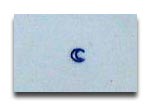
In the late 1700s Worcester were among the first to use the Bute shape for teabowls, tea cups and coffee cups.
The presence of the crescent mark dates these items to the Dr Wall period and they are all very similar in shape, size and decoration to those made in the same period by Caughley.
See our early worcester for sale section for examples of sparrow beak jugs, Bute cups and Dr Wall period pieces.
About Royal Worcester Marks

The Royal Worcester standard printed factory mark includes the number 51 in the centre which refers to the year 1751 when the Worcester Porcelain Company was founded by Dr. John Wall.
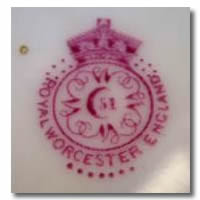
Early standard marks show the crown slightly above or perched on the circle and from 1876 the crown sits down onto the circle. The mark can appear in any colour.
In 1862 with the restructuring of the Royal Worcester company and the introduction of a new factory mark came the first of the new Worcester date coding sequences.
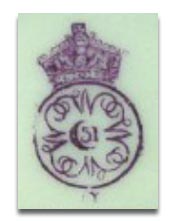 From 1862 until 1867 the last two numbers of the year would be used. These could be printed or impressed under the circle but like all impressed marks these could be difficult to see when they fill with glaze.
From 1867 until 1877 the code would either be the printed last two numbers of the year or a capital letter under the circle reprrsenting the date.
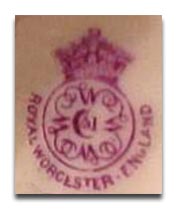
From 1877 the year number was dropped in favour of the letter system which carried on the same sequence.
In 1890 the capital letter changed to a small letter and started again but the sequence was only to last for one year.
Note: There was no 'F', 'J', or 'Q' used and the 'O' comes after the 'Z' in 1889.
In 1891 the mark changed, No date code was used but 'Royal Worcester England' appeared around the circle
Royal Worcester Marks and Date Codes
| 1867 - 67 or A 1868 - 68 or B 1869 - 69 or C 1870 - 70 or D 1871 - 71 or E 1872 - 72 or G 1873 - 73 or H 1874 - 74 or I 1875 - 75 or K 1876 - 76 or L 1877 - 77 or M 1878 - N 1879 - P 1880 - R 1881 - S 1882 - T 1883 - U 1884 - V 1885 - W 1886 - X 1887 - Y 1888 - Z 1889 - O 1890 - a |
1892 - 1 dot on left of crown. 1893 - 1 dot each side of crown 1894 - 2 dots left 1 right 1895 - 2 dots left 2 right 1896 - 3 dots left 2 right 1897 - 3 dots left 3 right 1898 - 4 dots left 3 right 1899 - 4 dots left 4 right 1900 - 5 dots left 4 right 1901 - 5 dots left 5 right 1902 - 6 dots left 5 right 1903 - 6 dots left 6 right |
1904 - plus 1 dot under circle 1905 - plus 2 dots under circle 1906 - plus 3 dots under circle 1907 - plus 4 dots under circle 1908 - plus 5 dots under circle 1909 - plus 6 dots under circle 1910 - plus 7 dots under circle 1911 - plus 8 dots under circle 1912 - plus 9 dots under circle 1913 - plus 10 dots under circle 1914 - plus 11 dots under circle 1915 - plus 12 dots under circle |
About Royal Worcester Marks 1916 to 1948
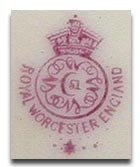
This dating system continued until 1915 when 24 dots are arranged around the standard printed mark.
The dots system was getting a little clumbersome so they were replaced by a single asterisk in 1916 which was then followed by a new dot sequence. All under the circle.
From 1916 a small star or asterisk appears below the Worcester mark ...
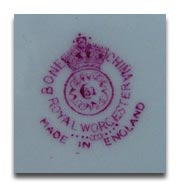
- 1916 * below the mark
- 1917 * and one dot
- 1918 * and two dots
However on some pieces the old dot sequence continued for a few years.
It being easier and cheaper to put an extra dot on existing copper plates than make new ones.
This continued until the dots became un-manageable and then Worcester marks changed to different shapes, all printed beneath the circle.
| 1916 - * under circle 1917 - * plus 1 dot 1918 - * plus 2 dots 1919 - * plus 3 dots 1920 - * plus 4 dots 1921 - * plus 5 dots 1922 - * plus 6 dots 1923 - * plus 7 dots 1924 - * plus 8 dots 1925 - * plus 9 dots 1926 - * plus 10 dots 1927 - * plus 11 dots 1928 - open square 1929 - open diamond 1930 - division sign |
1931 - 2 linked circles 1932 - 3 linked circles 1933 - 3 circles 1 dot 1934 - 3 circles 2 dots 1935 - 3 circles 3 dots 1936 - 3 circles 4 dots 1937 - 3 circles 5 dots 1938 - 3 circles 6 dots 1939 - 3 circles 7 dots 1940 - 3 circles 8 dots 1941 - 3 circles 9 dots |
1942 - 3 circles 10 dots 1943 - 3 circles 11 dots 1944 - 3 circles 12 dots 1945 - 3 circles 13 dots 1946 - 3 circles 14 dots 1947 - 3 circles 15 dots 1948 - 3 circles 16 dots |
Dating Royal Worcester Marks from 1949 to 1963
Worcester continued this sequence until 1941 when there were 9 dots and the triple circle mark.
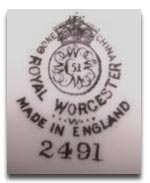
From c1942 the vast majority of factory stamps were printed in black with the following codes below the mark.
- 1942-48 no dating system was used
- 1949 V
- 1950 W
- 1951 W
- 1952 W
- 1953 W
In 1949 the various asterisk, square, diamond and circle shapes changed to letters and then quickly back to letters and dot sequences.
These continued until 1963 but their use was rather inconsistent and a great many pieces produced at this time are un-dated.
| 1949 - V 1950 - W 1951 - W plus 1 dot 1952 - W plus 2 dots 1953 - W plus 3 dots |
1954 - W plus 4 dots 1955 - W plus 5 dots 1956 - W plus 6 dots 1957 - W plus 7 dots 1958 - W plus 8 dots |
1959 - W plus 9 dots 1960 - W plus 10 dots 1961 - W plus 11 dots 1962 - W plus 12 dots 1963 - W plus 13 dots |
Dating Royal Worcester Marks from 1963 on
After 1963 no Worcester dating system is used but patterns are all named and bear the date that they were first introduced.
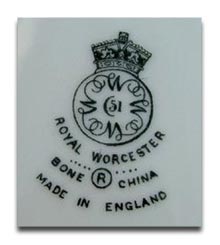
This continued until 1963 when 13 dots are arranged around the W.
After 1956 the letter W was nearly always substituted with a letter R in a circle, i.e. 1959 = R or W under the circle with 9 dots.
From 1966 no date coding system was used, but on tableware the year the pattern was introduced is stated next to the pattern name.
In 1974 the current format of factory stamp was adopted. The date included is the year of introduction of the design, not the date of manufacture.
In April 1988 a system of year of manufacture identification that fitted with that used by Spode was introduced and an M within a diamond was incorporated below the factory mark.
In January 1989 new factory stamps were phased in with N in place of the M and soon afterward black numbers were introduced.
These numbers were replaced with grey ones in August 1989 to reduce their visual impact.
January 1990 a new system introduced a printed grey lithographer identification number plus a suffix to signify the year.
| Printed In Grey 1990 - 39-0 1991 - 39-1 1992 - 39-2 1993 - 39-3 1994 - 39-4 1995 - 39-5 1996 - 39-6 |
Printed In White 2000 - 39-00 2001 - 39-01 2002 - 39-02 2003 - 39-03 |
In 1990 all factory stamps reverted to the R form under the mark. The R signifying registered. 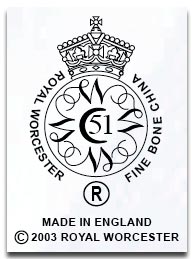 |
Royal Worcester Tableware Marks
At some point during the 1960s it became standard practice for the Royal Worcester factory to name all their tableware and dinner services. The Evesham and Royal Garden patterns being just two examples.
Prior to this date named sets were uncommon, although there were some the majority of early named patterns were given the name in more recent times.
Rather than use names the Worcester factory relied on pattern numbers which were hand written in script, rather than stamped.
- In the 1860s when Royal Worcester was formed from the earlier Kerr and Binns, tableware was given a simple four figure pattern number which carried on from those used by both Kerr and Binns and the Chamberlain factory Worcester marks.Numbers begin with 7247 in mid-1862 and continued to 9685 in August 1876.
- From 1876 they changed to numbers prefixed with a ‘B’ and these ran until B 1081 which was produced in May 1883.
- From 1883 all new tableware patterns were prefixed with a ‘W’ which started with ‘W1’ and contimued until at least ‘W9978’ which was probably produced around mid-1913.
- In 1913 prefixes then changed to a ‘C’ and the numbers started again and continued up to ‘C3390’ which was first produced in 1928.
- From 1928 all tableware patterns were prefixed with a ‘Z’ which continued until after 1962.
Records of Worcester tableware marks were only published for the more expensive hand painted patterns which appeared randomly throughout the numbering sequence.
These records detail tableware type, the decoration, and the painter, but the simpler apprentice sets and transfer printed sets appear to have no clear record of what each set looks like.
Leave a Reply
You must be logged in to post a comment.